Every rare disease journey begins with a question and a search for answers. At FDNA, we harness the power of AI to bring those answers closer. Find out more: https://t.co/vnPjnjGhKx
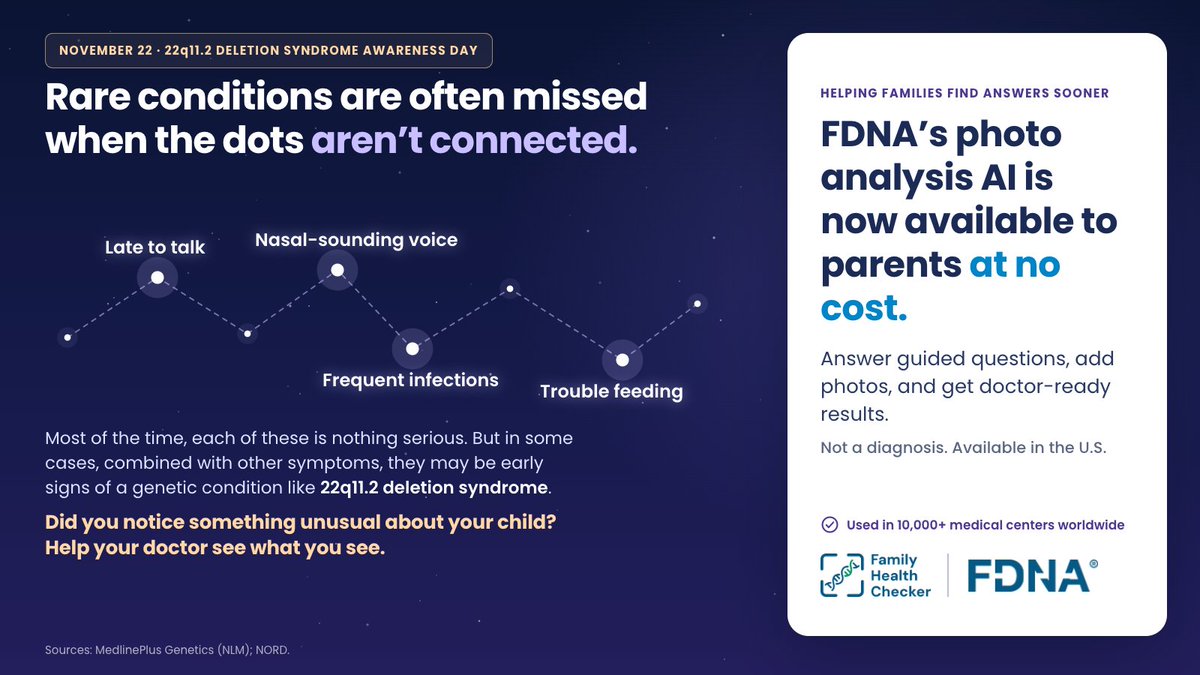
Rare conditions are often missed when the dots aren't connected.
Late to talk. A nasal-sounding voice. Frequent infections. Trouble feeding.
Most of the time, each of these is nothing serious. But in some cases, it can be more than that. Combined with other symptoms, these may be early signs of a genetic condition like 22q11.2 deletion syndrome.
Today is 22q11.2 Deletion Syndrome Awareness Day. 22q11.2 deletion syndrome is a genetic condition that can affect almost any part of the body, including the heart, the immune system, speech and learning. It affects an estimated 1 in 4,000 people, and it may be more common than that. Its features vary widely, even within the same family, so it is thought to be underdiagnosed.
Did you notice something unusual about your child? Help your doctor see what you see.
FDNA is committed to helping families find answers sooner. Our photo analysis AI, used in 10,000+ medical centers worldwide, is now available to parents at no cost. With FDNA's Family Health Checker, parents answer guided questions about their child's health and development, add photos, and get doctor-ready results to share with their child's provider. Family Health Checker is available in the U.S. It is not a diagnosis, and it does not replace a medical evaluation.
Start here: https://t.co/ZsVhCDY3vF
Thank you to the 22q families, advocates and researchers working toward earlier answers.
Sources: MedlinePlus Genetics, U.S. National Library of Medicine; National Organization for Rare Disorders (NORD).
#22q #22q11 #RareDisease #RareDiseaseAwareness
Is your child up at night? Late to talk? Has big meltdowns?
Usually, it's nothing serious. Many children go through this.
Sometimes, it's something common, like ADHD.
But in some cases, it can be more than that. Combined with other symptoms, these may be early signs of a genetic condition like Smith-Magenis syndrome.
Today is Smith-Magenis Syndrome Awareness Day. Smith-Magenis syndrome is a rare genetic condition that impacts development, behavior and sleep. It occurs in at least 1 in 25,000 people worldwide. Sleep problems typically begin early in life. Its early signs can look like everyday childhood challenges, so many people with it go undiagnosed or misdiagnosed.
Did you notice something unusual about your child? Help your doctor see it too.
FDNA is committed to helping families find answers sooner. Our photo analysis AI, used in 10,000+ medical centers worldwide, is now available to parents at no cost. With FDNA's Family Health Checker, parents answer guided questions about their child's health, physical features and development, add a photo, and receive a doctor-ready report to share with their child's provider. Family Health Checker is available in the U.S. It is not a diagnosis, and it does not replace a medical evaluation.
Start here: https://t.co/ZsVhCDY3vF
Thank you to the Smith-Magenis families, advocates and researchers working toward earlier answers.
Sources: MedlinePlus Genetics, U.S. National Library of Medicine; National Organization for Rare Disorders (NORD).
#SmithMagenisSyndrome #RareDisease #RareDiseaseAwareness
Sanfilippo syndrome is often diagnosed first as developmental delay, ADHD or autism. The right diagnosis can take years.
FDNA is committed to helping families find answers sooner. Our photo analysis AI is now available to parents at no cost: https://t.co/ZsVhCDY3vF
With Family Health Checker, parents can check their child at home and get a report to share with their child's doctor.
Available in the U.S. It is not a diagnosis, and it does not replace a medical evaluation.
#WorldSanfilippoDay #RareDisease
Evelyn searched 8 years for answers for her son. The breakthrough came from another caregiver: a grandmother who saw Miguel looked like her grandson. Both boys have Pitt-Hopkins.
Care connects us. For Miguel, it did.
#NationalFamilyCaregiversMonth
https://t.co/8lZQdGzo9R
October is #DownSyndromeAwarenessMonth.
We recognize people with Down syndrome, their families, and the clinicians, researchers and advocates working to advance understanding, care and inclusion.
Learn more: https://t.co/FduiFeuX3e
#DownSyndrome#Genetics
September 15 is Wiedemann-Steiner Syndrome Awareness Day. WSS's genetic cause (KMT2A) was identified only in 2012. Arora et al. reported the first WSS patient from India - Face2Gene suggested WSS as the top-ranked candidate.
https://t.co/k3aCDPOFXs #WiedemannSteiner#Face2Gene
Announcing today that @fdna has been selected by @ARPA_H as a performer in the Rare Disease AI/ML for Precision Integrated Diagnostics (RAPID) program.
ARPA-H awarded FDNA a contract as part of a larger investment in RAPID.
30 million Americans live with a rare disease.
Diagnosis takes six years on average—for some, it can take decades.
Only 5% have an approved treatment.
ARPA-H is changing the pace with RAPID—using AI, data, and scalable systems to diagnose rare diseases faster and support the development of new treatments.
Meet the teams behind RAPID 👉 https://t.co/4DSvNJFUHS
It's #SMAAwarenessMonth. Worried about your child's movement or strength? Family Health Checker helps you organize symptoms & history into a clinician-ready summary for a more productive visit. Educational, not a diagnosis. #RareDisease
"AI becomes a force multiplier in the fight against rare diseases." A respected clinical geneticist's framing, not ours. And he points to #Face2Gene as an example. Worth a read:
https://t.co/vhwwbBrnTb
#RareDisease#AIinHealthcare#ForceMultiplier
For children with GDD/ID, phenotype-driven evaluation matters: history, exam, growth, vision/hearing, syndromic features, then genetic testing guided by the child’s presentation. Clinical picture first.
https://t.co/LKt7pegGaC
#PediatricGenetics#GDD
Genetic testing can help uncover insights into developmental and genetic disorders in children - from newborn screening to diagnostic tests, carrier screening, and whole genome sequencing.
🧬 Learn how different tests may support next steps.
🔗 https://t.co/kOOcfPDPEC
FDA is calling on patients, clinicians, and researchers to help identify drugs that could be repurposed to treat chronic and rare diseases and help address other unmet medical needs. Share your ideas to help advance new treatment options. https://t.co/qQPCrOfZwV
Parenting a child with developmental or health challenges can feel isolating - but you don’t have to go it alone. Peer support groups offer comfort, shared wisdom, and practical resources for families navigating similar journeys. 🌱
🔗 https://t.co/GPSp8ivY6A
Autism diagnoses have risen sharply - largely due to better detection, broader criteria, and greater awareness. Genetics and other risk factors matter too; more children are now identified earlier.
https://t.co/gkKW9zAYhV
@zebrahoofbeat Accredited references: OMIM #217090 - NORD entry on Congenital Type 1 Plasminogen Deficiency, the Plasminogen Deficiency Foundation, and the most recent peer-reviewed clinical review: Shapiro AD, Nakar C. How I treat type 1 plasminogen deficiency. Blood. 2025;145(25):2954-2965
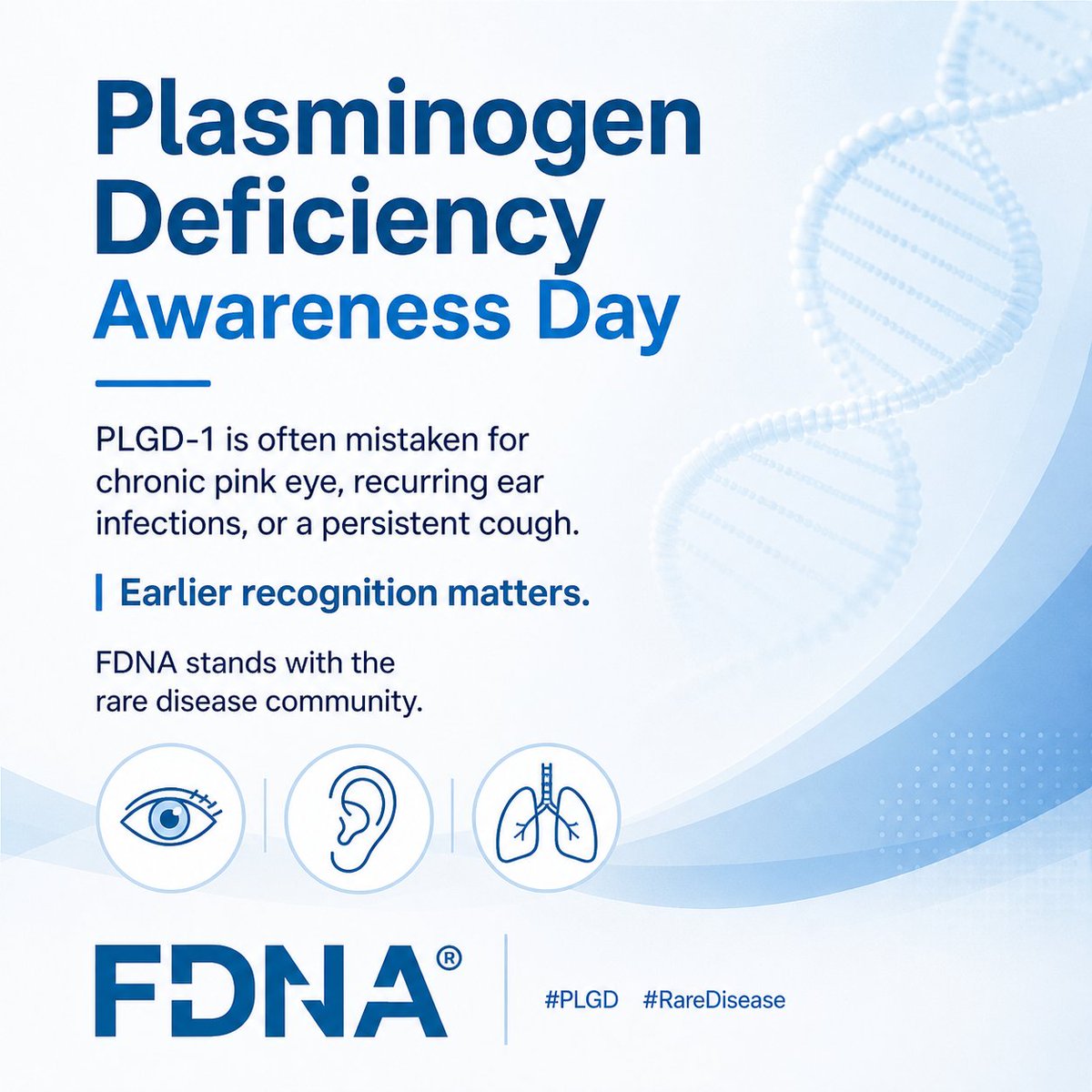
Today is Plasminogen Deficiency Awareness Day. PLGD-1 is often mistaken for chronic pink eye, recurring ear infections, or a persistent cough. Earlier recognition matters. FDNA stands with the rare disease community. #PLGD#RareDisease
@zebrahoofbeat We're not clinicians, so we defer to the published literature. PLGD-1 typically presents in infancy or early childhood, with a median age at onset of approximately 1 year — but onset varies widely, and adult-onset cases are documented.