@SwissArmyWrench@nu_shell `slice` works on lists. So, `"nushell" | split chars | slice ..-4 | str join` would return `nush`. However, in the latest main branch of nushell `"nushell" | str substring ..-4` also works.
@orpxof @HSVSphere@nu_shell Sounds like you've made up your mind, but I just wanted to clarify that some commands are not written from scratch like cp, mkdir, mktemp, mv, touch, whoami, uname. All those come from the wonderful folks at https://t.co/iuZxxw3i2y with more to come.
@SpaceTree12@nu_shell If your Windows code page isn't utf8 you can set it with `chcp 65001` and then things like this work. `net start | lines | range 2..(-4) | str trim`. If you need to go through decode, you need to know which code page you have currently in order to decode it.
@JohnDunlap TIP: if you use `open` instead of `cat`, you don't have to use `from csv`. Also, you shouldn't have to use quotation marks unless in `where` unless there is a space in the column or value.
@practicalrs@nu_shell Our current plans don't have us releasing v1.0 until the new-nu-parser is complete. It hasn't seen much work recently so I'm pretty sure this will force us into v0.100.0 releases.
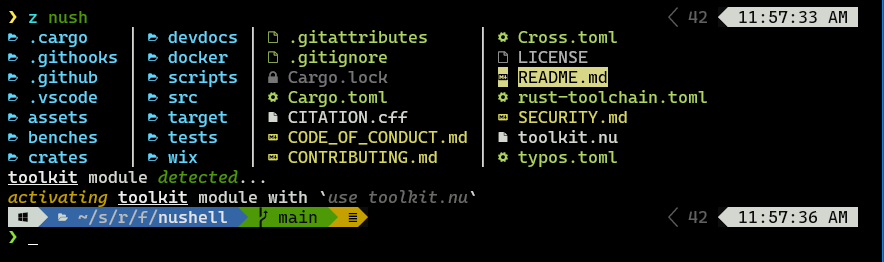
@lowvram One shortcut / time savings device I use with nushell is to use the env_change hook with the PWD env variable. So, every time I change directories, no matter how I get there, cd, z, etc., Nushell does a grid listing with LS_COLORS and icons.
@Throudin Worse than that, you end up with the HKLM environment with one case like "Path" and HKCU with a different one like "path". It's incredible that Windows even works with this bug.
@tempmail_us_com Here's a tip on how to handle git range-diff parameters in nushell. Put them in a nushell list and use the spread operator to pass them to git.
def range-diff [begin end] {
let params = [range-diff $"($begin)...($end)"]
git ...$params
}
Have fun!