Introducing NLLB-LLM2Vec! 🚀
We fuse the NLLB encoder & Llama 3 8B trained w/ LLM2Vec to create NLLB-LLM2Vec which supports cross-lingual NLU in 200+ languages🔥
Joint work w/ Philipp Borchert, @licwu, and @gg42554 during my great research stay at @cambridgeltl
SimBench accepted at #ICLR2026!
A lot of the time in social simulations, the goal is not to predict what one specific person will say or do. It is to estimate how an entire group will respond, whether in pre-testing a real polling question, or in stress-testing a policy or intervention before running it in the real world.
Are you interested in interning with me and my lab?
A unique opportunity for a 4-month research stay, with generous funding as an Azrieli visiting PhD fellow!
DM me if you're interested.
https://t.co/JHYcGFABo5
Frontier LLMs can navigate complex websites, but are expensive and can't run locally. At the same time, small open models can't match the capabilities of commercial APIs. Can we close this gap with synthetic data?
To answer this, we built Agent-as-Annotators (A3): a framework for agentic capability distillation, which is inspired by the human annotation process. Our new A3-Qwen3.5-9B model trained on just 2.3K trajectories matches the 3x larger Qwen3.5-27B on WebArena (41.5%) and nearly doubles the previous best open-weight SFT result (21.5%), despite never seeing WebArena tasks in during training.
Paper: https://t.co/nLOQDUbt7x
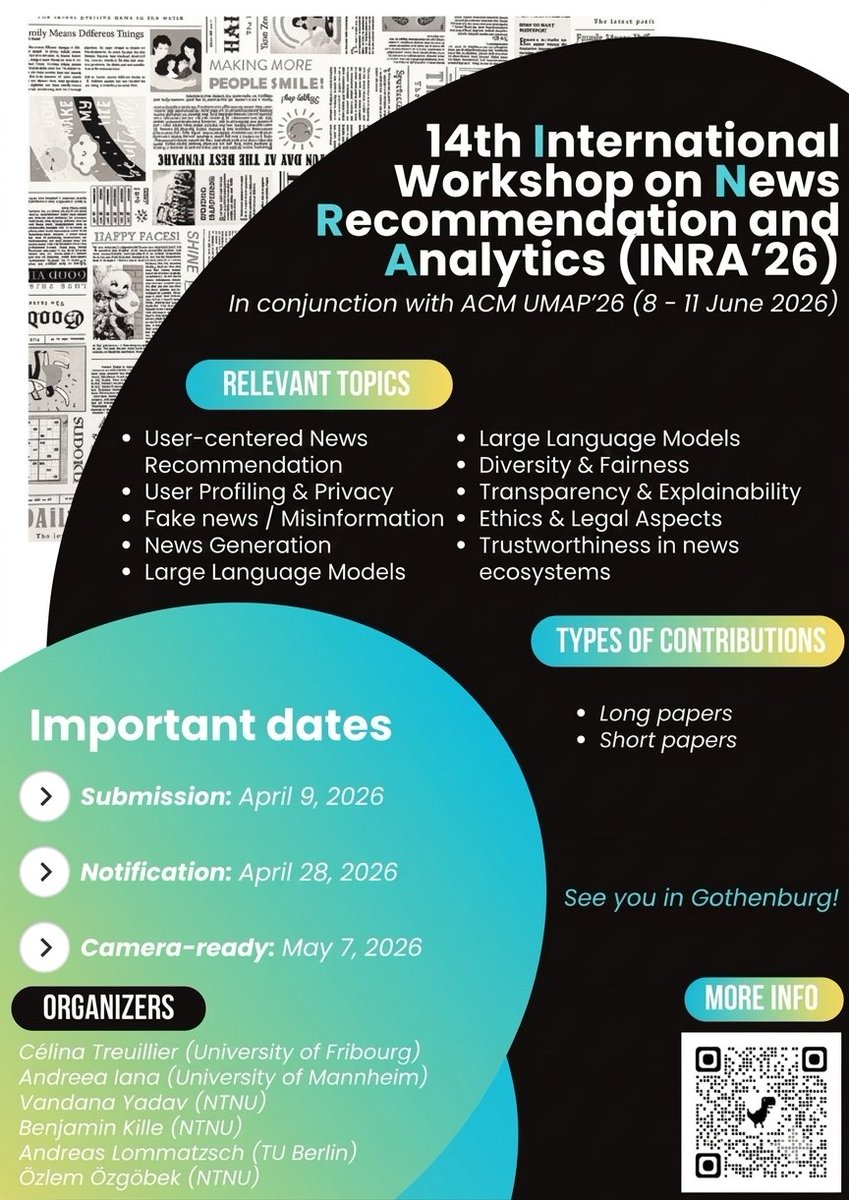
📢 2nd Call for Papers 📢
Working on user-centered #news#recsys or their legal & ethical dimensions?
👉 Submit to the 14th @NewsRecWorkshop co-located w/ @UMAPconf in Gothenburg!
🗓️Paper deadline: April 9, 2026
More info: https://t.co/rxHEvq0tBX
#INRA2026#UMAP2026
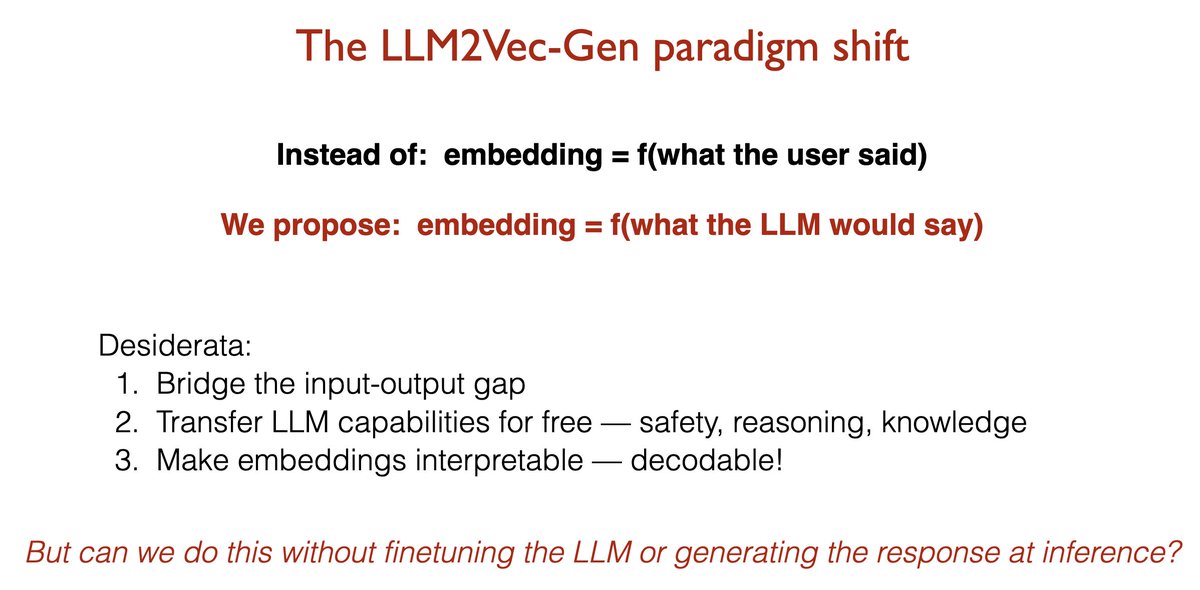
LLM2Vec-Gen represents a major paradigm shift for embeddings/retrieval. Why encode the query when the LLM already knows what to look for and can directly produce an embedding for it?
Best part: it’s self-supervised, and it does all of this while the LLM remains completely frozen.
Think about it: "solve x² + 3x − 4 = 0" has zero reasoning in it. But the LLM's response does. By encoding the response, the embedding captures the reasoning --- and the better the LLM reasons, the better the embedding. This is why our results scale with model size. As LLMs get smarter, our embeddings automatically get better.
LLM2Vec-Gen is also the first demonstration of the promise of @ylecun's JEPA for text embeddings. The alignment loss is JEPA — predict in representation space, not token space. The reconstruction loss goes beyond --- it keeps embeddings decodable.
This paradigm shift opens new frontiers:
🔬 Can we build a full JEPA for language where the teacher and student are the same LLM?
⚡ Can LLMs reason in compressed space without ever generating text?
🤖 Can agents reason in compression tokens and carry that directly into retrieval?
💬 Can agents talk to each other in compression tokens instead of text --- dense, fast, and still human-readable?
LLM2Vec-Gen is a first step toward all four.
Checkout our latest work on building self-supervised text embeddings without relying on contrastive data. ☝️
The main idea behind LLM2Vec-Gen is trying to encode a model's answer to a query, rather than the query itself.
Your LLM already knows the answer. Why is your embedding model still encoding the question?
🚨Introducing LLM2Vec-Gen: your frozen LLM generates the answer's embedding in a single forward pass — without ever generating the answer. Not only that, the frozen LLM can decode the embedding back into text.
🏆 SOTA self-supervised embeddings
🛡️ Free transfer of instruction-following, safety, and reasoning
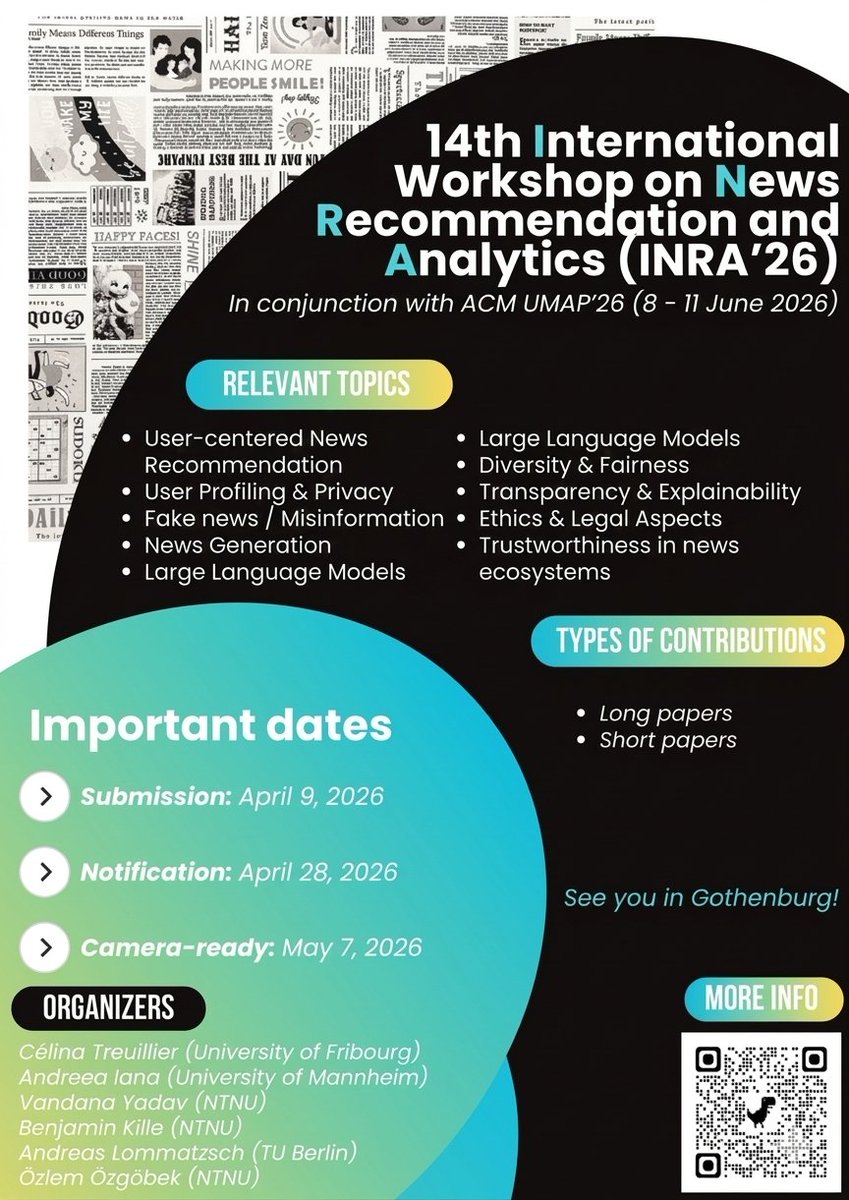
📢 Call for Papers📢
Working on user-centered #news#recsys or their legal & ethical dimensions?
👉 Submit to the 14th @NewsRecWorkshop co-located w/ @UMAPconf in Gothenburg!
🗓️Paper deadline: April 9, 2026
More info: https://t.co/rxHEvq0tBX
#INRA2026#UMAP2026
Check out our new preprint on the superficial alignment hypothesis (SAH). 👇
We operationalize the SAH via the length of the shortest program that achieves a certain performance on a task, unifying previous views on the SAH and showing how post-training affects "superficiality".
Introducing ✨Tiny Aya✨, a family of massively multilingual small language models built to run where people actually are.
Tiny Aya delivers strong multilingual performance in 70+ global languages in a 3.35B parameter model, efficient enough to run locally, even on a phone.
📢I am hiring a highly-motivated Ph.D student at the University of Copenhagen, in Denmark🇩🇰, to work on tokenization-free NLP.
See our previous work in this topic: https://t.co/bim6SIRmjF
https://t.co/rcfHGbmOo0
https://t.co/xwt7tpI2n6
Apply by March 8: https://t.co/oxf8ACiMzL
I am grateful that the Carlsberg Foundation is supporting our basic research on tokenization-free language models at the University of Copenhagen.
I will be hiring Ph.D students to start in September 2026. Feel free to reach out early if you want to express informal interest.
Introducing our latest breakthrough in AI search and retrieval: Rerank 4!
It’s the most advanced set of reranking models on the market, with best-in-class performance across search relevance, speed, deployment flexibility, multilingual support, and domain-specific understanding.
Presenting our paper "Disentangling Latent Shifts of In-Context Learning with Weak Supervision" (with Jan Šnajder) at NeurIPS 2025, San Diego:
🗓 Fri, Dec 5 · 11:00–14:00 PST
📍 Exhibit Hall C/D/E · Poster #2615
Paper: https://t.co/q1pbChaHTq
#NeurIPS2025
Ready for day 3 of #EMNLP2025 🎉🎉 I've been on the lookout for memorization, unlearning, interp, memory module papers & more, chat w me if these topics fascinate you too😻 Looking forward to more of Suzhou, the conf & my BlackboxNLP keynote Sunday 1.45PM! https://t.co/JkJVjmNAm3
🚨How do LLMs acquire human values?🤔
We often point to preference optimization. However, in our new work, we trace how and when model values shift during post-training and uncover surprising dynamics.
We ask: How do data, algorithms, and their interaction shape model values?🧵
Instruction tuning unlocks incredible skills in LLMs, but at a cost: they become dangerously overconfident.
You face a choice: a well-calibrated base model or a capable but unreliable instruct model.
What if you didn't have to choose? What if you could navigate the trade-off?
(1/8)
I’m so excited that Global PIQA is out! This has been a herculean effort by our 300+ contributors. The result is an extremely high-quality, culturally-specific benchmark for over 100 languages.