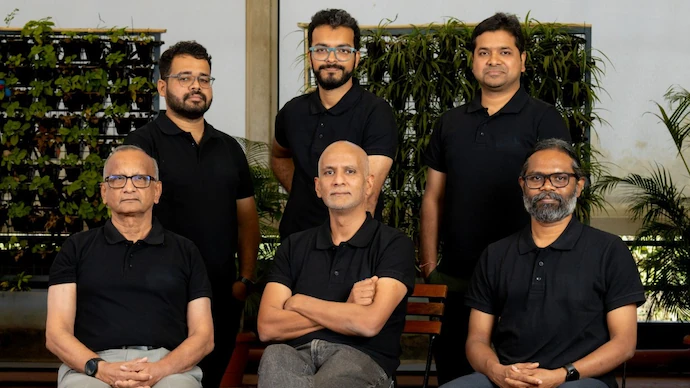
Five professors and two PhD scholars spent 15 years developing Gallium Nitride technology long before semiconductors became India's biggest technology mission. Their research became AGNIT Semiconductors, India's first vertically integrated GaN startup.
Read more: https://t.co/vpLGc8sHVw
✍️ @roshnism
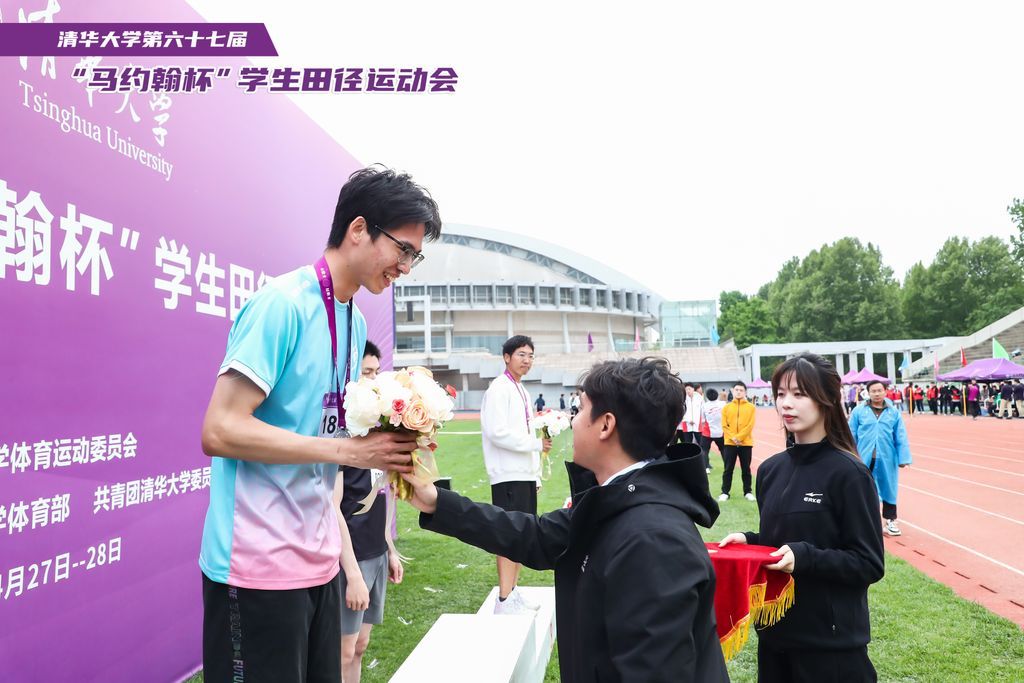
“In research, we must dare to explore new questions & never limit ourselves to our own fields,” says TsinghuaRen Chen Boyuan (China), a class of 2026 undergrad at Xingjian College. Starting in mechanics, he grew into an interdisciplinary explorer bridging mechanics & embodied AI.
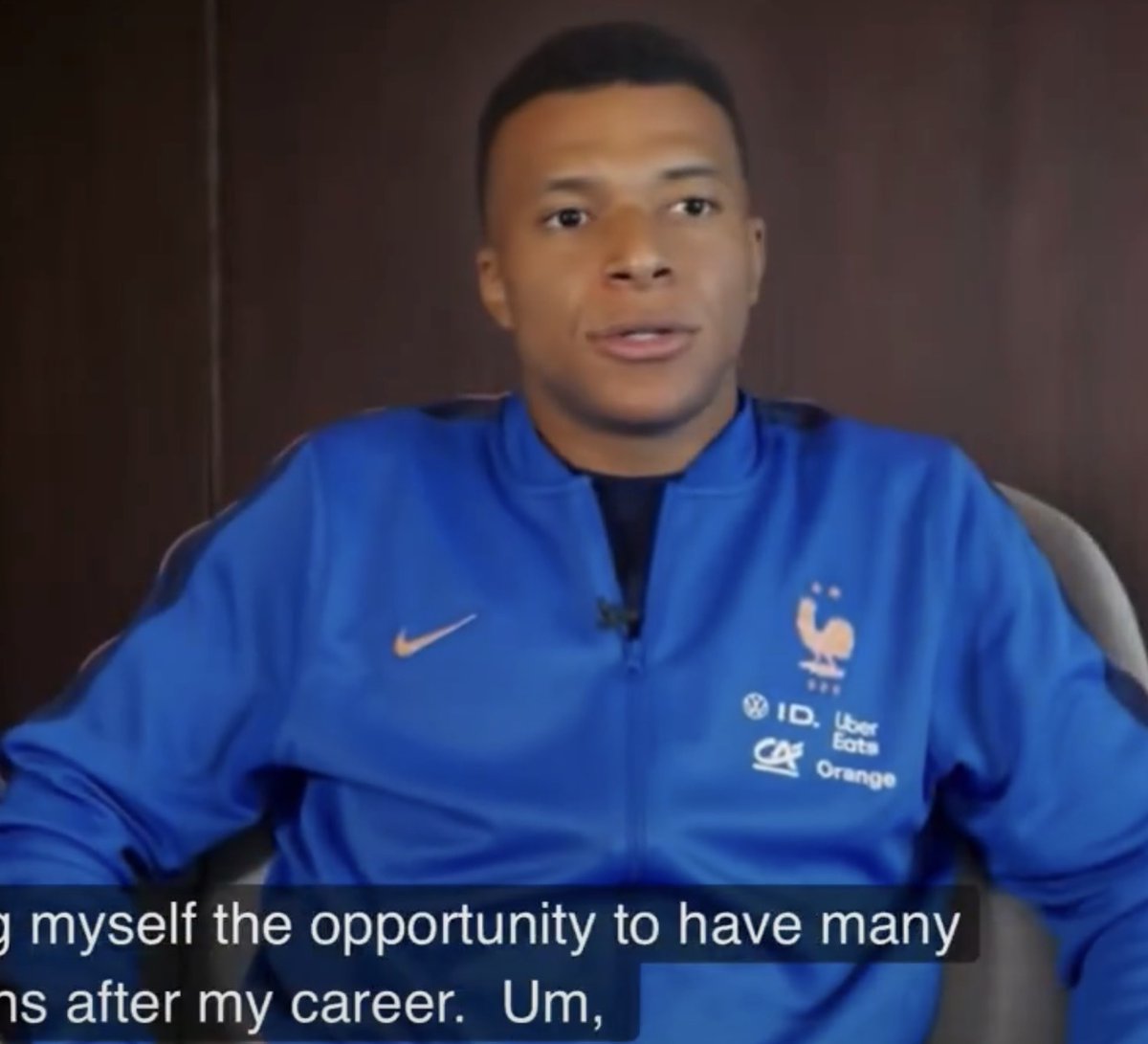
🚨🗣️ Kylian Mbappé: "My businesses are going wonderfully, so I could be a businessman."
"My team says I should run for the presidency of France after I retire, but I definitely won't be a coach."
The world doesn't slow down. Neither do we. Follow @EagleIntReports for real-time geopolitical analysis, global news, and foreign policy intelligence. 🌍
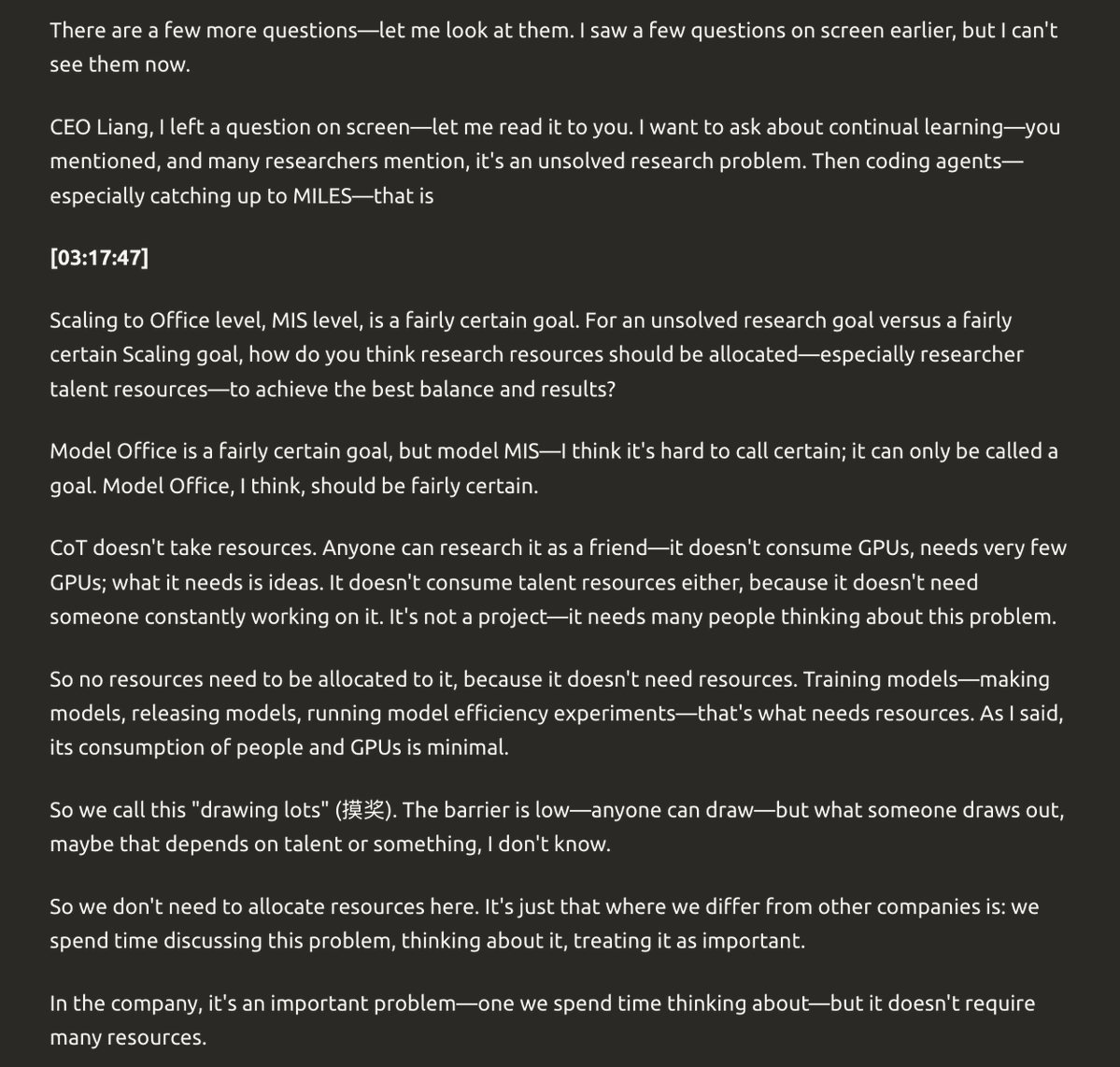
@scaling01@zephyr_z9 V4 GA *is* being delayed, he wanted it in June.
Wenfeng hoped to start training a model with 150B active by end of 2026 - April 2027.
@scaling01@zephyr_z9 It's probably grating to him that K3 or even GLM 5.2 are already useful for self-development.
But again: "the first goal of the models we build isn't that users find them good to use, but that we find them good to use ourselves"
explains a lot, really
Liang Wenfeng believes that the comprehensive gap in AI between China and the US is 12-18 months, just like Kai-Fu Lee says and Dario hopes; and can be shrunk to 3, with surpassing in some few key areas. @scaling01@zephyr_z9
on costs, and again, the peril of trying to eat a large chunk of global GDP
«We also have many algorithmic methods—costs can go lower still.
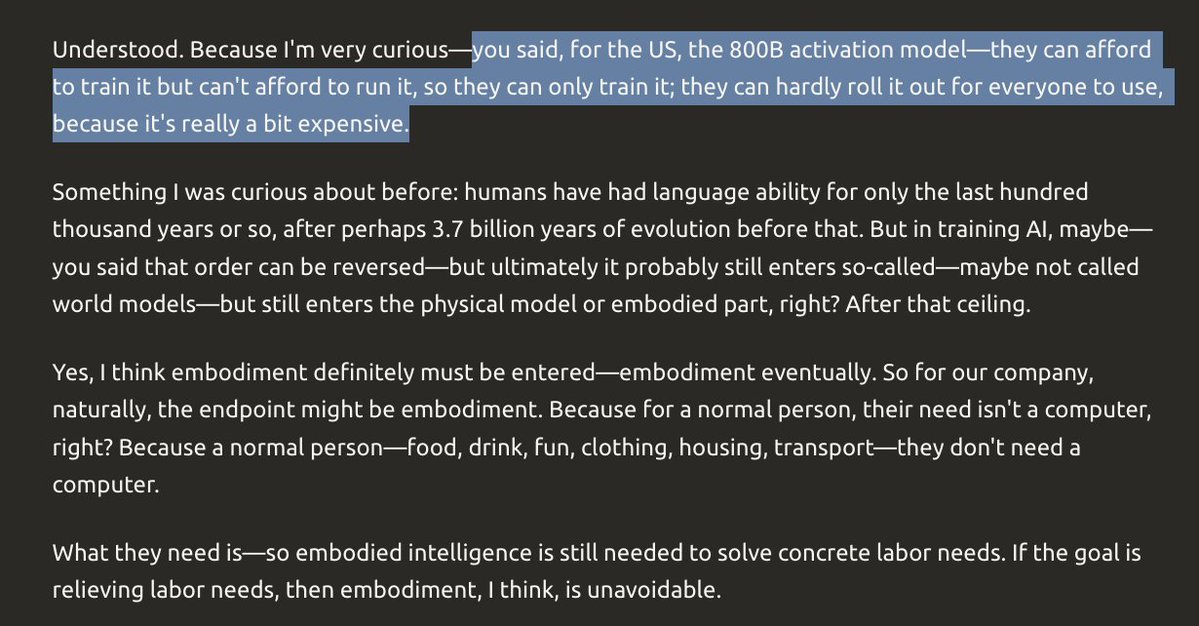
«the lower the cost, the bigger the model I can train, the bigger the model I can afford»
Next generation DeepSeek must have continual learning. You see this objective in V4's paper, and you see it in hiring. Before they get there, they'll just be iterating on bang-for-the-buck.
V4's updated version should have native multimodality.
V4 is as big as he could train at the moment.
Suggests that either Kimi has more compute, or it has in his view made an error training something beyond their inference means.
Interesting contradiction with newer (and some older) reporting: «I hope not to make chips». But aren't you making chips already? I guess the funding round success + compute scarcity gave him more sense of urgency.
950s vs Nvidia:
«when V3 trained, it still used NVIDIA GPUs, but no longer used NVIDIA's ecosystem… As long as I redo this whole process on Huawei GPUs, it's done. I think this might be a historic mission»
«Huawei 950 supernode can fully substitute for NVIDIA's GB200 and GB300 in performance and price»
«four Huawei GPUs equal one NVIDIA GPU, and it's two years behind… So our chip gap with the US, I believe, will no longer exist in ecosystems, but in chips it's four-fold plus two years.»
On Huawei:
«we participate deeply in Huawei's ecosystem»
«Huawei gives us capacity for about 16,000 GPUs; internet giants might get over a 100K… but this may already be all the capacity Huawei has.»
«So we can't count on training the next bigger model on Huawei, or training models with several hundred B activated parameters… But next year or the year after, there might be a chance.»
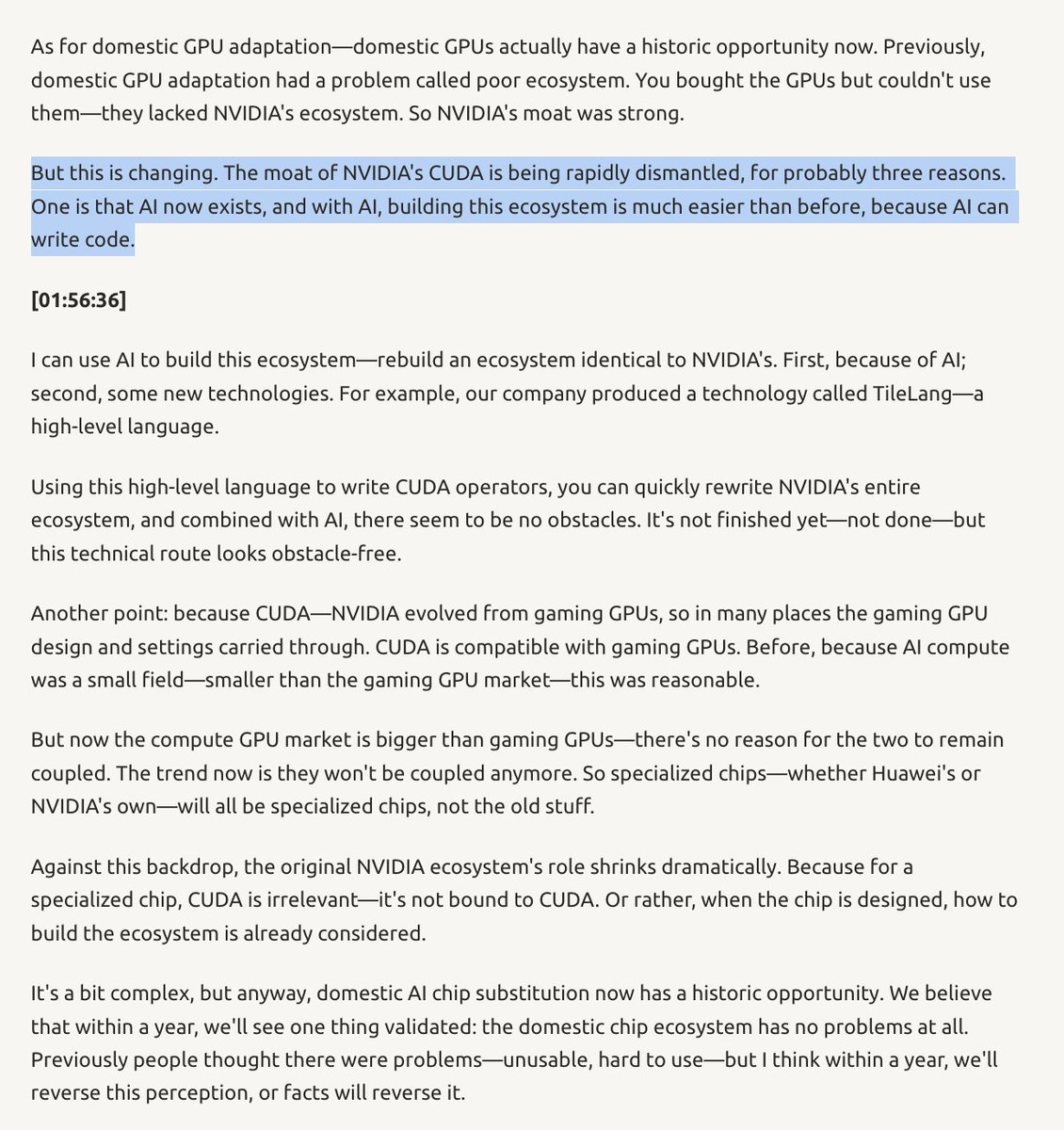
On domestic compute: bullish within a year. «Domestic AI chips have no problems in hardware or ecosystem—the only problem is insufficient production capacity»
«Previously, domestic GPU adaptation had a problem called poor ecosystem… The moat of NVIDIA's CUDA is being rapidly dismantled, for probably three reasons.
- with AI, building this ecosystem is much easier than before, because AI can write code.
- second, some new technologies. For example, our company produced a technology called TileLang—a high-level language. Using this high-level language to write CUDA operators, you can quickly rewrite NVIDIA's entire ecosystem, and combined with AI, there seem to be no obstacles.
- Another point: because CUDA—NVIDIA evolved from gaming GPUs, so in many places the gaming GPU design and settings carried through»
«When the global AI division of labor takes shape, the role Chinese companies most likely play is still the largest producer. Common sense says our production capacity is largest—including chips; our chip capacity may be largest, our electricity most abundant—so for AI we'll most likely end up as one of the three powers.»
Which three?