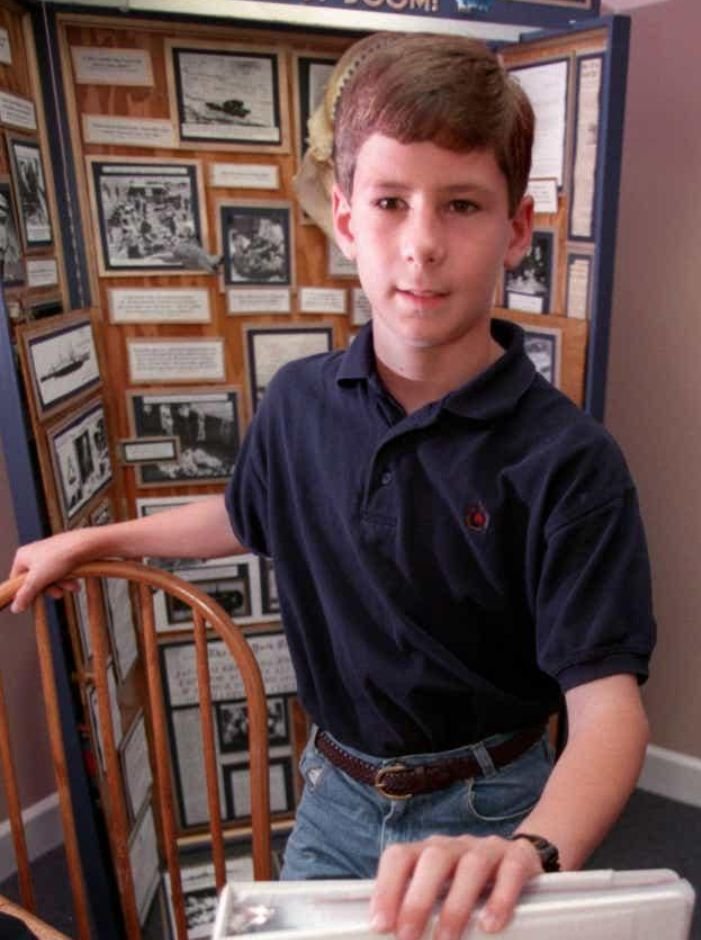
An 11-year-old boy watched the movie Jaws. Then he helped clear the name of a dead man the US Navy had blamed for a terrible disaster.
In 1996, a boy named Hunter Scott was watching the film Jaws at his home in Florida.
One scene particularly fascinated him.
The shark hunter Quint recalled the sinking of the USS Indianapolis during the Second World War.
Hunter had never heard of the ship.
He asked his father whether the story was true.
It was.
On July 30, 1945, a Japanese submarine torpedoed the USS Indianapolis in the Pacific Ocean.
The American warship had just completed a secret mission delivering components for the atomic bomb that would devastate Hiroshima.
Within approximately 12 minutes, the ship sank.
Of the 1,196 men aboard, only 316 survived.
Hundreds had escaped the sinking, only to spend days floating in the ocean, suffering from dehydration, exposure, injuries and shark attacks.
Nobody had raised the alarm when the ship failed to arrive at its destination.
The survivors were discovered almost by accident.
And then came another tragedy.
The US Navy court-martialled the ship's captain, Charles McVay, accusing him of negligence for failing to steer a zigzag course to avoid enemy torpedoes.
Yet McVay had not been informed of important intelligence concerning Japanese submarines in the area. His request for an escort had been denied.
Even the Japanese submarine commander testified that zigzagging would not have changed how he fired his torpedoes.
Many survivors considered McVay a scapegoat.
He carried the burden of the disaster for the rest of his life.
In 1968, he died by suicide.
Almost three decades later, an 11-year-old boy decided to investigate what had happened.
Hunter began what was supposed to be an ordinary school history project.
He read books and military documents. He contacted survivors, asking them to describe the disaster and what they thought of their captain.
Eventually, he reached out to all 154 survivors still alive in 1996.
More than 80 responded.
Many were elderly. Some had rarely spoken about their experiences.
They told Hunter about the men they had watched die. About their captain. About the injustice they believed had been done.
The boy kept investigating.
He wrote to President Bill Clinton. He assembled documents. He challenged the official version of events.
His research attracted national attention and helped persuade members of Congress to take up the case.
In 2000, Congress passed legislation calling for McVay's exoneration.
In July 2001, the Secretary of the Navy ordered that the congressional declaration of McVay's innocence be placed in his official military record.
More than half a century after the sinking, the captain's name had finally been officially vindicated, although the original court-martial conviction was not formally overturned.
And the boy?
Hunter Scott eventually became a US Navy officer himself.
There is something profoundly moving about this story.
Hundreds of sailors survived a nightmare. For decades, they struggled to get their captain's name cleared.
Then an ordinary schoolboy watched a film, became curious and refused to stop asking questions.
Sometimes history changes because someone powerful makes a decision.
And sometimes it changes because a child refuses to accept that the adults have already established the truth.
My 13 year old Daughter died from #BrainCancer 5, 030 days ago. 💔
I would LOVE to see my Ashley’s name 5, 030 times in comments for all the days she’s been missing.
When you lose a Child, the most beautiful word you can hear is their name. ❤️
A Repost & Follow would mean the world to us to keep our Ashley’s story alive.
💜 𝒜𝓈𝒽𝓁𝑒𝓎 💜
On September 10, 2025, the world lost one of its most gifted speakers and passionate advocates for freedom. We will never forget where we were on that fateful day when reports rolled in about the horrific assassination of Charlie Kirk. A part of our nation's soul died along with him, knowing that a good and decent man, husband, father, and patriot was ripped from us in an unimaginable way.
Charlie knew the risks of his mission and understood the dangers. He openly told others that his life was on the line for daring to hold the line for freedom, defending the right to debate ideas, and fighting for traditional values.
As a young husband and father who had already accomplished so much, Charlie could have easily retreated into comfort and safety. Yet, he chose not to abdicate his calling. He walked out the door every day, trusting in a higher power to guide his path, knowing his efforts were making a critical difference for the next generation of Americans. He was bold, unafraid of the future, and compassionate toward humanity - up until the moment he died.
They say time heals all wounds, but for those who knew and loved Charlie, this wound will remain open for the rest of our lives. While many of us are still hurting, it is impossible to fathom what his family has endured over the last twelve months—first with his tragic murder, and then with the hostility that followed from so many sides. Our deepest prayers remain with Erika Kirk and her children as they navigate life without him. Throughout this past year, Erika has shown tremendous courage, forgiveness, and grace in the face of great evil and hate. Charlie would be so incredibly proud of her—and I know he still is.
Today, we remember Charlie Kirk and honor his life that was dedicated to the cause of freedom. I'm grateful for this man and the example he left for me and future generations of Americans. I pray we are found worthy in our efforts to pick up Charlie's mantle and pass the torch of liberty to our children and grandchildren.