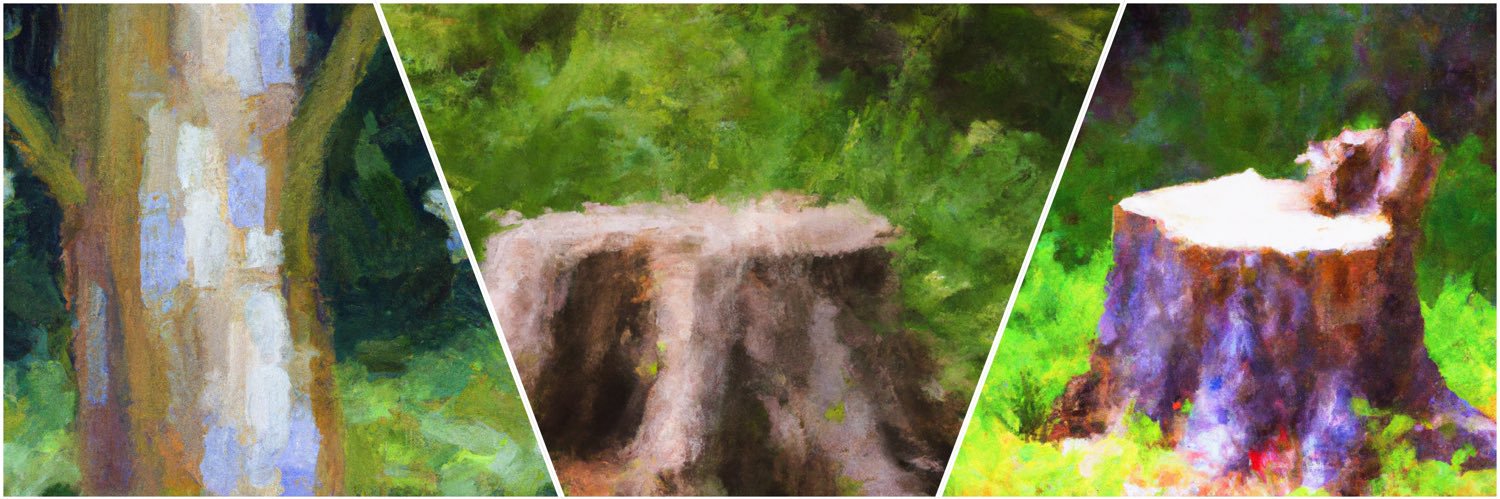
How well can you describe the feature selectivity of a vision neuron … with words? Interpretability has long borrowed from neuroscience — and maybe it can give back too! 🧵
🚨 New paper! https://t.co/1Xuw1xElcX
Are you sure your post-trained LLM isn’t forgetting something?
Adapting LLMs is known to cause forgetting.
We usually measure it via general knowledge benchmarks.
But if MMLU doesn’t drop…. are you really fine?
How can agents learn in long, open-ended tasks where success is rare and rewards are sparse? 👀
🚨 Enter ∆Belief-RL: we show how to use agent’s own belief updates as a dense reward for turn-level credit assignment.
the result? Surprisingly strong generalization.
(1/8) 🧵⬇️
When I discover a paper on @arxiv, I save it to @zotero, then I want to forget about it.
But it gets published, so when I cite it, it still says "arXiv preprint".
Multiply by 50. Nobody has time to track all of these.
So I built a tool with @claudeai to free up mental space.
This is a concrete step toward bridging the performance/understanding gap in vision science.
⚙️ Code: https://t.co/AGXUCJtpLv
📄 Paper: https://t.co/Gn6EVZinEI
🙏 A joint effort with Matthias Kümmerer, Lisa Schwetlick, @bethgelab#NeurIPS#CognitiveModeling
🚨 New paper at #NeurIPS2025!
A systematic fixation-level comparison of a performance-optimized DNN scanpath model and a mechanistic cognitive model reveals behaviourally relevant mechanisms that can be added to the mechanistic model to substantially improve performance.
🧵👇
💬 Conceptually: Deep neural networks should be viewed as scientific instruments. They tell us what is predictable in human behavior.
We then use that information to ask why, building fully interpretable models that approach the performance of their black-box counterparts.
🚨 New paper alert! 🚨
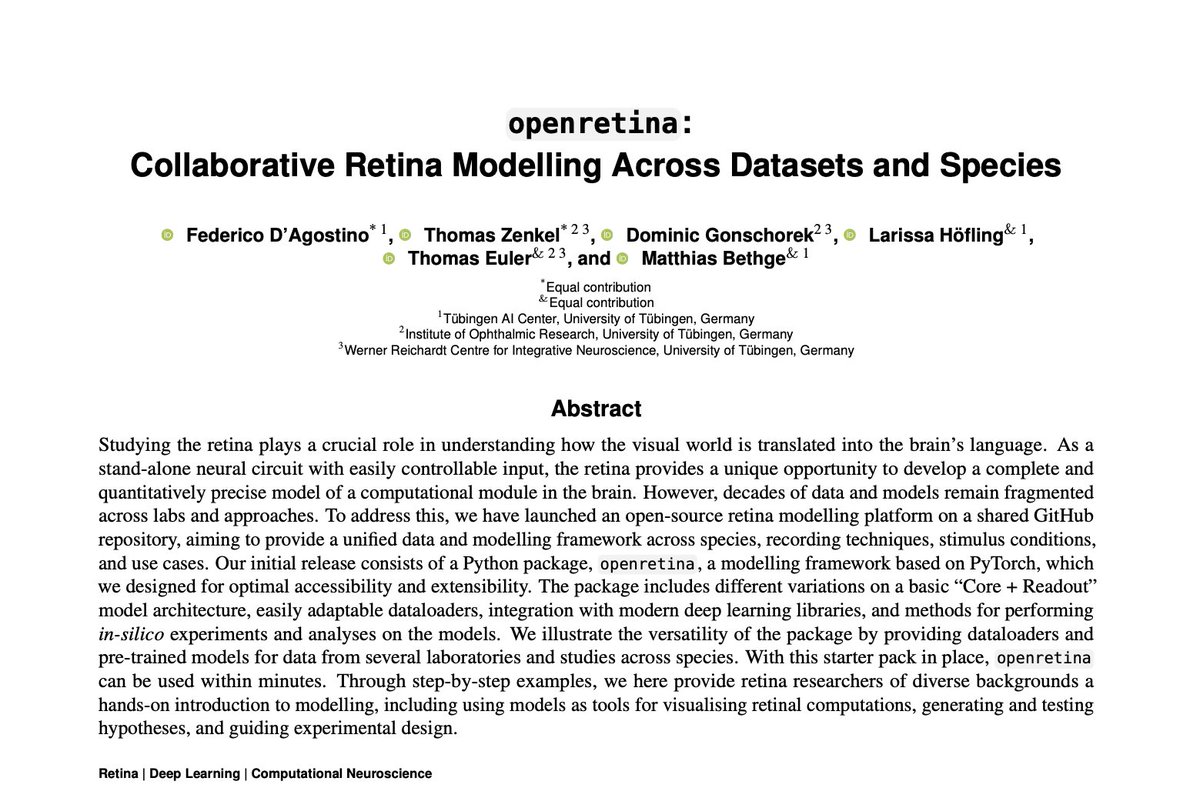
We’ve just launched openretina, an open-source framework for collaborative retina modeling across datasets and species.
A 🧵👇 (1/9)
This is just the beginning.
We see openretina as more than a Python package—it aims to be the start of an initiative to foster open collaboration in computational retina research.
We’d love your feedback! (8/9)