Call for applications – 6th BDAS | Big Data Africa School is now open!
We are excited to announce that the Call for Applications for NRF/SARAO – South African Radio Astronomy Observatory‘s 6th BDAS | Big Data Africa School is now open! The school will take place in Cape Town, South Africa, from 4 – 10 October 2026.
The thematic area of this year’s school is “Machine, Deep Learning and Novel Quantum Computing Techniques applied to Medical Imaging”. At the school, students will work on real-life data sets in the area of healthcare focusing on medical imaging by solving some of the biggest challenges facing the African continent.
Students* registered at an African university and currently undertaking their 4th year BSc Honours or final year BEng degree, Master of Science / Engineering or PhD degree in a science or engineering discipline, with intermediate to advanced programming skills, are invited to apply for the school.
Eligible countries for this opportunity* – South Africa, Botswana, Ghana, Namibia, Kenya, Mauritius, Madagascar, Mozambique, Zambia.
APPLICATION DEADLINE: 3 May 2026 (no late applications will be accepted)
More information can be found in the attached brochure and link to the application below:
https://t.co/Z25AUFgsya
#BigDataAfricaSchool #TrainingOpportunity #SkillsDevelopment #DataScience #CapacityDevelopment #BigDataAfrica
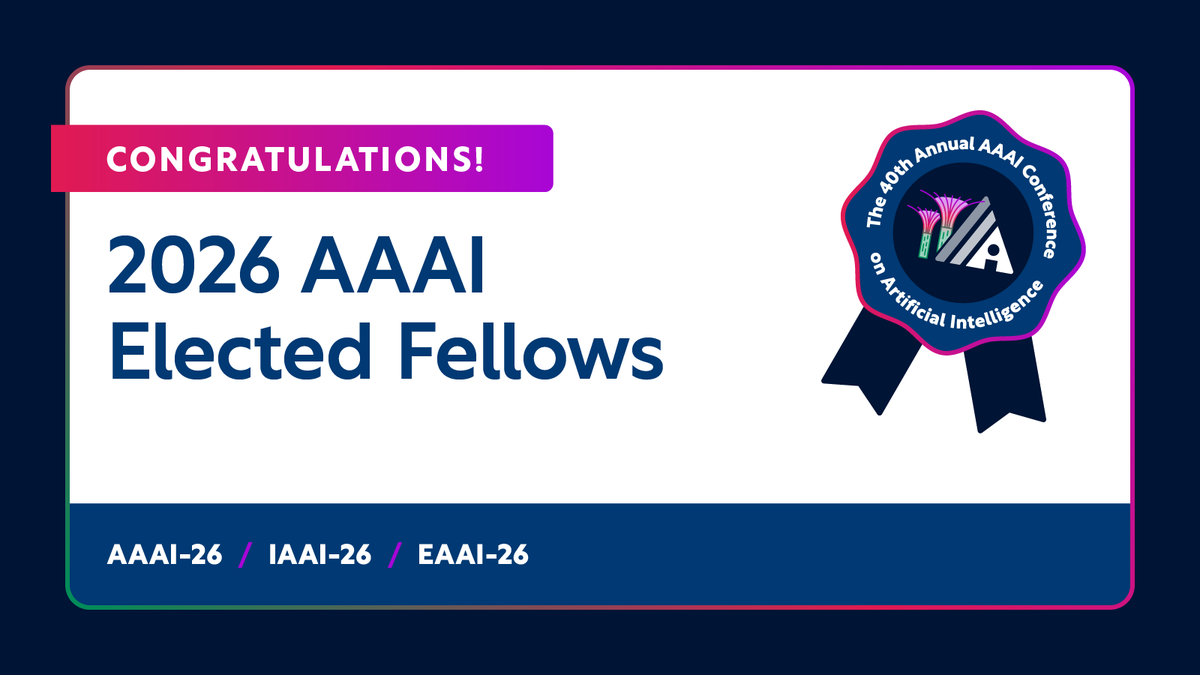
We are very happy to announce the list of newly elected AAAI Fellows for 2026. AAAI will celebrate the newly elected Fellows at the awards ceremony during AAAI-26. Congratulations to all the 2026 Fellows for this well-deserved honor!
Bo An
Elias Bareinboim
Roman Barták
Tanya Berger-Wolf
Sanmay Das
Alan Fern
Irwin King
Yan Liu
Nathan Sturtevant
Qi Tian
Francesca Toni
Ingmar Weber
Learn more: https://t.co/nB2iBp9dFo
Flower AI Summit 2026 is happening in London and it couldn't be easier to get there!
The venue is just a 5-minute walk (242 Pentonville Rd) from King's Cross station, putting it within easy reach whether you're arriving by tube, train, or rail from anywhere in the UK.
Not able to join us in person? The full event is also free to attend remotely so there's no reason to miss it.
Join us for a day of talks, ideas, and conversations at the cutting edge of federated AI.
https://t.co/HY8kkGiPEQ
“Timing is very important. You need to pick hard problems to solve and be ambitious with them. But you've also got to pick the right time when the world and the context that you're in is the right kind of environment for those ideas to flourish.”
In his official Nobel Prize interview, Demis Hassabis discussed how his aspirations as a young gaming programmer were ahead of their time.
Watch our official interview: https://t.co/2ovRqsSAtc
The Mathematical Collaborative Forum is inviting you to a Zoom meeting.
Topic: DEFECT-CORRECTION FINITE ELEMENT METHODS FOR ELLIPTIC AND PARABOLIC PROBLEMS ON POLYGONAL DOMAINS
Speaker: Jake L. Nkeck
Time: Mar 7, 2026 07:00 PM (GMT)
Meeting ID: 889 7920 0169
Passcode: 427705
The Mathematical Collaborative Forum (MCF) is inviting you to a scheduled Zoom meeting.
Time: Jan 24, 2026 07:00 PM Dublin
Speaker: Dhorasso Temfack
Host: Joseph Romaric Cheuteu
Co-Host: Allassan Nken
Meeting ID: 969 6037 7491
Passcode: 294049
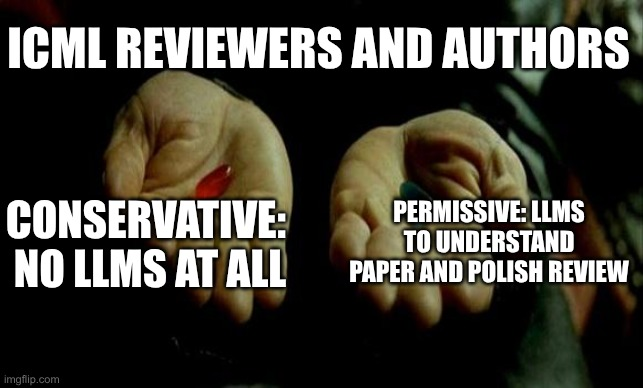
Announcing the ICML 2026 policy for LLMs in reviewing! Reviewers and authors both pick either conservative or permissive LLM use, and will be matched accordingly. Importantly: authors on papers who choose conservative must obey the conservative policy as reviewers.
☀️ 𝐅𝐞𝐝𝐞𝐫𝐚𝐭𝐞𝐝 𝐀𝐈 𝐒𝐨𝐥𝐚𝐫 𝐅𝐨𝐫𝐞𝐜𝐚𝐬𝐭𝐢𝐧𝐠 𝐍𝐨𝐰 𝐑𝐮𝐧𝐬 𝐨𝐧 @Raspberry_Pi
🌍 𝐈𝐧𝐭𝐫𝐨𝐝𝐮𝐜𝐢𝐧𝐠 𝐒𝐨𝐥𝐚𝐫𝐓𝐫𝐚𝐧𝐬𝐟𝐨𝐫𝐦𝐞𝐫
Exciting research published in Energy Conversion and Management: X (@ElsevierConnect). It introduces SolarTransformer; a federated learning system that achieves accurate solar power predictions while keeping sensitive energy data completely private.
Traditional AI forecasting requires centralizing operational data from multiple solar installations, which can expose sensitive information.
⚙️ 𝐓𝐡𝐞 𝐏𝐫𝐨𝐩𝐨𝐬𝐞𝐝 𝐒𝐲𝐬𝐭𝐞𝐦
Using a 2-layer Transformer trained with Flower (@flwrlabs) and FedProx across distributed sites, the system:
✅ Trains collaboratively WITHOUT sharing raw data; only encrypted updates.
✅ Compresses to just 47-69 KB for edge deployment (sub-2ms on @Raspberry_Pi)
✅ Self-corrects sensor anomalies, reducing errors by 39% during extreme weather.
The authors tested it on 70,000+ hourly measurements. SolarTransformer achieved 30% better accuracy than centralized approaches. This proves privacy and performance aren't trade-offs. Solar operators can now collaborate on forecasting models without exposing proprietary data, while the tiny footprint enables deployment from rooftop installations to utility-scale farms.
💡 The future of renewable energy forecasting is distributed, private, and efficient.
🔗 Read the full paper: https://t.co/MwKnWEZk9U
#FederatedLearning #SolarEnergy #AI #RenewableEnergy #EdgeComputing #Privacy
Today @NeurIPSConf: Come meet Yan Gao (@yangao381) and dive into FlowerTune, the latest community-powered research paper from Flower Labs.
When: Dec 4, 4:30–7:30 PST
Where: Exhibit Hall C/D/E
Poster #800
Paper: https://t.co/JsLkA7PD3d
Join us for an engaging panel discussion on machine learning algorithms, their impact across diverse research fields, current trends, and promising future directions in this rapidly evolving area of AI.
The Mathematical Collaboration Forum (MCF) is inviting you to the biweekly meeting where we will have Frank Ngaha giving a talk titled: Improving Personalized Healthcare via Bias Modulation.
Date: 22 November 2025, 08:00 PM Paris
Meeting ID: 864 8441 1955
Passcode: 324656
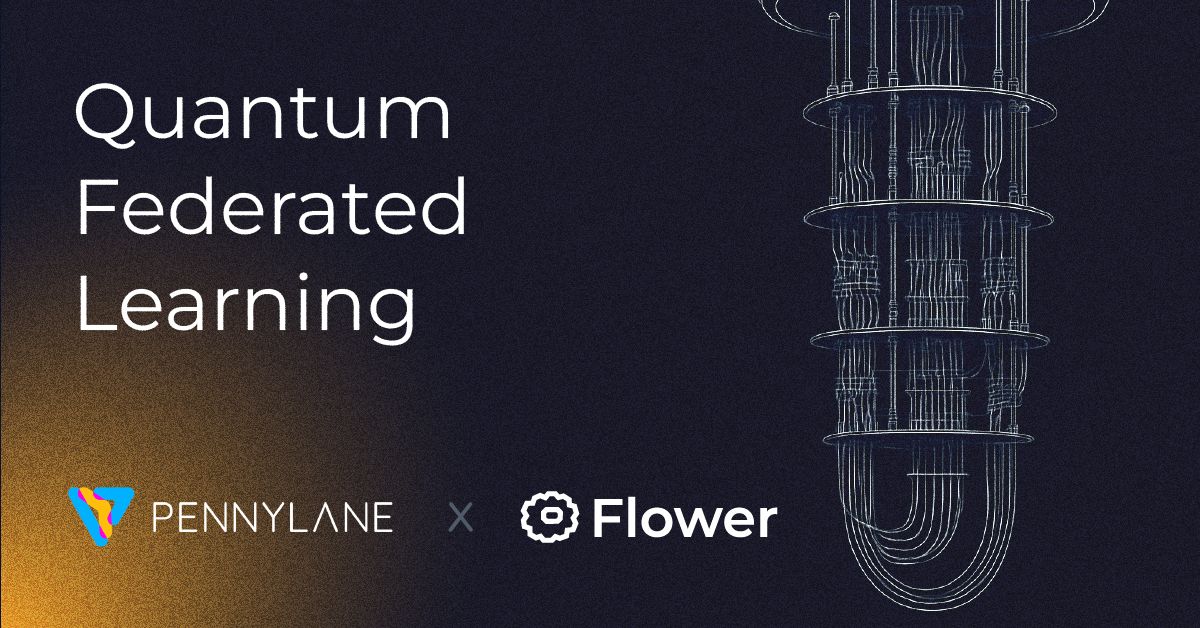
🚀 We just published a new blog post on Quantum Federated Learning using Flower! 🌼
As datasets grow, classical Federated Learning can become slow and resource-intensive. By integrating quantum computing and parameterized quantum circuits (PQCs), hybrid quantum–classical models enable richer representations while preserving privacy in decentralized settings. With Flower, each client trains its hybrid model locally, and the server aggregates updates via flexible strategies like FedAvg — unlocking exciting possibilities for Quantum FL.
In our recently released Pennylane <> Flower example, classical CNN features are projected into a quantum layer, where a final dense layer maps features to qubits, which are then processed by a PQC implemented using the PennyLane Library. Each client trains locally on a different subset of the dataset, and Flower coordinates the global aggregation to build a federated hybrid quantum model.
📘 Want to read more? read our new blog post that explains these ideas in depth
🧪 Want to try it yourself? explore our Quickstart Quantum FL example using PennyLane + Flower
📣 Big shoutout to Alan Yi and @bernalde from the SECQUOIA research group at Purdue University (@LifeAtPurdue) for making this possible, and the Flower team @jafermarq and @dstripelis_ for reviewing and supporting this effort!
PennyLane x Flower Blogpost: https://t.co/cNegkY2vrN
PennyLane x Flower Example: https://t.co/kFPn90tN0A