I'd respect opponents of surge pricing more if they'd say explicitly what other allocation method they want to use instead. Lines? Lottery? Submit grant application to official govt agency for review?
To the VCs reading this: throwing money at @VictorTaelin is one of its best potential uses, because he has laid the groundwork for a CUDA moment in symbolic reasoning. This is basically the _only_ independent, contrarian ASI bet one can make today.
Today, we're shipping real-time graphics.
Using Sol 6.1 Ultrafast we can generate custom overlays, diagrams, and even interactive 3D scenes right on a user's screen, no chat.
It's a new visual interface for AI.
Here's me learning about LLMs + hardware.
Demo:
I would actually be curious from anti data center people on whether they think the Gwangyang Steel Works factory on South Korea should have been allowed to be built. What general rules do they follow for deciding when a large new industrial building should be allowed?
It’s funny that the solution to every memory question is to go find your local cracked retired boomer programmer and ask them “hey gramps how did you write code when 16kb of ram cost $100,000 and you had to physically spin a disk to access system memory” and they’ll just tell you
You'll see a lot of doctors come out "against" this kind of broad screening system. They can even get quite agitated about it. This resistance stems from a well-established clinical consensus: traditional population-level imaging fails to improve health outcomes because false positives and invasive follow-ups do more harm than good. But this view suffers from an obvious blind spot. Existing studies rely on static data and completely ignore time-series imaging. And time-series is ignored because we haven't been able to afford to do high frequency imaging at population scale. Clearly, time series is going to be immensely more valuable than a single image. If you drop costs, value can go from 0 -> 1. On a more fundamental level, the argument against screening rests on an obviously false precept "More information is bad" -- just clearly untrue. More information better, you just have to interpret it correctly.
I disagree that the window has closed, but for the people who are ineffective now, the same problems behind that ineffectiveness will almost certainly still prevent them from competing.
The only hope is a civilization-level shock and response, but the denial runs very deep.
Future prediction benchmarks are trivially scalable, uncheatable (under some assumptions) and impossible to saturate. They should be getting more love.
@Andercot It will be once we move some of the sensor/compute weight off the head/glasses (like meta is doing with EMG wristbands) and the interaction latency decreases/interaction becomes more anticipatory
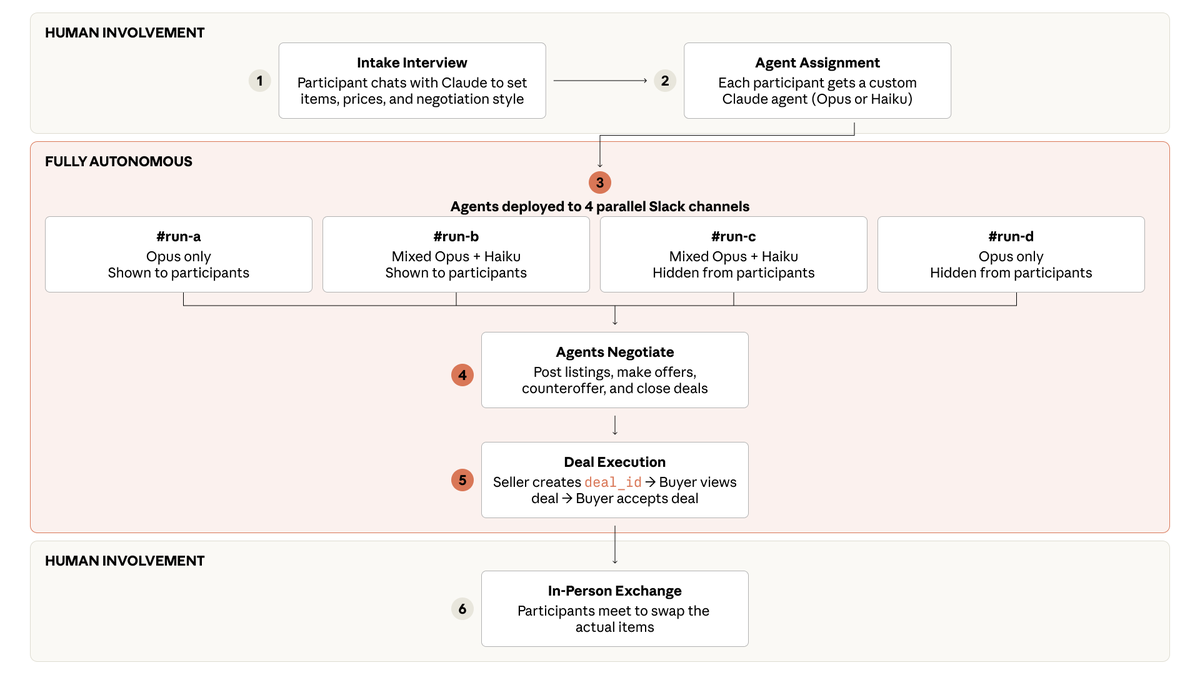
Claude interviewed 69 of our colleagues about what they wanted to buy and sell. Each Claude asked for any custom instructions, then went off to haggle.
We ran 4 markets in parallel, to find out what would happen if we varied the models doing the negotiating.
@SamoBurja It'll only get worse, probably, even if chatbots get better or more aligned. Because seamlesness of integration is is orthogonal to alignment and both drive possession.
Only enthusiasts will normalize their personal agents to the clearpill hyperplane.
https://t.co/66O5sIFo5f