@PeterContiBrown I wouldn't have made that case in general, but it could be true in this instance. As Vice Chair, Brainard may be the Fed's point person on some of the emerging frontiers of central banking, such as climate change and CBDCs. Her portfolio in the role may be very broad.
@JNicholsonInDC @nanc455 But the uncertainty around that forecast remains massive. Picture a NOAA storm-path forecast cone a month out. (The only difference is that NOAA's forecasts are a lot more scientific than mine.)
Rebound in mkt supply of #Treasury collateral accelerates this week. The combination of unabated bill issuance by Treasury and declining open mkt coupon purchases by #Fed will lead to sizable increase in net market supply of #Treasurydebt.
While the #Fed will, at a minimum, resume organic balance sheet growth at the October meeting, many market participants are now hoping for something more audacious. The Fed will have some delicate messaging to do in the weeks ahead.
The Fed will frame the resumption of outright purchases of Treasuries [QE Lite] as a technical response to the market structure issues that came to the forefront last week, but some investors will view it as a form of stimulus.
In today’s circumstances, a rate cut won’t actually provide much support to the economy, but the lack of a rate cut would disrupt global financial markets in a way that could be profoundly destabilizing.
There’s absolutely no economic or financial reason for a U.S. or global recession to occur in the next year or two, but we’re likely to experience one anyway because of political risks, says Lou Crandall, chief economist for Wrightson ICAP
https://t.co/wla09WjYMm
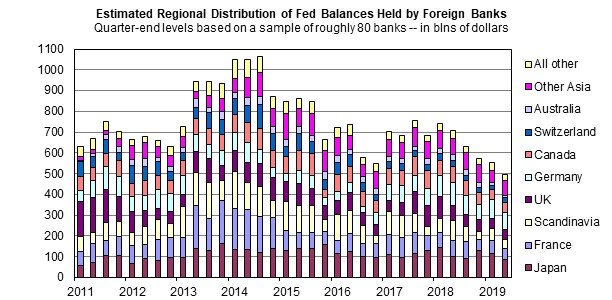
This week's MMO analysis features our quarterly chartbook of foreign bank holdings of reserve balances. Aggregate FBO holdings in our sample were down $54 billion between the end of March and end of June. Read our full analysis at https://t.co/V5bVzw4fIG - free trial.
#Inflation trends won’t trigger a #Fed rate cut in 2019. If #FOMC is forced to ease later this year – a risk that rises with each new provocation in the trade war – it will be due to the outlook for the real economy, not inflation data.
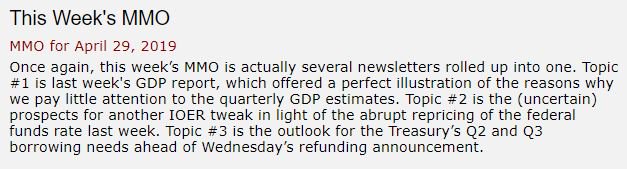
Long-time readers know that we don't think quarterly #GDP estimates are a useful gauge of economic conditions. Annual GDP numbers are the bedrock of our national economic measurement system; quarterly numbers reflect more noise than signal.
The fact that #repo market pressures spilled over into the #fedfunds market by the end of the week will add more fuel to the debate over the possibility of a #Fed repo backstop facility. https://t.co/V5bVzw4fIG
#Fed managed to produce a remarkably low-key set of minutes for what was a very high-profile #FOMC meeting. Text of the March 20 minutes provided very little new information on the various policy and operational issues that are currently in play.
In a close call, our updated forecast now suggests that the #USTreasury may not run out of resources under the current #DebtLimit until the first couple of days of October. #TreasuryBills
We are essentially agnostic about the direction of the next #Fed policy move at this point. Over the coming twelve-month period, we would assign roughly equal probabilities to a Fed tightening, a Fed easing and no change.






![Fedwatcher's tweet photo. The Fed will frame the resumption of outright purchases of Treasuries [QE Lite] as a technical response to the market structure issues that came to the forefront last week, but some investors will view it as a form of stimulus. https://t.co/FfXDVUtVUg](https://pbs.twimg.com/media/EFKdX85WwAAMQc5.jpg)