India's food supply chain has a surprising vulnerability.
We import a significant share of our fertilizer requirements.
That means a disruption thousands of kilometres away can influence what happens on an Indian farm months later.
Food security is also geopolitical security.
A food crisis doesn't necessarily begin with empty supermarket shelves.
Sometimes, it begins with a fertilizer bag.
Because behind that bag are natural gas, cargo ships, global trade and geopolitics.
And eventually, all of it can reach your kitchen.
Imagine walking through an ordinary street while an entire ancient city lies beneath your feet.
Old houses. Roads. Hearths. Graves.
The strange part?
In many cases, the city didn't sink.
The ground rose around it.
Singapore's transformation is impressive.
But every transformation has trade-offs.
Growth vs inequality.
Stability vs freedom.
Development vs social pressure.
A success story becomes more interesting when you ask:
Who paid the price?
Singapore didn't just build factories.
It built housing, education, infrastructure, savings systems and a strategy to attract global businesses.
The interesting question isn't just "How did Singapore get rich?"
It's "What did it build first?"
Imagine starting a country with almost no natural resources, limited freshwater, high unemployment and serious security concerns.
Most countries would protect what little they had.
Singapore made a different bet:
Open up. Invite global companies. Build for the world.
In 1965, Singapore had a GDP per capita of just $516.53, no natural resources, limited freshwater and serious economic uncertainty.
Today, its GDP per capita is above $98,000.
So what changed?
My new documentary drops this evening.
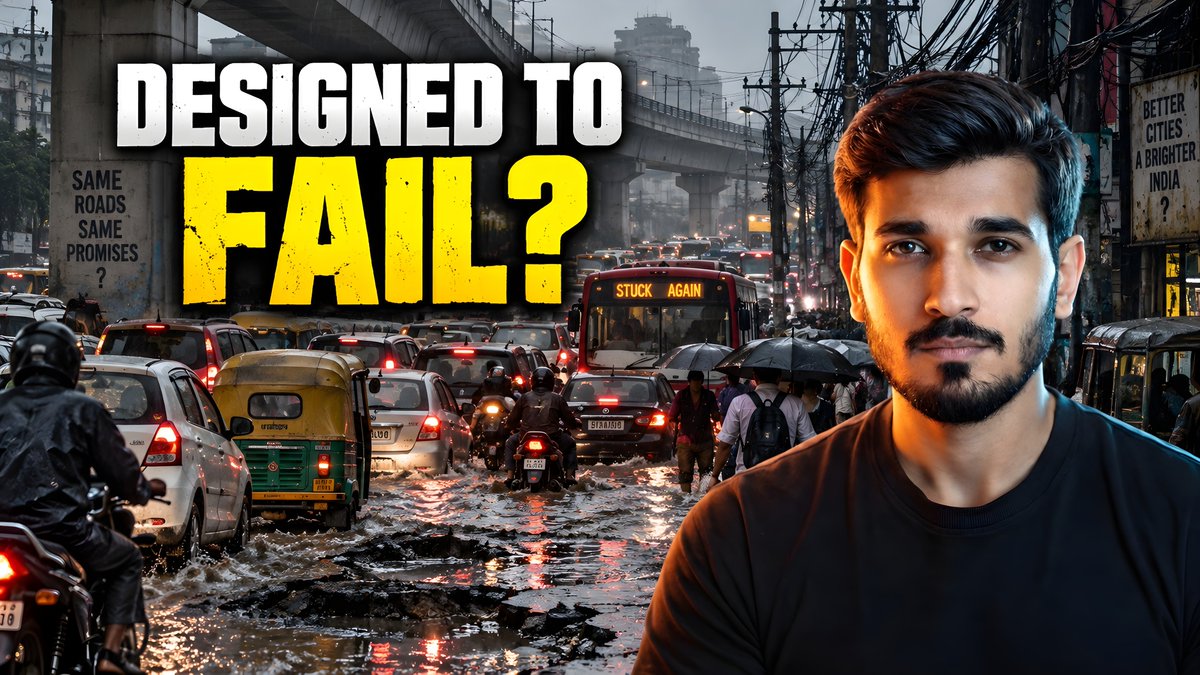
Indian cities generate nearly two-thirds of India's GDP.
Yet municipal corporations control less than 1% of the country's total tax revenue.
Huge economic importance.
Limited financial power.
Can cities really function like this?
In one city, roads, water, transport, footpaths and urban planning can all be controlled by different authorities.
So when something goes wrong…
Who is actually accountable?
Traffic, waterlogging, broken footpaths and expensive housing seem like separate problems.
But what if they're not?
What if they're all symptoms of one bigger problem: a city where no single institution is responsible for the whole system?
What if India's job crisis isn't just a skills problem?
Imagine every graduate in India suddenly becomes perfectly skilled.
Coding. Communication. Problem-solving. Everything.
Would there be enough good jobs for them tomorrow?
If not, training alone can't solve the problem.
India's unemployment rate can tell only part of the story.
Someone can be technically “employed” and still be doing work far below their education or potential.
The real question isn't:
Do you have a job?
It's:
Do you have a good, productive job?
55,000 Indian Railways jobs.
1.86 crore applicants.
That's 300+ people competing for one seat.
And many applicants are graduates.
So why are highly educated Indians competing for jobs far below their qualifications?
The answer is more complicated than “India has no jobs.”
The search team didn't find the children.
They found clues.
A feeding bottle.
An improvised shelter.
Shoes.
Hair ties.
A pair of scissors.
Each clue meant they were alive.
But every clue created another question:
Where were they going?
40 days.
Amazon jungle.
Four children.
The youngest was just 11 months old.
They survived without an adult, while hundreds of people searched for them.
The question isn't just how they survived.
It's what they already knew that helped them survive.
India has a huge workforce.
Manufacturing could create millions of jobs.
But there's a problem:
Factories are becoming more automated. So what happens if India wins the manufacturing race…
but the factories don't need as many workers?
That's the question nobody should ignore.
China didn't become the world's factory by building one giant factory.
It built an ecosystem.
Thousands of suppliers. Components nearby. Fast logistics. Skilled workers. Massive manufacturing clusters.
India is trying to build that ecosystem now.
India is making more phones than ever.
But becoming a manufacturing giant isn't just about assembling products.
If the critical components still come from elsewhere, you're part of the supply chain not necessarily the centre of it.
India wants to become the world's factory.
But here's the problem:
Building factories is the easy part.
The hard part is building the ecosystem around them:
Suppliers. Skills. Logistics. Technology. Financing. Exports.
One weak link can break the whole chain.
Here's the uncomfortable question about India's AI ambitions:
If an AI data centre brings billions in investment..but also consumes enormous amounts of electricity and water…
who should get priority?
AI infrastructure?
Industries?
Farmers?
Or ordinary households?