In 1975, Los Angeles, Danny DeVito walked into a casting room full of six-foot actors and asked, “So… which one of you is playing the tall guy?”
They laughed — until he walked out with the role they all wanted.
The producers of One Flew Over the Cuckoo’s Nest had nearly cast every patient in the ward, except one: the unpredictable, sharp-witted Martini. DeVito entered the room with a New Jersey accent, a worn jacket, and a confidence that made the character feel alive before he’d even read a line.
When director Milos Forman asked him why he wanted the part, DeVito tapped the script and said,
“Because he thinks faster than the room. People just miss it.”
He booked the role for $350 a week, surrounded by taller, more classically trained actors — yet the camera kept drifting toward him. Forman let him improvise freely.
In one take, DeVito silently slid his chair closer to Jack Nicholson, inch by inch. Nicholson broke character laughing. Forman kept it in the film.
Then came Taxi.
Network executives doubted viewers would accept a five-foot actor as a major presence in a primetime comedy.
DeVito walked into the table read, slammed the script shut, and growled,
“Who wrote this dispatcher? I love him.”
The room exploded with laughter.
He walked out with a deal for $15,000 an episode.
By season two, he had a Golden Globe, winning audiences with scenes that weren’t even written for him.
His defining moment arrived in 1989 with Batman Returns.
Warner Bros wanted a traditional villain. Tim Burton wanted DeVito.
When they met, Burton placed a sketch of the Penguin on the table.
DeVito traced the long pointed nose with his finger and said:
“He’s angry because the world never gave him a chance to be ordinary.”
Burton nodded.
“Then you are him.”
DeVito endured three hours of makeup every day and insisted on performing the sewer scenes himself. The film earned over $260 million in the U.S. alone.
Danny DeVito became living proof that:
• Presence matters more than height.
• Skill matters more than type.
• And the industry’s rules don’t survive someone determined enough to break them
He once said,
“If they shut a door, I climb through the window.”
That’s the story of his career a man who never fit the mold,so he changed the shape of the mold instead.
This will be one of the best stories you’ll read today.
This is Jake Pratt.
Jake got a job with UPS.
So I guess that makes him “Jake from UPS.”
His sister Amy Hyde wrote about how happy she is that UPS hired him.
“Thank you @UPS for giving my brother a chance & promoting inclusion in the workforce.
Jake has Down Syndrome but that doesn’t stop him!
He loves his new job running packages up to 8 hours per day. That’s after working 6-10 am every morning at the golf course. I’m so proud of him.
He (also) asked me to recognize his driver & mentor, Richard. Richard has taught him so much & has been incredible with Jake.
Thank you UPS.”
His sister also told People magazine:
“This opportunity to work for UPS means everything to Jake because it is his dream to be able to live independently.
He has achieved so much, but none of it would be possible without people embracing him and giving him a chance.
Jake is so worthy and capable, so it’s just awesome for others to be able to see that.
He has done a lot to break barriers and raise awareness that people with Down syndrome can accomplish anything they set their mind to."
Jake also tweeted this picture of him and Richard and said simply:
”My man.”
And UPS tweeted out:
“Great to have Jake on our team.
Thanks, Jake, for helping us deliver!”
It makes me so happy to see that UPS hired him.
It says a lot about the company.
Go get ‘em “Jake from UPS.”
It's been 5+ years on X
But, Today only I got to know that you can take a clean screenshot of any tweet with X badge directly from the share option. 😅🫨🤯
Hi! My name is Harriett. I’ve come a long way. I’m 2.5 years sober. Before sobriety, alcohol owned me. I could not imagine going one day without it. Now, I’m thriving and living the best sober life - for life!
People often cannot fathom how much I drank in a day. Frankly, I cannot fathom it. My life revolved around alcohol. Then one day, I started having seizures from alcohol withdrawal. That’s where this bruised pic comes in. What should have just been a bump on my forehead from the fall was unbelievable bruising because my body was not properly functioning.
I turned it all around post-seizure. I went to a treatment facility and made an effort to attend AA.
AA saved my life.
Today I am flourishing and am so grateful for my acceptance that I am an alcoholic. I am also grateful for my willingness to turn it over to my Higher Power.
Stay True: Crystal Gayle’s Long Hair, A Legacy of Authenticity
Crystal Gayle’s hair reached the floor by the time she was performing sold-out shows across America in the late 1970s, but the decision to let it grow began quietly years earlier, long before she became a country-pop crossover icon. As a teenager, influenced by her mother’s encouragement to embrace individuality and femininity, Gayle chose not to cut her hair again. That decision soon became more than appearance, it was an act of self-definition.
By the time her chart-topping hit "Don't It Make My Brown Eyes Blue" took over radios in 1977, audiences were as captivated by her long, straight, dark brown hair as they were by her velvet-smooth vocals. Backstage and during interviews, people constantly asked her the same question: how do you manage such length? She’d often smile and reply, “It’s who I am.” There was no strategy, no gimmick. For her, long hair reflected her sense of calm, her personality, and her connection to authenticity.
As trends shifted in the industry, Crystal stood firm. Hairdressers frequently offered to trim or style it. Photographers suggested changing the look for album covers like "We Must Believe in Magic" and "When I Dream," but Gayle gently refused. Even during the pressure of high-definition television appearances on shows like "The Tonight Show Starring Johnny Carson," where lighting and camera angles scrutinized every strand, she kept her signature look untouched. For her, the hair was not fashion, it was faithfulness to the image she had shaped for herself from day one.
When touring, Crystal’s floor-length hair required a unique kind of discipline. She brushed it daily in sections, used minimal heat styling, and slept with it gently wrapped to prevent tangles. Her hairstyling routine was often as discussed as her performances. At concerts, audience members seated near the stage whispered about whether the hair was real. Gayle responded to the curiosity with humor and grace, once saying in an interview, “It’s all mine, and it grows a little every day.”
In the visual medium of country music television, her look helped her stand out. In a genre where many female artists leaned on rhinestones and big curls, Gayle arrived on stage in elegant gowns with her straight hair flowing down like a curtain of silk. It became part of the mystique, soft-spoken, poised, and quietly bold. She didn’t speak loudly about empowerment, but she embodied it with every step onto the stage.
During her 1980s appearances on "Hee Haw" and in music videos for songs like "Talking in Your Sleep," her hair often moved with its own rhythm, a presence all its own. In the age before social media, fan letters poured in weekly, many asking about her hair routine. It was not unusual for her to receive shampoo samples or requests for beauty tips along with song requests.
Crystal never viewed her look as a brand. She simply honored the personal promise she made to herself. Even into the 2000s, when styles and standards evolved, she maintained her signature length. For her, consistency was not resistance to change, but loyalty to identity.
In a world that constantly encourages reinvention, Crystal Gayle remained unmistakably herself. The voice may have drawn the world in, but the long hair reminded everyone that staying true can sometimes be the most radical thing of all.

For the past 6 years, a dog named Capitan has slept in the grave of his owner every night. His owner, Miguel Guzman died in 2006 and Capitan dissapeared shortly after the family attended the funeral services. They searched everywhere and put out flyers to try and find him. But no one had seen him.
A week later, some people who were at the cemetery late one evening spotted Capitan laying on the grave and they contacted the grounds keeper at the cemetery. The cemetery notified the family who promptly came to pick him up and take him home. But each night he would cry and scratch frantically at the door to go out and he wouldn't return home until morning. It was later discovered that Capitan would walk the 3 miles back to the cemetery each night to guard his master's grave.
It has been 7 years now. The cemetery does not close the gates until he arrrives each night promptly at 6 pm. He sleeps there all night guarding the grave until the ground keeper opens the gate in the morning. This is a true picture of Capitan here.
Credit: Anomalous Club
At 40, Franz Kafka (1883-1924), who never married and had no children, was walking through a park one day in Berlin when he met a girl who was crying because she had lost her favourite doll.
She and Kafka searched for the doll unsuccessfully.
Kafka told her to meet him there the next day and they would come back to look for her.
The next day, when they had not yet found the doll, Kafka gave the girl a letter "written" by the doll saying "please don't cry. I took a trip to see the world. I will write to you about my adventures."
Thus began a story which continued until the end of Kafka's life.
During their meetings, Kafka read the letters of the doll carefully written with adventures and conversations that the girl found adorable.
Finally, Kafka brought back the doll (he bought one) that had returned to Berlin.
"It doesn't look like my doll at all," said the girl.
Kafka handed her another letter in which the doll wrote: "my travels have changed me." The little girl hugged the new doll and brought the doll with her to her happy home.
A year later Kafka died.
Many years later, the now-adult girl found a letter inside the doll. In the tiny letter signed by Kafka it was written:
"Everything you love will probably be lost, but in the end, love will return in another way."
Embrace change. It's inevitable for growth. Together we can shift pain into wonder and love, but it is up to us to consciously and intentionally create that connection.
While filming Maverick in 1993, Jodie Foster and Mel Gibson had a heated off-camera argument about politics.
The two had worked together before and usually got along well, but that day, their strong opinions led to a tense clash. Gibson, known for his fiery temper, walked off the set after the disagreement, leaving the crew in an awkward silence.
Foster, calm and composed, didn’t shout back but clearly felt disappointed. Later, a crew member shared that Gibson wasn’t really angry at her—he was frustrated with himself.
About an hour later, Gibson returned with flowers and a handwritten note. He apologized sincerely, and Foster later revealed the note said: “I was raised by a man who shouted first and thought later. I’m trying not to be that man anymore.” She appreciated his honesty, saying, “That’s why I love him—he owns his flaws.”
This moment became one of Foster’s strongest memories from the film. She valued Gibson’s willingness to reflect and make amends, which she found more meaningful than any political debate.
Gibson’s temper was partly shaped by his strict upbringing. His father, Hutton Gibson, had strong, often aggressive opinions, which influenced Mel’s own struggles with anger. Foster understood this, saying, “I’ve known Mel a long time… he thinks deeply about his actions afterward.”
The argument didn’t hurt their working relationship—in fact, the set became more relaxed afterward. Co-star James Garner even joked that the two balanced each other perfectly, both on and off camera.
Years later, when Gibson faced public criticism, Foster stood by him. While promoting The Beaver* (2011), a film she directed starring Gibson, she said, “He’s been a friend for 20 years. You can’t judge someone’s whole life by their worst moment.”
This private apology showed how owning up to mistakes can strengthen a friendship far more than public words ever could. Sometimes, the most difficult moments lead to real growth
She Carried Her Baby for 37 Weeks, Knowing She Might Never Bring Her Home. But She Hoped Her Daughter Could Save Other Children.
In 2017, an Oklahoma couple received news that no expectant parent should ever have to hear. Their unborn daughter had a rare condition, and doctors warned them that she was unlikely to survive after birth.
But in the middle of unimaginable heartbreak, Keri Young made a decision that would touch countless lives.
Keri and her husband, Royce Young, were expecting their second child when a routine ultrasound at 19 weeks changed everything. Doctors discovered that their daughter had anencephaly, a rare birth defect in which major parts of the brain and skull fail to develop.
The prognosis was devastating. Their little girl was not expected to survive.
Yet, through their grief, Keri asked the doctors a question: Could their daughter donate her organs and give another child a chance at life?
After speaking with medical specialists, Keri and Royce decided to continue the pregnancy. They named their daughter Eva Grace.
For the next several months, Keri carried Eva knowing that she might never get to watch her take her first steps, hear her laugh, or celebrate her birthdays. She knew that the time they would have together could be painfully short.
Still, she wanted to give Eva every opportunity to make a difference in the world.
Then, on April 16, 2017, at 37 weeks of pregnancy, Keri noticed that Eva had stopped moving.
She rushed to the hospital, where doctors delivered the heartbreaking confirmation: Eva’s heart had stopped beating.
On April 17, 2017, Eva Grace was delivered stillborn.
The family had hoped to hold their daughter alive, even if only for a few precious moments. They were devastated. And the possibility of donating her major organs was no longer available.
But Eva’s story did not end there.
Doctors received unexpected news from LifeShare of Oklahoma. Although her major organs could not be donated, Eva could still donate her eyes.
Her corneas could potentially help restore sight to someone else.
Keri and Royce held their daughter, took photographs, and spent precious time with her. Their young son, Harrison, also had the opportunity to meet his little sister.
Later, the couple shared Eva’s story publicly. Their experience reached thousands of people and brought attention to the possibilities of infant tissue and organ donation.
For Keri and Royce, Eva was never defined by her diagnosis or by how long she lived.
She was their daughter. She was wanted, cherished, and loved long before she entered the world.
Eva never got the chance to grow up, but even in her brief life, she left behind a legacy of compassion.
Sometimes, a life is not measured by how many years someone gets to live, but by the love they leave behind and the difference they make in the lives of others.
We met on a blind date in 1968 and got married in June 1970. I was 19 and she was 17. We are still married. We have two sons. We wanted more children, but after our second son was born, my wife couldn’t carry another pregnancy. We tried several times, but she kept losing the babies after a few months. The doctor said no more.
Now we have two sons, three grandsons, and two great-grandchildren.
People said our marriage wouldn’t last because we were so young when we got married. Well, here we are 55 years later. We grew up together and stayed together all this time.
I spent an hour in the bank with my dad,as he had to transfer some money. I couldn't resist myself and asked...
''Dad, why don't we activate your internet banking?''
''Why would I do that?'' He asked...
''Well, then you wont have to spend an hour here for things like making a transfer.
You can even do your shopping online. Everything will
be so easy!''
I was so excited about initiating him into the world of Net banking.
He asked ''If I do that, I wont have to step out of the house?”
''Yes, yes''! I said. I told him how even groceries can be delivered at your door now and how amazon
delivers everything!
His answer left me tongue-tied.
He said ''Since I entered this bank today, I have met four of my friends, I have chatted awhile with the staff
who know me very well by now.
You know, I am alone...this is the company that I need.
I like to get ready and come to the bank. I have enough time, it is the physical touch that I crave.
Two years back, I got sick. The store owner from whom I buy fruits, came to see me and sat by my bedside and cried.
When your Mom fell down a few days back while on her morning walk, our local grocer saw her and immediately got his car to rush her home as he knows where I live.
Would I have that 'human' touch if everything became
online?
Why would I want everything delivered to me and force
me to interact with just my computer?
I like to know the person that I'm dealing with and not
just the 'seller'. It creates bonds of Relationships.
Does Amazon deliver all this as well?'''
Technology isn't life..
Spend time with people .. Not with devices
A 26-year-old student sends a message to his teacher to explain that he will be absent from the course because he has not found anyone to keep his five-month-old daughter.
Nathan Alexander, 34, a math professor at Morehouse College (Atlanta) responds to his student by saying:
"If that's the problem, bring her to class."
Upon arriving in the classroom, the teacher offered to take the child so that his student could devote himself entirely to the course.
The teacher held the child throughout the lesson and even after, when he answered the students questions.
In September of 2005, on the first day of school, Martha Cothren, a History teacher at RobinsonHigh School in Little Rock, did something not to be forgotten. On the first day of school, with the permission of the school superintendent, the principal and the building supervisor, she removed all of the desks in her classroom. When the first period kids entered the room they discovered that there were no desks.
'Ms. Cothren, where are our desks?'
She replied, 'You can't have a desk until you tell me how you earn the right to sit at a desk.'
They thought, 'Well, maybe it's our grades.' 'No,' she said.
'Maybe it's our behavior.' She told them, 'No, it's not even your behavior.'
And so, they came and went, the first period, second period, third period. Still no desks in the classroom. Kids called their parents to tell them what was happening and by early afternoon television news crews had started gathering at the school to report about this crazy teacher who had taken all the desks out of her room.
The final period of the day came and as the puzzled students found seats on the floor of the desk-less classroom. Martha Cothren said, 'Throughout the day no one has been able to tell me just what he or she has done to earn the right to sit at the desks that are ordinarily found in this classroom. Now I am going to tell you.'
At this point, Martha Cothren went over to the door of her classroom and opened it. Twenty-seven (27) U.S. Veterans, all in uniform, walked into that classroom, each one carrying a school desk. The Vets began placing the school desks in rows, and then they would walk over and stand alongside the wall. By the time the last soldier had set the final desk in place those kids started to understand, perhaps for the first time in their lives, just how the right to sit at those desks had been earned.
Martha said, 'You didn't earn the right to sit at these desks. These heroes did it for you. They placed the desks here for you. They went halfway around the world, giving up their education and interrupting their careers and families so you could have the freedom you have. Now, it's up to you to sit in them. It is your responsibility to learn, to be good students, to be good citizens. They paid the price so that you could have the freedom to get an education. Don't ever forget it.'
By the way, this is a true story. And this teacher was awarded the Veterans of Foreign Wars Teacher of the Year for the State of Arkansas in 2006. She is the daughter of a WWII POW.
Do you think this email is worth passing along so others won't forget either, that the freedoms we have in this great country were earned by our U.S. Veterans?... I did.
Let us always remember the men and women of our military and the rights they have won for us.
A 90 year-old D-Day veteran is set to marry his former fiancée 70 years after they split up due to the PTSD of his wartime experiences.
Roy Vickerman called Nora Jackson's home to apologize for their split and told the taxi driver to wait outside for a few minutes while he presented her with a bunch of flowers.
Nora threw her arms around Roy as soon as she saw him and now, a year later, the couple have celebrated their engagement at Roy's 90th birthday party
The couple first met in 1940 at school in Bucknall, Stoke on Trent and soon became engaged, but the outbreak of war interrupted their plans.
The couple was reunited after Roy spoke about Nora on a local radio show and the host helped find her address.
Not knowing if Nora had a husband and not wishing to upset her, he simply planned to give her some flowers, apologise for the way their affair had ended, and then leave.
"Nora came to the door and put her arms around me and gave me a kiss. Four hours later, I had to tell the taxi driver I was staying."
"I knew him straight away, but I never thought I would see him again," Nora said. "It was a shock to see him, because it had been such a long time, but it was lovely. It was just like old times."
After reuniting, the original engagement ring is back on Nora's finger
Two years ago I started working at Captain D's Seafood. We had an elderly customer come in who was a veteran. He became a regular and someone we counted on to brighten our days. He was always such a nice and funny man and always knew how to make us laugh. Quickly, many of us began to grow close to him. We learned that he had served over 20 years in the military and his wife had recently died from cancer. His son is active in the marines as well. Each time he came in we would talk to him and he would always ask us how life was or what our plans were or how our day was. This man hasn't been simply kind, he has been supportive, there for all of us. He always made us laugh. I graduated Friday night. He surprised me and showed up in a suit, all dressed up! He stood there and got so proud when they called my name. I'm leaving for college in a few days and we said our goodbyes and he handed me one hundred dollars... and refused to take any back. So I guess the moral of my story is this: no matter how big or how small your job is, there is always someone watching. Someone who will care. Someone who will support you. Or listen. Always be nice. Always be kind. You never know.
Credit: Megan Milliken
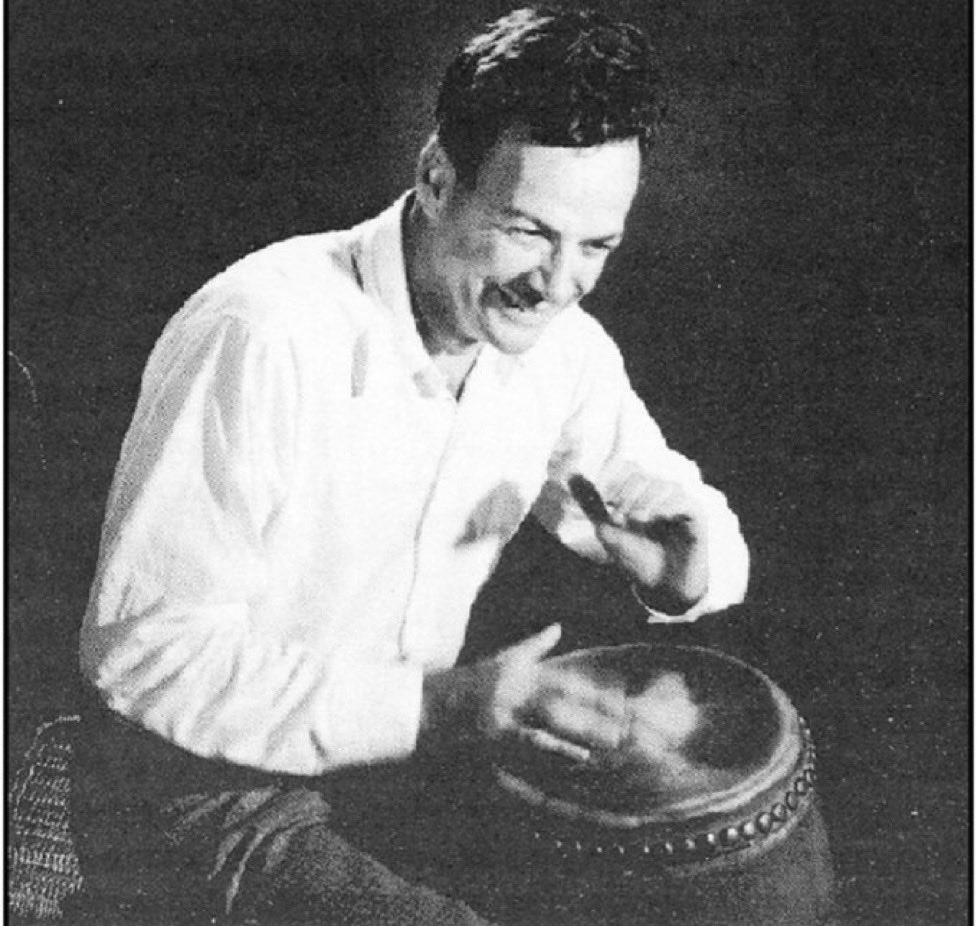
The first time American physicist Richard Feynman went to Brazil, he usually ate outside of normal hours, so he was always the only customer at the restaurant
One day, while he was enjoying a plate of rice with meat, a Japanese abacuses vendor came in.
The vendor turned to the waiters and bet that he could add much faster than they could.
The waiters, who did not want to make a bad impression, invited him to speak to the only customer who was sitting alone in a corner.
"I don't speak Portuguese very well!" protested Feynman.
"It doesn't matter," laughed the waiters, "numbers are easy to understand." So they brought him a pencil and paper, and the challenge between the physicist and the street vendor began.
In adding numbers, Feynman was largely defeated.
And the situation did not change when they moved on to multiplication: this time, however, Feynman was defeated by a small margin, because he was quite good at multiplication.
At this point, the man suggested moving on to divisions, without realizing that the results with paper and pencil improved as the calculations became more complex: the more complicated the operation, the greater the chances Feynman had of winning.
And in fact they both performed a long division, and in the end they were tied.
Unable to bear to be beaten by an anonymous customer at the restaurant, the Japanese man exclaimed:
"Raios cubicos!". Cubic roots!
He wrote the number 1729.03 on a piece of paper and challenged the physicist to extract the cube root.
While the street vendor worked frantically, sweating blood, Feynman sat quietly doing nothing.
"What are you waiting for?" a waiter asked him.
"I think," the physicist replied, pointing to his forehead with a finger.
He wrote 12, shortly after 12.002 and then 12.0023 again.
Wiping his forehead with a handkerchief, the man with the abacus said, "12!"
"Oh, no! You need decimals!" Feynman replied, knowing full well that, when you extract a cube root with arithmetic, calculating decimals is quite tiring and the tiring increases decimal after decimal.
The Japanese dove back into the abacus and after a while, said, "12.0!" A paltry result compared to the numerous decimals found by the physicist.
Humiliated, the abacus seller walked away with his head down, leaving the waiters to gloat.
This is how Feynman had managed to beat the abacus champion.
"I knew that a cubic foot contains 1728 inches, so the result had to be a little more than 12. That left 1.03, about two thousandths of 1728. I had learned from calculating small fractions that the excess of the cube root is equal to one-third of the excess of the number itself. So I just had to find the value of the fraction 1/1728, multiply it by 4 (that is, divide by 3 and multiply by 12). In this way, I was able to calculate so many decimal places." If Feynman's explanation is not clear enough for you, know that he refers to the binomial expansion.
Thirteen-year-old Maria Santos stood eight months pregnant at the Western Union telegraph office in Boston on December 3, 1921, dictating an emergency message to sixty-year-old telegraph operator
Mrs. Helen Walsh—"URGENT: 13 YEAR OLD GIRL 8 MONTHS PREGNANT SOLD BY FATHER TO 42 YEAR OLD MAN STOP NEEDS IMMEDIATE HELP STOP BOSTON WESTERN UNION STOP"—and Mrs. Walsh, realizing what she was hearing, had made a split-second decision to send the telegram not just to one person but to EVERY major newspaper, police station, courthouse, and women's organization in Massachusetts—forty-seven telegrams in total, all sent within twenty minutes—and within two hours, three newspaper reporters, two police detectives, a judge's clerk, and five women's advocates had arrived at the telegraph office where Maria still sat, and Mrs. Walsh had told them all "This child came here desperate. I sent her story everywhere because one person might ignore it but forty-seven cannot"—and by evening, Maria's story was front-page news in six newspapers, police had arrested her "husband" Carlos Santos at his workplace, and her father was in custody—and the telegraph operator's decision to broadcast one desperate message to forty-seven recipients had created such immediate public pressure that Carlos was denied bail, the case was fast-tracked to trial, and he was convicted in nine days—and Mrs. Walsh received commendations from multiple organizations for "creative use of emergency communications to protect a child."
Maria lived until 2004, dying at age ninety-one. Before her death, she reflected: "I walked into a telegraph office at thirteen, eight months pregnant, and dictated one desperate message. The operator sent it to forty-seven places—newspapers, police, courts, women's groups. Within two hours, people were arriving to help me. By evening, my story was in six newspapers and my husband was arrested. One telegram operator decided one message to forty-seven people was better than one message to one person. That decision saved me. Telegraph wires carried my cry for help across an entire state in twenty minutes
"This guy named John has been coming into my work for years. I told him I was going to Vietnam next week with my girlfriend. He told me he was over there during the fall of Saigon and helped orphan babies get on evacuation planes and helicopters as a Marine. I told him I was one of those babies. He looked at me, his eyes started to well up and said he might have held me in his arms during the rescue mission (Operation Babylift).
We talked for a while and I thanked him dearly for his service and kindness. In the end, he told me he'll sleep better tonight knowing that a small innocent baby has now grown up with a better life in America. What an amazing man you are John. And thank you again for your service! I'm no longer an orphan." ❤️ ❤️
Credits goes to the respective owner ~
“On Wednesday in Alabama, a Walker County Sheriff's Office Deputy came across a man walking down the road with an oxygen tank and learned he is a Disabled American Veteran trying to walk/hitchhike from the Jasper area to Huntsville for a Dr. Appointment he was told he could not miss. With no way to get there, he said he started walking. The deputy acted quickly and escorted the Gulf War Veteran to the Cullman County line where a Cullman Sheriff Deputy picked him up. The deputy then transported him to the Morgan County Line where a Morgan County Sheriff Deputy took over and met a Madison County Sheriff Office Deputy in Huntsville who finished the trip and took the man to his appointment. After an overnight stay, we were happy to do it all again today..... in reverse to help get the man back home. We are thankful for our Veterans and were honored to play a small role in supporting this man who gave a great deal for our country!” 🇺🇸 ❤️
Credit: Morgan County Sheriff's Office