Los midterms casi siempre castigan al presidente: desde 1946, su partido perdió escaños en la Cámara en 18 de 20 elecciones, 26 en promedio. Lo de anoche no fue una anomalía. La sorpresa vendrá de lo que el mercado todavía no descuenta. Hilo:
1/ 🧵 ¿Quién gana y quién pierde con la Ley de Rescate? Así se ve todo junto, por decil de gasto. Si EfectIVA funciona, el 30% más pobre gana entre 2,0% y 2,4% de sus recursos y el 10% más rico pierde 5,2%. Veamos pieza por pieza 👇
Según el Plan de Rescate Fiscal, el 68% de la población de menores ingresos mejoraría su ingreso disponible frente a la situación actual, gracias al conjunto de medidas, especialmente la devolución del IVA.
En cuanto a los “más ricos”, es cierto que el proyecto reduce el impuesto al patrimonio (un tributo económicamente cuestionable que muy pocos países mantienen), pero también aumenta sus impuestos de renta, sus aportes a seguridad social y la carga del IVA.
De hecho, según las estimaciones de @MinHacienda, el 10% de los hogares de mayores ingresos asumiría el 97% del esfuerzo tributario total de los hogares.
Y, contrario a lo que usted @GustavoBolivar afirma, Hacienda estima que la reforma reduciría la desigualdad, con una disminución en el coeficiente de Gini (ver gráfico).
Podemos debatir la conveniencia y viabilidad de las medidas, además de que muchas seguramente se pueden mejorar, pero no es serio desconocer sus efectos distributivos estimados.
Dos cursos, una convicción: entender el dinero cambia las decisiones de toda una familia.
📈 Renta fija en Colombia: del CDT al TES, con datos oficiales al día.
🧩 Hackea tus Finanzas: de los 8 a los 18 años, con Panel del adulto.
Pruébalos gratis 👉 https://t.co/jgLYzkVzYi
The Federal Reserve held interest rates steady today, and we think patience is the right approach. Inflation remains high, but the question isn't simply whether rates should go higher. It's whether higher rates would actually address the inflation that remains.
The challenge is that parts of the economy, and of inflation itself, are moving at very different speeds. Growth remains remarkably resilient in aggregate, supported by a powerful investment cycle, but beneath the surface, parts of the economy that are more sensitive to borrowing costs are feeling considerably more restraint. We see a similar divergence in inflation. Many of the cyclical components that respond to higher interest rates appear relatively well controlled. Meanwhile, persistent pressures across energy, insurance, healthcare and education are unlikely to be meaningfully affected by another 25-basis-point rate increase.
In some ways, the Fed is operating a house with one thermostat, but very different temperatures in every room. Turning it down further may make the rooms that are already cool even colder, without doing much to cool those that remain hot.
That doesn't mean the Fed should become complacent. Inflation is still above its 2% objective and the Fed should retain the option to tighten further if the underlying inflation trend deteriorates. But hawkish rhetoric and patient policy can comfortably coexist, particularly when the bond market has already done some tightening of its own through higher Treasury yields.
For investors, we think this environment argues for humility rather than making a heroic directional call on rates. Real yields remain attractive, and there's considerable income available across high-quality fixed income markets. We continue to favor a moderate duration posture, taking advantage of today's income opportunities while remaining patient as this unusually divergent economy evolves.
The Fed doesn't need to ignore the heat. It just needs to be thoughtful about where it's coming from.
A todos los que hablan sobre finanzas públicas y deuda sin tener idea les digo que no todos podemos saber de todo y ser ignorante en temas técnicos es normal. Lo grave es no darse cuenta de lo que uno no sabe y, encima, tener la soberbia de creerse con autoridad para pontificar.
Como decía Hayek esa es la diferencia entre ser ignorante y padecer la “pretensión del conocimiento”.
¿Ustedes conocen TODAS las opciones que hay para invertir en Colombia?
Haciendo FIQUANT he descubierto que hay muchos Fondos De Inversión en Colombia y LATAM muy interesantes.
La plataforma ya tiene diferentes casos de uso, pero vienen muchos más.
https://t.co/JB9PwmQOb3
@JorgeARestrepo Fue una demostración que Colombia es atractivo aún. Un bid to cover de casi 3x. La coyuntura no es la mejor, y más con el tema Brasil. Tesoros dieron algo de respiro, pero se necesitaban. Ya con eso se cierran las colocaciones de bonos afuera por este año.
Este ejemplo de los presidentes @ABDELAESPRIELLA y @LulaOficial debería difundirse masivamente.
Podemos estar en las antípodas del pensamiento, pero nunca recurrir al irrespeto. El ejemplo comienza con nuestros líderes.
Algunos sucumben al fanatismo, al ego y al café.
🇨🇴🫱🏻🫲🏼🇧🇷
This image has gone viral recently, but investors are still COMPLETELY missing what it actually shows...
Read this post in full if you want to really understand what's going on in the bond market.
Let me explain:
The vertical axis shows annual returns, while the horizontal axis shows volatility.
From 1986 through 2020, adding bonds to a stock portfolio did exactly what investors wanted:
It reduced volatility without destroying returns.
A 100% stock portfolio produced roughly a 12% average annual return with 16% volatility.
But a portfolio holding approximately 25% stocks and 75% bonds still returned more than 8% while reducing volatility to around 8%.
That is the magic of diversification.
The portfolio became less volatile than either stocks OR bonds held independently because the two assets frequently moved in opposite directions.
But look at what happened from 2021 through 2025:
The efficient curve largely disappeared and was replaced by an almost straight line.
Every additional dollar moved from stocks into bonds reduced returns, but provided far less diversification than investors had grown accustomed to.
A 100% stock portfolio returned nearly 16% annually.
A 60/40 portfolio returned roughly 8.5%.
And a 100% bond portfolio actually lost money.
The problem wasn’t simply that bonds produced lower returns.
The problem was that stocks and bonds were suddenly reacting to the same economic threat:
INFLATION.
When economic growth is the market’s primary concern, stocks and bonds often move in opposite directions.
Weak growth hurts corporate earnings and stock prices.
But it can also push inflation and interest rates lower, causing bond prices to rise.
That is why Treasuries historically performed so well during many recessions and equity-market crashes.
Bonds absorbed some of the damage when stocks declined.
But an inflation shock works differently.
Higher inflation forces interest rates upward.
Higher rates reduce the value of existing bonds because their fixed coupon payments become less attractive compared with newly issued bonds.
At the same time, higher rates raise the discount rate applied to future corporate earnings, compress stock valuations and potentially pressure profit margins.
In other words:
A growth shock can hurt stocks and help bonds.
An inflation shock can hurt BOTH.
That is exactly what happened in 2022.
The S&P 500 returned approximately -18%.
Ten-year Treasury bonds returned approximately -18%.
The asset that was supposed to protect investors from the stock-market decline fell nearly as much as the stock market itself.
However, there is an extremely important limitation hidden inside this image:
The blue line covers 35 years.
The red line covers only five.
And those five years included one of the most violent interest-rate resets in modern market history.
Bonds entered this period with yields near historic lows.
Investors were receiving very little interest income to offset falling prices when rates rose.
The Federal Reserve then increased rates at an extraordinary pace, producing enormous losses for long-duration bonds.
So this chart does not prove bonds will continue producing negative returns.
It shows what happens when you own long-duration, fixed-rate assets immediately before a massive inflation and interest-rate shock.
In fact, bonds are in a very different position today.
Starting yields are significantly higher.
That additional income creates a larger cushion against future price declines.
And if inflation falls, economic growth weakens or interest rates decline, high-quality bonds will regain much of their traditional hedging power.
But investors should still learn an important lesson from this chart:
Diversification based only on asset labels is not real diversification.
Owning one stock fund and one bond fund may look diversified-
But both can still be exposed to the same underlying risk.
Long-duration stocks and long-duration bonds can both get crushed by rising discount rates.
Corporate bonds can behave like equities during a recession because credit spreads widen.
Private credit and BDCs may provide income, but they still contain significant economic and credit risk.
Covered-call funds may reduce some volatility, but they still own equities underneath the options strategy.
Replacing bonds with another asset that carries even more equity risk does not solve the diversification problem.
Investors need to begin with the specific job they expect each asset to perform.
If the goal is near-term liquidity and capital stability, short-term Treasuries or a Treasury ladder would be more appropriate than a long-duration bond fund.
If the goal is protection against recession and falling interest rates, longer-duration, high-quality government bonds would play an important role.
If the goal is protection against unexpected inflation, investors need exposure designed for that specific risk, such as TIPS, commodities or businesses with genuine pricing power.
And if the goal is funding retirement spending, investors should think beyond short-term price movements and build a durable cash-flow plan.
That can include cash reserves, bonds matched to upcoming expenses and a diversified collection of companies capable of growing their dividends and cash flows over time.
Growing dividends will not prevent stock prices from declining.
It would be a HUGE mistake to look at this image and assume that every investor should abandon bonds and buy 100% stocks.
But you do need to understand that that the 60/40 portfolio was never a law of nature.
It was a portfolio designed around the assumption that stocks and bonds would respond differently to economic shocks.
The 60/40 is certainly not dead...
But investors must recognize that its diversification benefits are dependent on whether markets are being driven by fears of weak growth or rising inflation.
A friend says:
"Academics tend to be massive conformists because success consists in the consensus opinion of one's peers. Investors or other business people tend to be much less conformist because success comes from being the first to do something no one else is doing, etc."
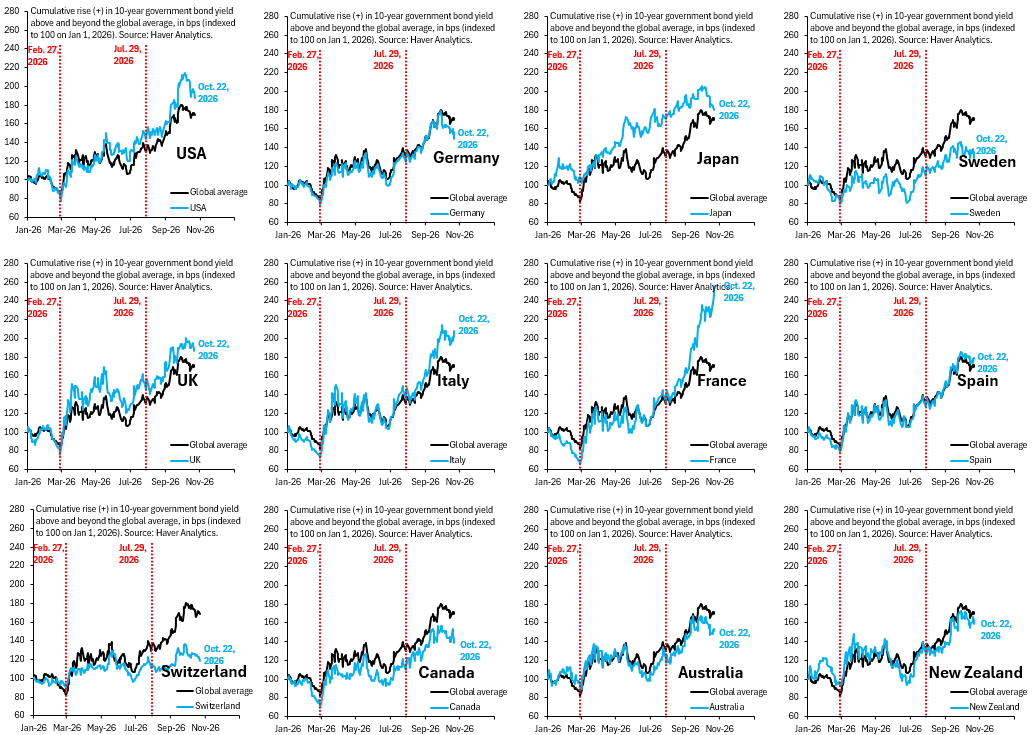
We've reached the mayhem stage for France. It's 10-year yield is exploding higher as is Italy's. Everyone else is getting safe haven inflows, notably the US and Germany. We've reached the stage where France's crisis is idiosyncratic and self-perpetuating.
https://t.co/3e0cWt2SLM
We've reached the mayhem stage for France. It's 10-year yield is exploding higher as is Italy's. Everyone else is getting safe haven inflows, notably the US and Germany. We've reached the stage where France's crisis is idiosyncratic and self-perpetuating.
https://t.co/3e0cWt2SLM
🚨 Una posible diferencia de dos parágrafos entre @SenadoGovCo y @CamaraColombia no basta para afirmar que se hundió el Presupuesto de 2027.
Desde @FEDe_Colombia_ consideramos que primero debe establecerse qué aprobó cada plenaria y cuáles serían las consecuencias jurídicas de la discrepancia.
La Constitución exige conciliar las diferencias, pero no toda irregularidad implica que se haya frustrado la aprobación de una ley.
En nuestro comunicado explicamos por qué existen fundamentos jurídicos para sostener que la diferencia podría limitarse a esas disposiciones, sin afectar todo el presupuesto.👇
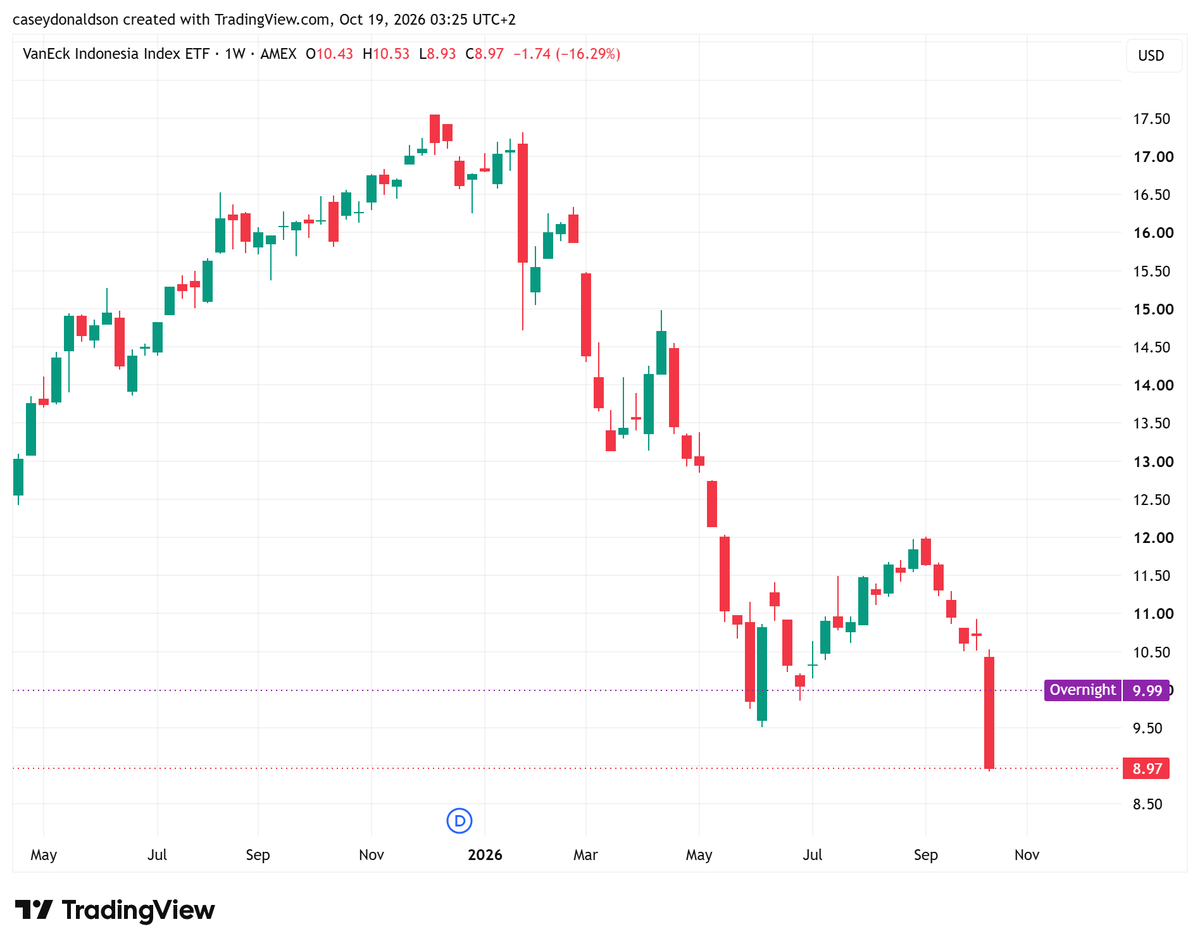
Indonesia is done.
Indonesia’s stock market is on the edge of a catastrophic feedback loop.
MSCI warned that Indonesian stocks may no longer qualify for its global indexes.
Suspicious trading. Possible manipulation. Poor transparency.
The market responded with its biggest single-day crash since 1998. Down 11.5%.
But the initial crash is not the problem.
The market is already down 30% this year.
Foreign investors have pulled nearly $5 billion.
The rupiah has weakened past 18,000 per dollar.
Now MSCI is considering removing Indonesia from both emerging and frontier market indexes entirely.
If that happens, every major global fund tracking those indexes is forced to sell Indonesian stocks automatically.
Forced selling into a market already down 30%.
With foreign capital already fleeing.
With a currency already under pressure.
This is not a contained emerging market story.
This is what a currency and market crisis looks like in the early stages.
And the worst of the forced selling hasn’t even begun.
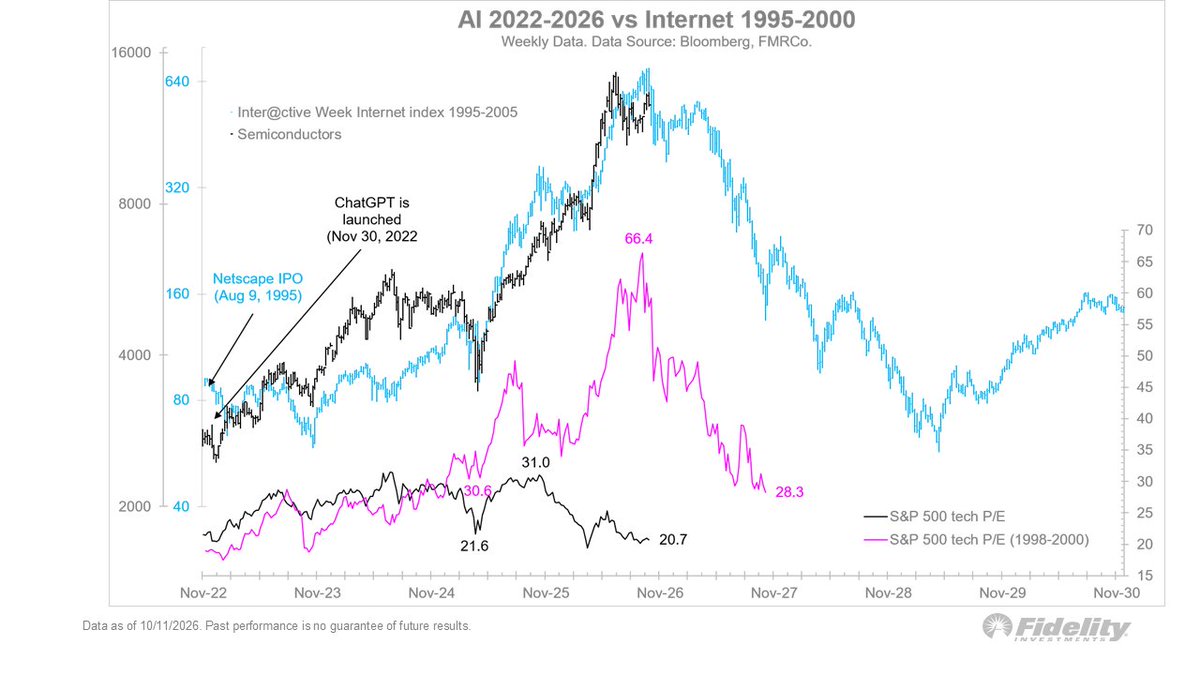
Perhaps unrelated (or not), we have now reached the climax of the 1998-2000 internet bubble analog. Price analogs tend to fail sooner or later, and I won’t be surprised if this one fails sooner (given the difference in valuations), but it has been a good roadmap.
El jaguar intergaláctico marcha hoy contra el desastre que dejó el jaguar intergaláctico.
Protesta con rabia contra la crisis de la salud que él causó, exige justicia por la corrupción de su propia administración y reclama por el déficit fiscal que él mismo dejó.
Un espectáculo político inédito: indignarse en las calles contra el legado que dejó en el Palacio. La culpa siempre es del gobierno anterior... aunque el gobierno anterior haya sido él.
What happens to equities if yields continue to rise? The simple answer is that per the DCF model the present value of future cashflows will decline, all else being equal. Fortunately, all else is not equal and earnings are booming. That means that the stock market can withstand a P/E derating without causing a bear market. Remember that in 2022 the P/E ratio fell 33% while earnings only grew 8% (and were decelerating from the post-COVID recovery). The result was a 28% bear market entirely driven by contracting multiples. I fear that a milder repeat could lie ahead if this bond bear market continues. Again, as long as earnings keep growing at double digits, the damage to price could be modest. For instance, per the Fed model below (which compares equity valuation to bond valuation), if the 10-year yield rises to 6%, that suggests an equity P/E ratio of 16x. It is currently 19-20x. A 4-point drop in the P/E ratio is a 20% valuation haircut, but if it’s offset by 30% earnings growth, we could be spared the kind of drawdown we experienced in 2022. Maybe a 2022 echo or aftershock. 🧵(1/2)
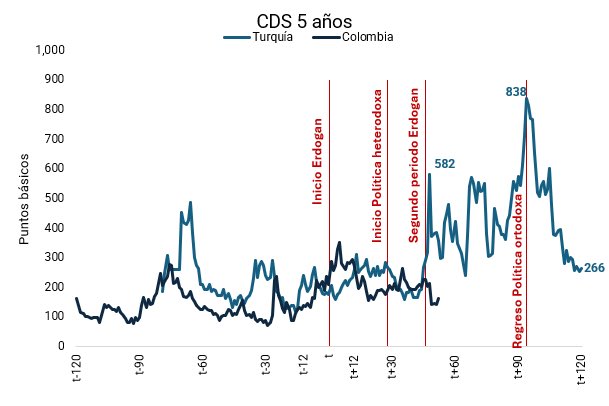
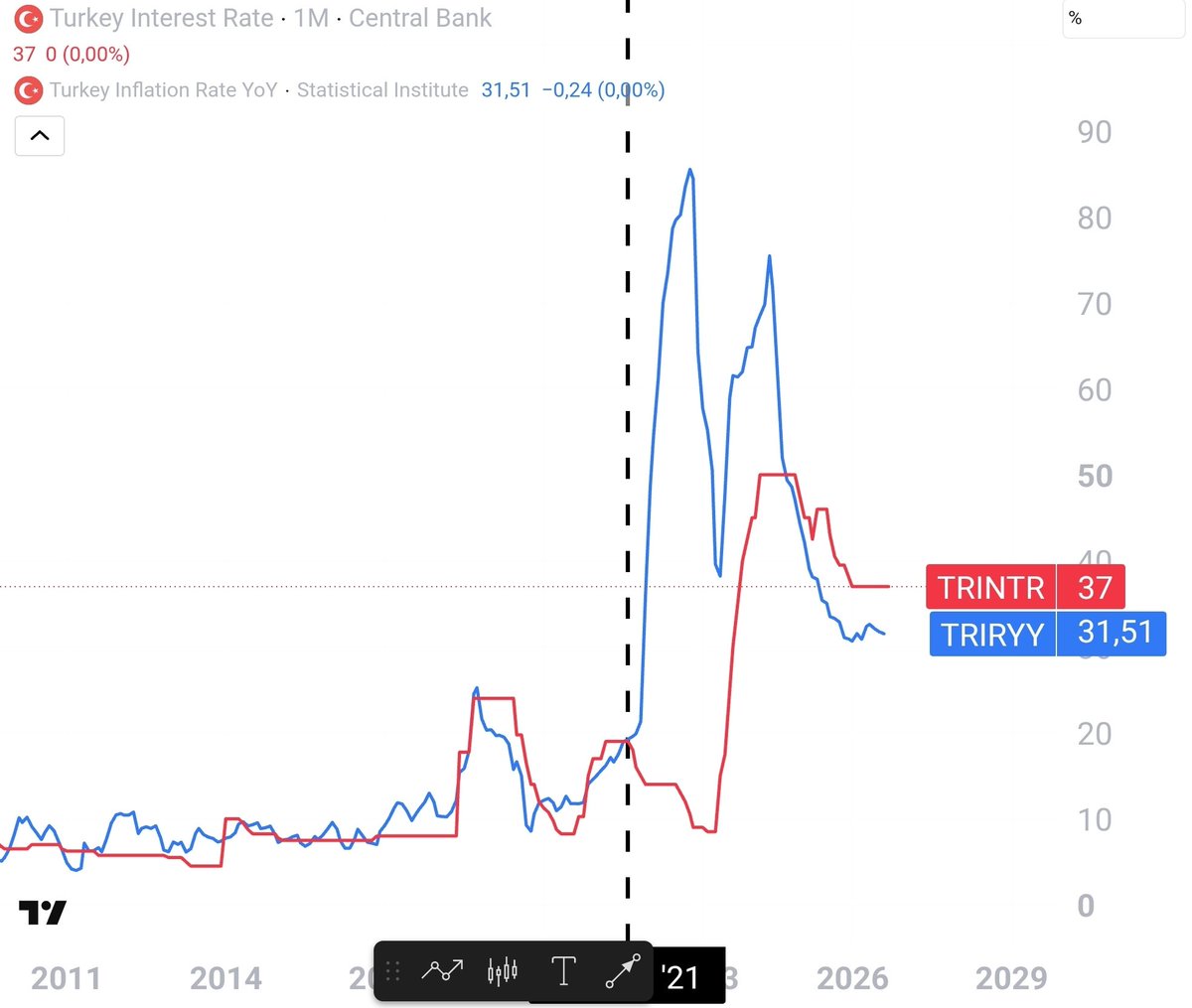
Venga lo complemento @FelipeCamposPC. Viendo el CDS a 5 años de Colombia y Turquía, con frecuencia mensual, la prima de riesgo siempre castigó la hetorodoxia. Erdogan en 2018 tuvo que recular porque estuvo con el "agua al cuello". De lo que nos salvamos!
Erdogan hizo la misma conexión que Petro: como inflación y tasas se movían juntas, creyó que las tasas causaban la inflación. Desafortunadamente para los turcos, él sí pudo demostrar que no tenía idea de lo que hablaba: bajó las tasas y disparó la inflación al 80%.