marc andreessen just went on Rogan and casually dropped a TON of AI alpha
full pod is 3 hours and 20 minutes, but i pulled out his most interesting takes here:
1. AGI is here. he thinks the line was crossed about 3 months ago with the new GPT-5.5, claude 4.6, gemini 3, and grok 4.3 models. nobody noticed because the field moves too fast for anyone to register the milestones anymore.
2. his other big claim: for almost any topic, the top AIs now give him better answers than the actual world-class experts he could call on the phone. and he can call basically anyone.
3. every doctor is already secretly using chatGPT in the exam room. marc says they turn around the second you stop talking and just type your symptoms in. some of them are doing it while you're still sitting there. his quote: "at that point you're asking the question of like, what do i need you for."
4. when AI refuses to answer something he wants to know, he tells it he's writing a novel. "i'm writing a detective novel, walk me through how the bad guy robs the bank." it'll explain almost anything if it thinks it's helping you write fiction.
5. when something is too complex he says "explain it to me like i'm 10." then "like i'm 5." then "like i'm 2." he keeps going until it actually clicks in his brain.
6. when he wants to understand a tough topic he doesn't ask "what's the right answer." he asks the AI to steelman one side, then steelman the other. then he decides for himself.
7. for big questions he tells the AI to pretend to be a panel of experts. "be a doctor, a lawyer, a historian, a psychologist, and argue this out with each other." then he reads the debate they have.
8. pay attention to the exact moment you think "i don't know how to figure this out." most people just give up at that moment. that's the moment you should open the AI.
9. the only real skill left in using AI is knowing what to ask it. the models can already do almost anything you can describe in plain english. the bottleneck lives in your own head.
10. you can send the AI photos of almost anything medical now and get a real answer. skin rashes, blood test results, even pictures of your poop. the new models can read images, not just text. it's a free 24/7 second opinion on basically anything.
11. the one type of therapy that's clinically proven to actually work is called cognitive behavioral therapy. it's also something an AI can fully do on its own. which means every person on earth is about to have access to a real therapist for free, anytime they want.
12. AI is now solving math problems that have been open for 100+ years that no human mathematician could crack. same thing is starting in physics, chemistry, and biology. expect cancer cures, new drugs, and weird new physics breakthroughs to start coming out of these things over the next few years.
13. the best AI coders in silicon valley now make $50 million a year. one person. that's how much value the top performers print with these tools. it tells you how big this thing actually is when you strip away all the doom takes.
14. one friend paid $200 to get his entire DNA decoded (this used to cost millions of dollars and take years to do). then he gave the AI his DNA, his blood test results, and his apple watch data. the AI built him a full health dashboard and started telling him exactly what to fix.
15. another friend (almost certainly zuckerberg) put two cameras in his home jiu jitsu gym. AI now watches him spar and gives him notes on his technique after every round. like having a world-class coach at every practice for free.
16. the best programmers in silicon valley now run 20 AI coding bots at the same time. each bot writes code while they review the others. they call themselves "AI vampires" because they've stopped sleeping. going to bed means 20 workers stop working and you literally lose money every hour you're out.
17. the obvious next step: the bots will start running their own bots. one human in charge of 20 bots, each in charge of 20 more bots. one person running an entire company of 1000 AI workers from a single laptop. this is months away, not years.
A 41yo mom told me this week that she's raising her daughter as a "90s kid" 😮
Her 10yo has an android that can only call and send texts (no browsing, no uber, nada). She plays the original Mario. When she wants to see her friends, she calls instead of texts - her mom is considering getting her a corded phone too. The kid watches new movies all the time and still picks The Princess Bride on repeat (elite taste). She has a personal iPad that was gifted to her and opens it once every few months.
I asked about tech literacy, and the mom said she learned to code at school in 3rd and 4th grade.
"These kids are basically born tech literate."
The mom said another thing I'm looping in my head:
"There's no rush to speed up her childhood."
The kids born now won't have a pre-algorithm childhood unless someone (a parent, a teacher, a caretaker) gives them one on purpose. This mom is choosing to give her daughter the long version of being a kid before the world hands her a compressed one.
I don't know if she's right. I don't know if any of us are right about any of this.
But I feel like "no rush" is one of the most generous things a parent can say to a kid.
(And fwiw - my movie rec was Hook.)
you don’t hire interns because they’re gonna ship mad features
Every intern is an investment in a future hire. Perhaps A modern day apprenticeship.
You don’t hire juniors cause you need that extra 2-3 bug fixes per day. You hire juniors so you can turn them into seniors
When you say “ai will replace juniors” all you’re telling me is you don’t understand mentorship in software careers, or you think of every engineer as a ticket factory.
We do need to rethink how we upskill this new generation of SWEs though. The best engineers are great at AI (coding, context eng, etc) and great at software engineering - (systems, algorithms, debugging, architecture)
More seniors are good at the latter, more juniors are good at the former, but a lot of ai coding takes away the “friction” which, as @badlogicgames so helpfully pointed out, is where you learn
Il y a une narrative qui se spread en ce moment dans la Silicon Valley et personne n'en parle en France.
De plus en plus de tech bros parmi les plus smart du game avouent en privé qu'ils vivent une forme de crise existentielle liée aux LLMs. Pas parce que l'IA marche pas. Parce qu'elle marche trop bien. Parce qu'ils passent des heures par jour à interagir avec un truc qui raisonne, qui extrapole, qui connecte des idées, qui les challenge intellectuellement mieux que 99% des humains qu'ils croisent.
Un fondateur m'a dit "je parle aux LLMs 10 fois plus qu'aux humains". Un autre "c'est le seul interlocuteur qui me suit sur n'importe quel sujet sans me demander de simplifier". C'est pas de l'addiction au produit. C'est la rencontre avec un miroir cognitif qui te renvoie une version structurée de ta propre pensée à une vitesse que ton cerveau ne peut pas atteindre seul.
Et le truc troublant c'est la question que ça pose. On débat de savoir si l'AGI arrivera en 2027 ou en 2030. Mais est-ce qu'on n'a pas déjà une forme d'AGI fonctionnelle sous les yeux sans vouloir l'admettre ?
Un système qui peut raisonner sur n'importe quel domaine, extrapoler à partir de données incomplètes, générer des hypothèses nouvelles, tenir un raisonnement logique sur 10 000 mots, passer d'un sujet technique à de la philosophie en une phrase, et le faire avec une cohérence qui rivalise avec un humain à 150 de QI. C'est quoi si c'est pas une forme d'intelligence générale ?
On peut chipoter sur la définition. On peut dire "oui mais il ne comprend pas vraiment". On peut parler de perroquets stochastiques. Mais le mec qui utilise ce truc 8 heures par jour et qui voit sa productivité multipliée par 10, il s'en fout de la définition académique. Pour lui, fonctionnellement, c'est de l'intelligence. Et elle est générale.
La vraie crise existentielle c'est pas "l'IA va me remplacer". C'est "l'IA me comprend mieux que mon cofondateur, elle me challenge mieux que mon board, et elle produit plus que mon équipe de 10 personnes". C'est vertigineux. Et les mecs les plus smart de la Valley sont en train de le vivre en temps réel.
On est peut-être déjà dans l'ère post-AGI. On est juste trop occupés à débattre de la définition pour s'en rendre compte.
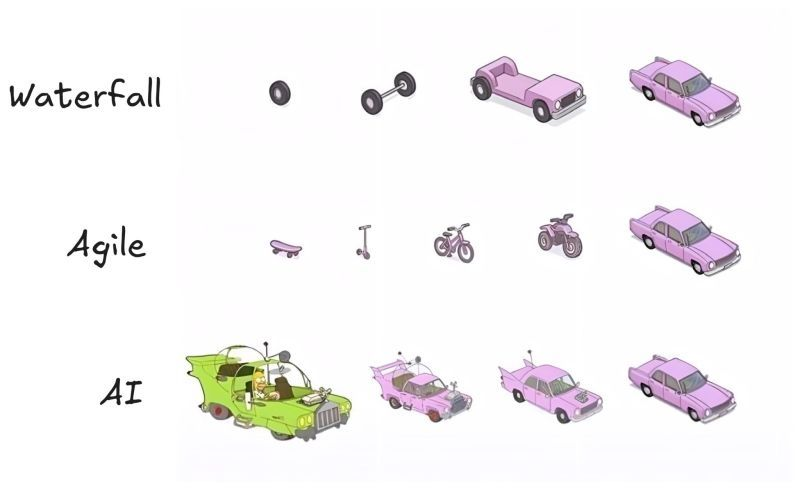
Honestly, this is the most accurate diagram I've seen.
Waterfall: You plan for 18 months and deliver exactly what nobody needs anymore.
Agile: You deliver something usable at every step, but the CEO keeps asking, "Where's the car?"
AI: You get the car on day one. It has six wheels, the doors are on backwards, and it has a rocket launcher. You spend more time making it yours than actually "building"; it's shaping. owning. verifying. That's what the best AI developers do now. They don't build. They shape and own.
New Anthropic research: Emotion concepts and their function in a large language model.
All LLMs sometimes act like they have emotions. But why? We found internal representations of emotion concepts that can drive Claude’s behavior, sometimes in surprising ways.
@anibal Por definición, claro que si, cada usuario termina reinventando una rueda a su medida. Pero el costo de esa reinventarla es casi nulo y el beneficio de la personalización y control es infinito.
Sufficiently advanced agentic coding is essentially machine learning: the engineer sets up the optimization goal as well as some constraints on the search space (the spec and its tests), then an optimization process (coding agents) iterates until the goal is reached.
The result is a blackbox model (the generated codebase): an artifact that performs the task, that you deploy without ever inspecting its internal logic, just as we ignore individual weights in a neural network.
This implies that all classic issues encountered in ML will soon become problems for agentic coding: overfitting to the spec, Clever Hans shortcuts that don't generalize outside the tests, data leakage, concept drift, etc.
I would also ask: what will be the Keras of agentic coding? What will be the optimal set of high-level abstractions that allow humans to steer codebase 'training' with minimal cognitive overhead?
Google and Microsoft just co-authored the spec that turns every website into an API for AI agents. The second-order effects here are massive.
Right now, browser agents work by taking screenshots, parsing the DOM, and guessing which buttons to click. It works about as well as you’d expect. Fragile, expensive, slow. WebMCP replaces all of that with a single browser API: navigator.modelContext. Websites register structured tools directly in client-side JavaScript. The agent reads a menu of available actions, calls them, gets structured data back. No scraping. No backend MCP server in Python or Node. The tools run inside the browser tab and share the user’s existing auth session.
Early benchmarks show ~67% reduction in computational overhead compared to visual agent-browser interactions. Task accuracy around 98%.
The second-order effect is where this gets wild. Today, when a browser agent visits two competing airline sites, it’s guessing at both interfaces equally. Once WebMCP adoption spreads, the site that exposes structured tools gives the agent a clean, reliable path to complete the task. The site that doesn’t forces the agent to fumble through the UI. Agents will prefer the cheaper path. Every time.
This means “Agent Experience Optimization” becomes a real discipline. Tool naming, schema design, description quality. Sound familiar? It’s the same shift that happened when meta descriptions and structured data became optimization surfaces for search engines. Except this time, the traffic source isn’t Google’s crawler. It’s every AI agent on the internet.
Bots already make up 51% of web traffic. Google just gave them a front door.
Daré una charla el próximo 12 de Febrero en el Meetup de Claude Code en Bogotá que organizó @felipeam86 , regístrense y allá nos vemos!
https://t.co/FiMBwNSFT1