Sedina Tamakloe Attionu walks free. Motion for stay of execution struck out as withdrawn
Coram: Sophia Rosetta Bernasko-Essah(Presiding), Dr. Ernest Owusu-Dapaa and Ayitey Armah-Tetteh, JJA
Counsel: Hilda Craig for Applicant
Enoch Deegbe with Sydney Antonio for Respondent
"You cannot say that there is legal vacation, so a judge who is actually sitting and ready to do your case cannot do it. No, that’s not it.”
- Paul Baffoe-Bonnie, Chief Justice of Ghana
#3NewsGH#TV3GH
Below is the law on legal vacations. It does not say that courts are to shut down. As you may see from Rule 4 below, the legal vacation schedule is, by Rule 1(1), subject to the CJ’s decision to give warrants to a judge to work during the vacation.
Now, those seeking to rely on an alleged convention, there are two things we know about what may constitute a convention:
1. The existence of a convention is a question of fact which must be established by evidence of two things, namely, (a) consistent practice, AND (b) opinion juris - that is, the uniform opinion that the practice is binding as law rather than as a preference or convenience.
The practice, as we know it, doesn’t support the existence of such an alleged convention. CJs have consistently, throughout the ages, given vacation warrants to judges who have conducted trials.
2. An alleged convention cannot operate to override an express provision of law. The express provision of law on the matter is Order 79 of CI 47. No law or practice gives a lawyer or our associations the power to determine whether court proceedings should go on during a legal vacation.
If you read nothing at all for 1 month. Read Ebi Bright’s article published yesterday on Centralised Decentralisation.
Well researched. Truly reflective, and Well articulated. And perhaps the most important take on Ghana’s self-inflicted decentralisation struggles in years.
This is something I will recommend a thousand times over for the President. John Dramani Mahama. Those with his WhatsApp number should send it to him.
It’s also a must read for all political actors.
Really good job - Ebi.
https://t.co/GXvb7ikwHm
Shalom
A person is protected by law to share any opinion on a public interest matter provided the basis for opinion is factual
Full decision here=> https://t.co/fG3ftsgQHU
I cut the sod for construction of a new SHS in my beloved Ayawaso West Wuogon. This project will be fully funded by a group of friends and myself. Some cooperate bodies have also started donating sand, cement, stones and iron rods as well as cash. It is my hope this project will be completed in 9 months. Insha Allah. #idey4u
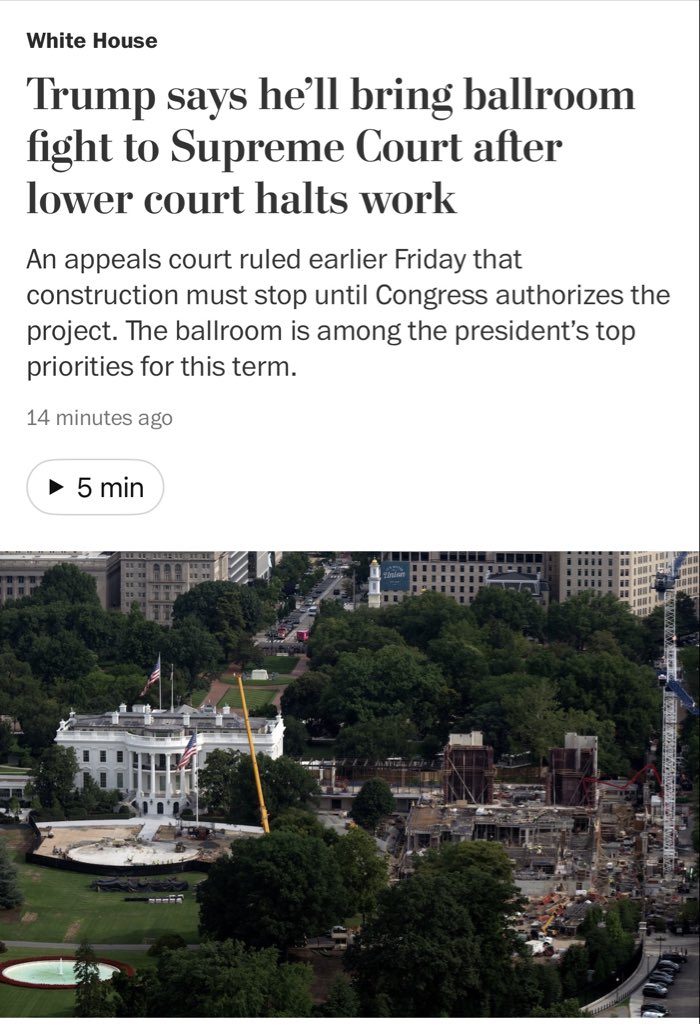
U.S. Court of Appeals has today held that President Trump cannot proceed with his proposed White House ballroom project without congressional approval. The administration has been given fourteen days to seek review before the Supreme Court. Well, a few minutes ago, Trump indicated that he'll bring the fight to the Supreme Court.
To some people, this case is simply about a ballroom. It is not. However, at its core lies an important constitutional question about the distinction between the state and the government. While the two terms are often used interchangeably, Governments are temporary custodians of the state. The state, however, is a continuing constitutional entity that survives every administration. Hence, there has always been the question of how far a government can alter the identity of the state.
For instance, President Trump will occupy the White House for only four years. Other Presidents will succeed him and occupy the same building. The question, therefore, is whether a temporary administration may fundamentally alter a permanent institution of the state without the approval of the constitutional organs that represent the state itself.
Why congressional approval? The answer lies in American constitutional history. The framers regarded Congress as the branch most directly representative of the people and entrusted it with authority over public expenditure, federal property, and major decisions affecting the institutions of government and the State. Structural alterations to one of the nation’s most enduring constitutional symbols, therefore, require more than executive preference; they require legislative authorization.
So, the Court of Appeals was not deciding whether a larger ballroom is a good or bad idea. The court is not made up of architects or interior designers. It was invited to answer a genuine question of constitutional authority.
By its decision, the court has, in essence, reaffirmed a foundational principle of constitutional government: the government of the day administers the state, but it does not own it. A government exercising temporary political power does not carry with it an unfettered power to reshape the state's permanent institutions single-handedly. Where the Constitution assigns that authority elsewhere, the Executive must obtain the necessary constitutional approval before acting.
The Trump legal team now has fourteen days to ask the U.S. Supreme Court to review the decision.
We live to
LIVE | Democracy Under Attack Demostration: NPP will reinstate Gertrude Torkornoo as Chief Justice when it returns to power in 2028 – Minority Leader Alexander Afenyo-Markin
Media personality Paul Adom-Okyere, has been spotted among the protesters at the NPP’s ‘Democracy Under Attack’ demo currently underway.
#3NewsGH#TV3GH
I hate to do this because of the immense respect I have for Godfred Dame, but I have to.
Every lawyer who practises before the Court of Appeal knows that once an appeal is filed, you rarely know the substantive panel that will hear the appeal until the very day it is called for hearing and subsequently adjourned for judgment.
As a result of this practice, interlocutory motions filed during the pendency of an appeal are often heard by different panels, depending on the Court’s composition on the day the motion is scheduled.
So, in Sedinam’s case, the State’s motion to rectify the Record of Appeal was heard by a panel presided over by Justice Mensah-Datsa. That, however, did not mean that this was the substantive panel assigned to determine the appeal itself.
We are perfectly entitled to disagree with the Court of Appeal’s decision. But we should not bend the facts in order to do so.
Godfred Dame says Sedina Tamakloe's appeal was being heard by Court of Appeal judges, presided by Justice Mensah Datsa.
"On 17th June, 2026, a different panel of the Court of Appeal presided over by Ankamah JA, sat on the matter for the first time and adjourned for judgment."
The distrust in the judiciary must not scare only judges and lawyers. It must be of great concern to every Ghanaian.
I can't say that the Court of Appeal, in the Sedinam Tamakloe case, was influenced by politics. But the deep-seated distrust in courts and judges must be addressed.
It must begin with how we appoint and discipline our judges.
Today, the Supreme Court delivered its decision in Noah Adamtey v the Attorney-General. This case challenged the constitutionality of the Office of the Special Prosecutor Act and, in particular, the prosecutorial powers of the Office as against the the constitutional vesting of all prosecutorial powers in the Attorney-General.
The Court held that the Attorney-General is the only person in whom all prosecutorial powers are constitutionally vested. Consequently, every person or institution, including the OSP, that prosecutes criminal offences does so under the authority or authorization of the Attorney-General.
Flowing from this holding, the Court agreed that the Office of the Special Prosecutor is subject to the Attorney-General in the exercise of its prosecutorial functions and that the Attorney-General may enter a nolle prosequi to terminate criminal proceedings commenced by the OSP. In effect, the Court rejected the proposition that the OSP is an independent prosecutorial authority or that the OSP can exercise parallel prosecutorial powers to the Attorney-General.
On the question of whether sections 3 and 4 of the Office of the Special Prosecutor Act, which confer prosecutorial powers on the OSP, are unconstitutional, the Court held that those provisions are constitutional. Meaning the OSP can prosecute within the OSP Act’s framework on the authority of the AG.
The Court further stated that the Attorney-General has the power to revoke the OSP’s prosecutorial authority by amending or repealing the relevant instrument of authorization. Whether the Court regarded the Act itself or a Legislative Instrument as that instrument will only become clear once the full judgment is available.
In effect, the Court held that although the OSP may continue to prosecute criminal offences, its prosecutorial authority remains subject to the constitutional authority of the Attorney-General. More importantly, the Court affirmed that all prosecutorial power ultimately resides in the Attorney-General.
The Court also made consequential orders validating all prosecutions previously undertaken by the OSP.
In summary, the Court granted reliefs (a) and (h) and dismissed the remaining reliefs.