I'm in Denver at #CVPR2026 this week! 🏔️
Together with @WolfStammer, I will be presenting our recent work, Vision-Language Programs, at Poster Session 3 on Saturday ⏰ 11:45 am - 1:45 pm.
Very excited to share our work and discuss the ideas behind it!
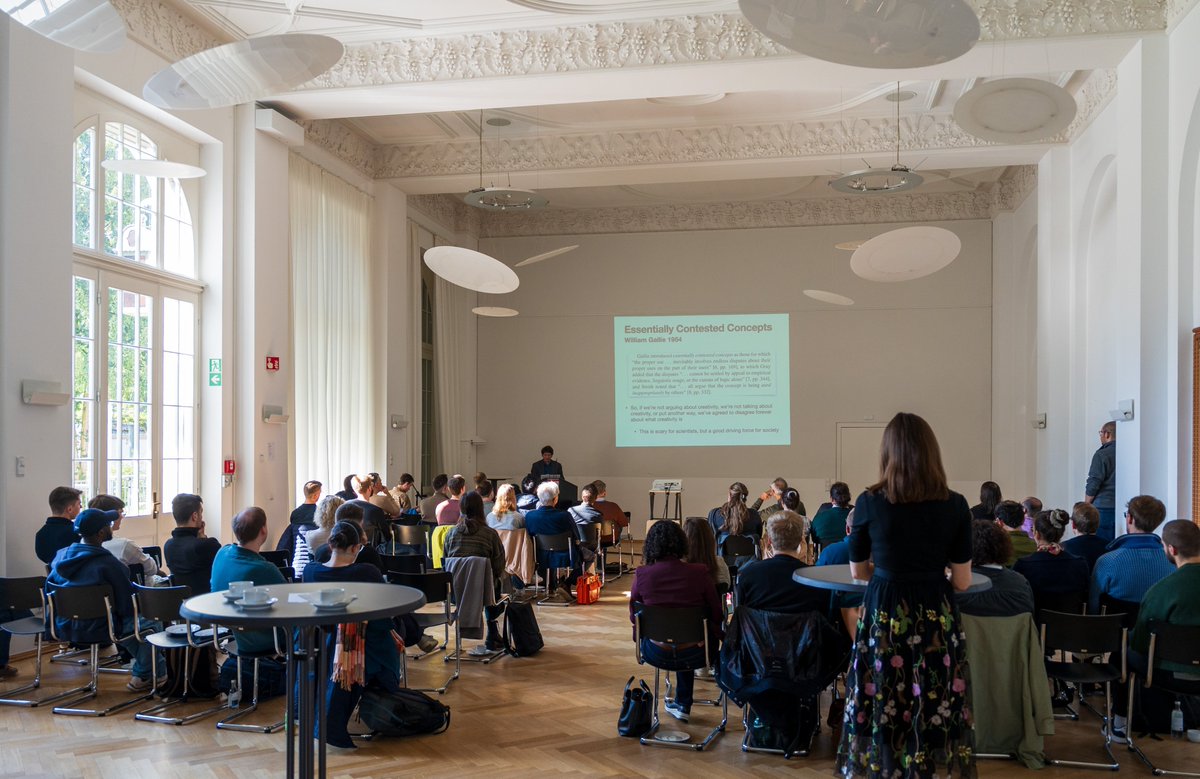
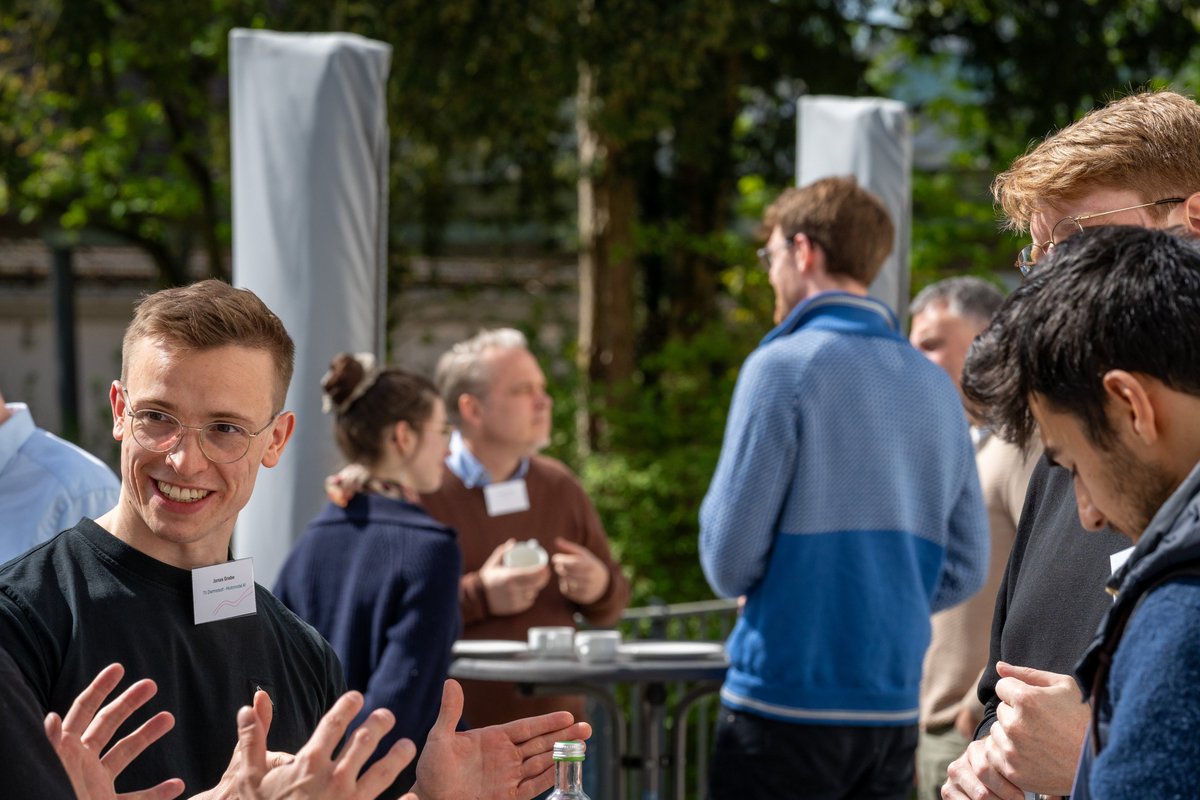
Last week, we hosted the Rhine-Main Universities AI & Creativity Symposium in Darmstadt, and the atmosphere was fantastic! 🧠💻
We gathered researchers from many disciplines to explore the big question: What does it truly mean to be creative, for both humans and machines?
Super exited that our recent work got featured in the Abstract Synthesis podcast! 🚀
I joined Brian to discuss inductive reasoning in the visual domain and how we can combine Vision-Language Models with Program Synthesis to enable more reliable and interpretable reasoning 💡
#NeurIPS2025 has passed, but we hope the celebration will last forever.
Here is a poster presentation we recorded at the event and we hope it can last forever in cyberspace.
Paper: Object Centric Concept Bottlenecks
Thanks for the authors: @Dav_Steinmann, @WolfStammer, @toniwuest, @kerstingAIML
Heading to #NeurIPS2025 in San Diego! ☀️🇺🇸
I’ll be presenting two posters (xLSTM-Mixer + Neural Granger Causality with xLSTMs) + @mkraus_io will give an invited talk on our method xLSTM-Mixer!
Excited to connect—also open to collaborations & internship opportunities 🤝☕
Thrilled to announce our paper, "The Constitutional Filter: Bayesian Estimation of Compliant Agents" ☕️, has been accepted at IEEE IROS 2025! 🚀
In Hangzhou 🇨🇳 for IROS? Come see our talk and visit our poster!
🗓️ When: Tuesday, Oct. 21st
🗣️ Session: Sensor Fusion 2, 13:20-14:00
:coffee: not only improves tracking of agents in regulated environments such as shared traffic spaces, but also estimates their compliance with the rules. CoFi fuses neuro-symbolic reasoning with trust modeling to make predictions more robust, interpretable, and adaptable.
🚀 Tsururu: A New Python Library for Time Series Forecasting (arXiv:2509.15843v1)
Tsururu is an open-source framework for building and comparing forecasting pipelines. Instead of focusing only on models, it emphasizes strategies (recursive, direct, MIMO, hybrid), preprocessing (like its powerful LastKnownNormalizer), and global vs multivariate setups.
Key features:
Mix & match strategies, models (CatBoost, DLinear, TimesNet, PatchTST, GPT4TS, etc.), and preprocessing.
Handles messy, non-aligned series and exogenous features.
Strong evaluation tools: backtesting, rolling validation, cross-validation.
Findings:
Strategy choice matters as much as the model.
The LastKnownNormalizer often beats standard scaling.
Hybrid Rec-MIMO forecasts perform especially well.
👉 Great for researchers, data science teams, and anyone tackling real-world forecasting problems.
xLSTM excels in time series forecasting: https://t.co/DD7sJJhuJK .
Introduces "stochastic xLSTM" (StoxLSTM).
"StoxLSTM consistently outperforms state-of-the-art baselines with better robustness and stronger generalization ability."
TiRex shows that xLSTM is time series king.
Can the new GPT-5 model finally solve Bongard Problems? 👉Not quite yet!
Using our ICML Bongard in Wonderland setup, it solved 64/100 problems - the best score so far! 📈
However, some issues still persist ⬇️
Forecasting Company Fundamentals
Felix Divo, Eric Endress, Kevin Endler, Kristian Kersting, Devendra Singh Dhami.
Action editor: Yan Liu.
https://t.co/q6NDtUbTey
#forecasting#forecasts#stock
📢 New work published in TMLR: Forecasting Company Fundamentals
✅ 24 ML models (stat/statistical + DL + pretrained) benchmarked
✅ DL models (RNNs, Transformers, etc.) beat classics, esp. for uncertainty
✅ Forecasts rival human analysts (!)
A rich playground for applied ML!🌍