In contemporary design culture, objects are often treated as endpoints — functional, aesthetic, or symbolic finishes of human intention. Yet within traditional Chinese visual philosophy, an object is never simply an object. It is a threshold. A carrier. A living container of memory, belief, and imagination.
This perspective does not separate form from spirit. Instead, it binds them.
A bronze vessel is not only a vessel. A piece of embroidery is not only craft. A lattice window is not merely architecture. Each becomes a medium through which time, nature, and human perception continuously flow. In this worldview, material things are not passive; they participate in meaning-making.
Chinese visual culture has long operated through this logic of layered perception. Mountains are not just landscapes — they are cosmological structures. Clouds are not decorative motifs — they are expressions of transition and impermanence. Objects exist in a state of transformation, where the visible surface always gestures toward something invisible.
This idea can be understood as a kind of “inner cosmology of objects.” Form is never final. It is always in dialogue with spirit.
In modern visual language, we often separate the conceptual from the material: ideas belong to thought, while objects belong to production. But traditional aesthetics suggest something more integrated. Meaning is not added to objects after they are made — it is embedded within their making.
To engage with these artifacts today is not only to preserve heritage, but to re-encounter a different way of seeing. A way that does not ask what an object is, but what it holds.
Because in this system of thought, things do not merely exist.
They carry spirit.
@midjourney
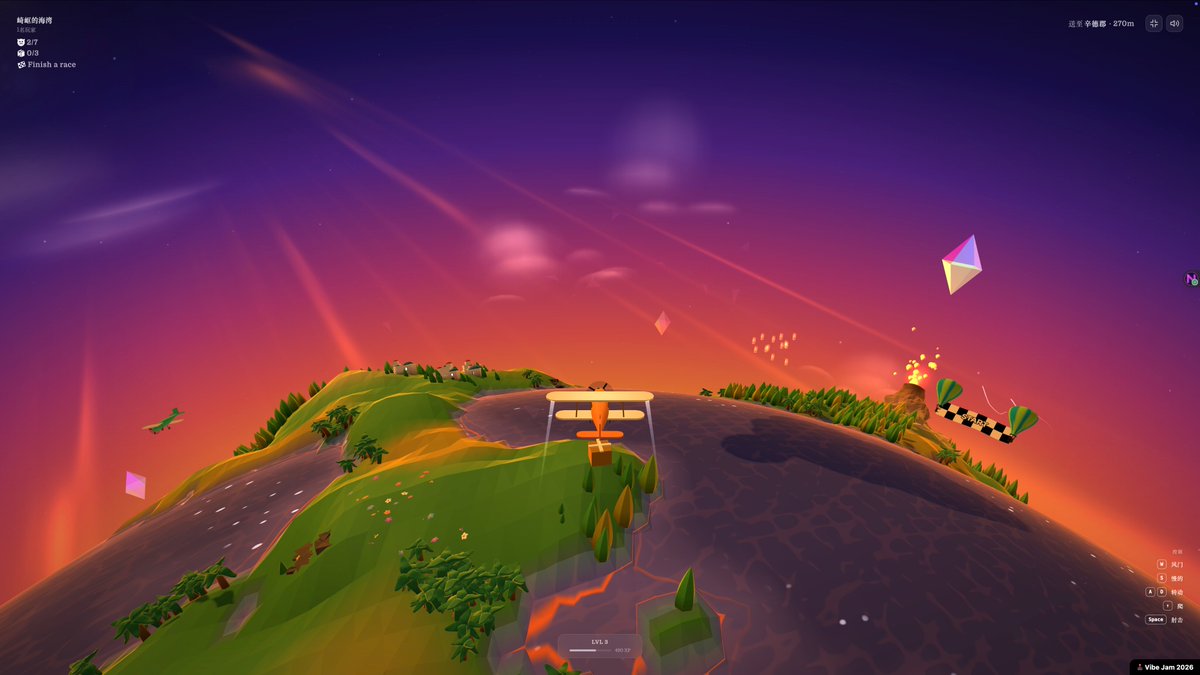
Danny, the game is so much fun! It's my first time playing, and it's raining in Shanghai today, which is perfect timing.
The mornings and evenings are beautiful. I'm already level 4, and I'll keep exploring.
I also really like low-poly games; I've made similar ones.
This game is fantastic.
I created a set of space science posters with GPT: Earth, the Moon, the Sun, and Mars.
Instead of making science look like a plain textbook page, I wanted to turn astronomy facts into something more visual, warm, and memorable.
Earth becomes the blue home of life.
The Moon becomes Earth’s quiet companion of tides and night.
The Sun becomes the star that lights planets and life.
Mars becomes the red world of dust, stone, and exploration.
The idea was simple:
take scientific information, break it into icons, keywords, surface features, orbit data, and bilingual labels, then rebuild it through folk-art patterns, dotted textures, decorative borders, and infographic layout.
From a distance, they look like art posters.
Up close, they still carry real science.
For me, this is the exciting part of GPT:
it does not just generate images.
It helps turn knowledge into something people actually want to look at, read, and share.