At @HutongChina we put together an infographic on the various reforms the Third Plenum Resolution proposed, highlighting how they could work together with each other and existing policies to rebalance China's central-local fiscal dynamics. This is an impactful set of reforms that will have long-lasting effects on China's economy, which the market has not yet fully appreciated. To learn more about Hutong's service offerings: https://t.co/9I1dJhpd5q
One of the most convenient political narratives in the US and Europe is to attribute China’s export competitiveness entirely to “overcapacity created by state subsidies,” arguing that Chinese products enjoy an unfair pricing advantage that crowds out Western competitors.
It is a useful narrative because it shifts attention away from domestic policy failures, industrial underperformance, and years of complacency built on technological and market advantages established decades ago. It is also a narrative that can be easily sold to voters.
Even if the EU proceeds with a major escalation in trade measures against China and erects significantly higher barriers to Chinese imports, it will not solve Europe’s underlying challenges. China’s competitive edge today is no longer primarily about low-cost manufacturing or weak intellectual property protection.
Having spent years conducting research in China and speaking directly with entrepreneurs and business leaders, what stands out to me is something much deeper. Many Chinese entrepreneurs—including those born in the 1990s—retain a remarkably vivid memory of what poverty looks like. There is a powerful determination, both personal and national, to avoid returning to that condition. This drive, in my view, is one of the most underappreciated sources of China’s innovation capacity.
China’s policy environment has also produced a uniquely apolitical form of entrepreneurship. In the West, once entrepreneurs achieve a major technological breakthrough, they often devote substantial resources to lobbying, shaping regulation, or supporting favorable political candidates in order to preserve their competitive advantages. While understandable, this can also breed complacency and reduce the urgency of continued innovation.
Chinese entrepreneurs operate under a different set of incentives. Rather than relying on regulatory protection, they often seek to reduce risk through relentless innovation, diversification, and constant reinvention. Breakthrough innovation becomes a hedge against uncertainty. This dynamic is particularly visible among serial entrepreneurs, whose movement across industries and technologies creates a powerful cross-pollination effect that has contributed to some of China’s most significant leapfrog innovations.
This does not mean Chinese industrial policy is irrelevant. It means that focusing exclusively on subsidies misses the more important story: the cultural, historical, and institutional forces that continue to drive China's capacity to innovate and compete.
China does not approach the US-China relationship primarily through the lens of “who has the upper hand” or “who holds more leverage.” For Beijing, the central objective of a leadership summit is to project stability and predictability, establish the overarching trajectory of the relationship, and strengthen or institutionalize guardrails that reduce the risk of uncontrolled escalation.
This time, Beijing’s “Moby Dick” is likely an extension of the trade truce through the remainder of Trump’s term, accompanied by greater clarity and stability around the overall tariff regime. Equally important is securing confidence that no sudden escalatory measures—such as the BIS “50% Affiliates Rule” introduced last September—will unexpectedly emerge from different parts of the US government without prior signaling or coordination.
Both sides already understand where their respective leverage lies, and neither needs to repeatedly “test” the relationship through coercive measures to prove the point. From Beijing’s perspective, constantly exercising leverage is counterproductive if it undermines the stable external environment China needs for its ongoing economic transformation. What China ultimately seeks is not a perpetual contest of leverage, but a sufficiently predictable framework in which tariff levels remain broadly stable and the risk of strategic “foul play” is reduced.
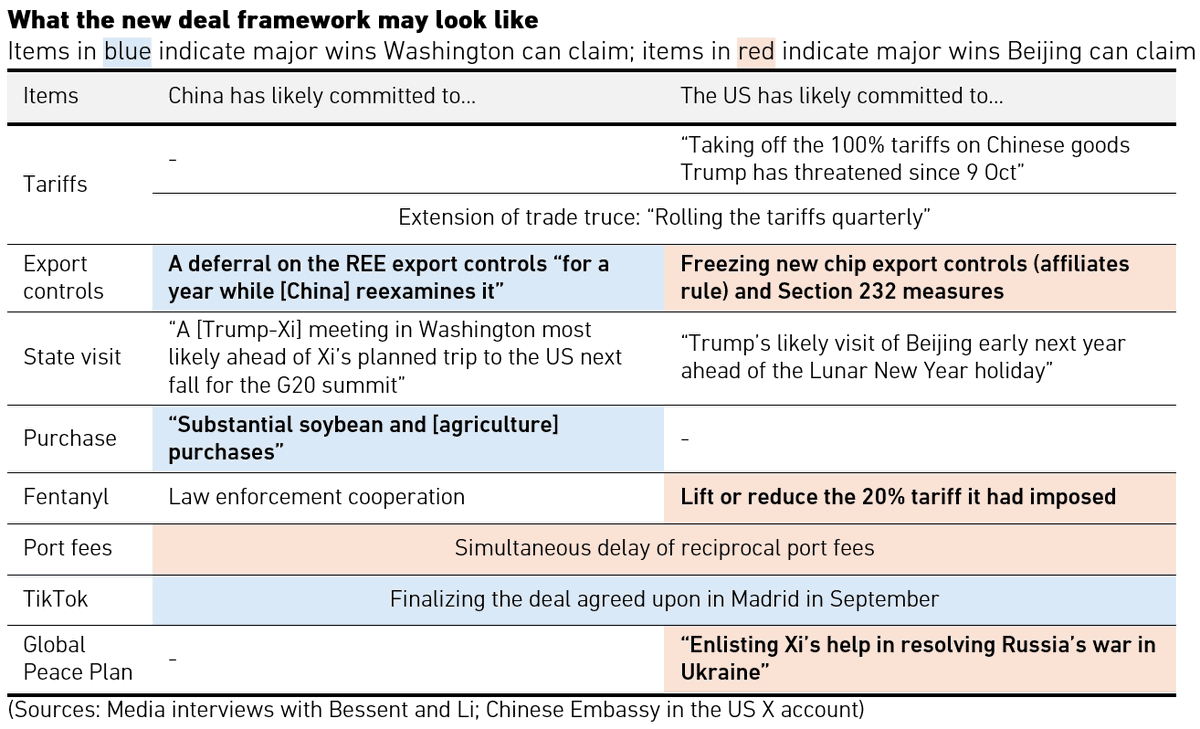
The table below is what we sent to clients on Monday, right after the Kuala Lumpur trade talks. The final deal confirmed by Chinese and US leaders today aligns almost exactly with what we assessed negotiators had already settled.
In effect, both sides just took a time machine back to the pre–September 29 status quo. On top of that, Beijing managed to extract something it had repeatedly sought but Washington had resisted—a 10% tariff cut tied to fentanyl enforcement.
This outcome underscores the potency of China’s rare-earth export controls. They demonstrated an ability to disrupt US defense production and, by extension, carry implications for dollar credibility—the core pillar of Trump’s reindustrialization agenda. It took a real-world demonstration for Washington to internalize this.
For Beijing, this episode will reinforce confidence in the strategy of industrial resilience—an agenda featured prominently in the Recommendations for the 15th Five-Year Plan endorsed at the Fourth Plenum.
From Beijing's perspective, the BIS's September 29 rule expansion—targeting subsidiaries of Chinese firms on the Entity List—represents the most significant unilateral escalation in recent years. Yet, the U.S. seems to downplay it as a "non-event," either unintentionally or deliberately. This narrative, which portrays China as overreacting or escalating unnecessarily, only hardens positions on both sides, making de-escalation increasingly difficult.
How Beijing interprets the rule: On paper, it's a harmonization effort to close loopholes, preventing Entity-Listed Chinese firms from using foreign subsidiaries to smuggle chips and controlled technologies back home. In practice, however, it severely hampers these firms' international expansion. Previously, they could establish overseas operations with entirely separate supply chains incorporating U.S. tech to serve global markets. Now, that's virtually impossible.
This isn't merely a defensive measure—it's a competitive one, tilting the playing field and aligning proactively with the Trump administration's latest AI Action Plan, which aims to solidify U.S. supremacy in global AI competition.
#USChinaRelations #TechPolicy #Geopolitics
Once again… In China the appointment and dismissal of officials take place in two phases. There is the actually personnel change, and then there is the on-the-paper formalities. Li Chenggang already left his old post as China’s ambassador to WTO in March, when he was promoted to become China’s international trade representative, a job half level above the ambassador to WTO role. The announcement of his WTO role dismissal yesterday was merely a procedural formality.
The fact that a routine dismissal following exactly the same procedure that has been in practice for years has been repackaged into some kind of "BIG NEWS" just shows how ignorant some have become (or may has always been) on China's political process, cherry-picking datapoints and misinterpreting them to fit in a biased understanding.
This morning, Beijing time 1020am, Xinhua News reported that President Xi Jinping has signed off on dismissing Li Chenggang from the role of China's ambassador to the WTO and UN Geneva. Li Yongjie, former MOFCOM deputy international trade representative until the end of June 2025, was appointed to replace Li Chenggang in the same announcement.
This was immediately interpreted by some as China bowing down to Bessent, who has singled out Li Chenggang as "hostile" in his latest attack on China in the recent escalation of trade tensions. However, what in fact happened was:
1. Li Chenggang was promoted to become MOFCOM international trade negotiator--a full-ministerial role--in April at the onset of the trade war with the US, and had returned to Beijing from Geneva to lead China's trade negotiation. China's ambassador to the WTO and UN Geneva is a vice-ministerial-rank job, half a level below the international trade negotiator in administrative rank.
2. His replacement, Li Yongjie, was most certainly chosen before the end of June, when Li Yongjie was dismissed as deputy international trade negotiator.
3. China's appointments of ambassadors take place in cohorts. It is the standard practice that multiple ambassadors are appointed/dismissed. Just today, Beijing appointed a total of SEVEN ambassadors, including Li Yongjie, and dismissed their predecessors, including Li Chenggang, from their previous ambassadorial roles in the same announcement.
4. In short, these latest dismissals and appointments are just routine practice Beijing has been following for years on its own, fixed schedule. It has nothing to do with how the US has been singling out a full minister for its own, could-be tactical purposes in trade negotiations.
5. This reminds me of the balloongate of 2023, when many misinterpreted the dismissal of then-China Meteorological Administration head Zhuang Guotai as Beijing scapegoating him. Zhuang, in fact, was promoted to become a full-ministerial chairman at Gansu CPPCC days before that dismissal. State Council dismissals and appointments, unfortunately, to the disadvantage of self-claimed China watchers, also happen in cohorts.
A more comprehensive view on the latest escalation of trade tensions between China and the US, as a potential mismatch in the assessment of oneself and the other side's respective vulnerability is emerging:
1. The design of Beijing’s 9 Oct retaliation indicates that China aims to establish a structured negotiation frame centered on reciprocal chokepoints between Chinese REEs and US Chips.
2. China’s underlying assumption is that it can withstand a temporary ceiling on chip imports. By contrast, from Beijing’s perspective, the US has no viable substitute for mid- and heavy-rare earth supply, creating what Beijing sees as a near-term leverage asymmetry in its favor.
3. Washington, however, appears to be operating from a very different approach. Bessent has repeatedly articulated the view since April that China’s economy is structurally fragile, dangerously imbalanced, and at risk of tipping into systemic crisis. The underlying assumption is that China will be forced to reverse its rare earth bans before any meaningful disruption hits US supply chains, as tariff-resulted economic stress push Beijing toward breaking points.
4. This line of reasoning applies Western orthodoxy to China’s political economy without fully integrating Beijing’s ongoing transition and the endogenous resilience mechanisms built into its policy playbook.
5. If Bessent and Greer are indeed anchoring their strategy in the expectation of economic fragility as China’s primary point of vulnerability, the next escalation step from the US could potentially be pressure on China’s financial system to accelerate economic strain and force a policy reversal for Beijing. Any move in that direction would almost certainly trigger a retaliatory response of significantly higher magnitude.
6. A more serious risk embedded in this perception is political: Long-standing China hawks in Washington—now becoming vindictive due to Beijing’s retaliatory measures, which they most certainly view as "massively escalatory" and "overreaching"—could use the narrative of China’s economic weakness to lobby for even greater pressure beyond the economic realm. This could include attempts to force concessions on geopolitical fronts. This would widen the overall scope and unpredictability of escalation.
If Bessent’s view reflects what he actually believes about US leverage, then we’re probably looking at a fundamental asymmetry in how both sides assess their respective vulnerabilities. Beijing has been framing its latest tactic as “rare earth supply shock vs. incremental chip controls,” convinced it can absorb the latter better than Washington can absorb the former.
Bessent, by contrast, seems to be betting on “China’s economic collapse vs. rare earth shock,” believing Beijing will blink first to avoid catastrophe and reopen REE exports. That could be a) a profound misread of China's economic reality and b) a total miscalculation of how Beijing prices pain and leverage.
Sino American economic relations have gotten testy. Bessent is arguing that China's export controls are a sign of weakness: "This is a sign of how weak their economy is, and they want to pull everybody else down with them." & the talks this summer weren't easy!
If Bessent genuinely believes Xi wasn’t looped in, that’s not just a miscalculation—it’s a fundamental misread of Beijing. A rare earth ban of this scale could not have moved without Xi’s explicit sign-off. Nothing that sweeping happens without his greenlight.
And this line about China’s economy being “too weak” or “imbalanced” has been Bessent’s talking point since April. It’s another dangerously misleading perception—one that risks blinding Washington to how Beijing actually calibrates leverage.
The latest round of trade escalation between the US and China is the result of serious miscalculation by the US—Beijing takes BIS’s 29 September rule expansion as a unilateral provocation.
1. The Geneva, London, and Stockholm talks were primarily about testing boundaries and guardrails between the US and China. By July, a fragile equilibrium had formed: China continued supplying REEs on the existing level; the US froze tariffs at the current level.
2. That equilibrium was solidified during the Madrid talks in September, when negotiators quickly agreed on a framework for the potential sale of TikTok US. While TikTok US was never central to the trade negotiations, approving its sale under agreed conditions was a major concession from Beijing to deliver a high-visibility win that Trump desires, signaling willingness to move on secondary issues in exchange for stability ahead of a leadership-level summit.
3. By the end of Madrid, both sides appeared aligned in avoiding new unilateral measures ahead of the proposed late October Xi-Trump meeting. The assumption was that only a leader-to-leader session could unlock a broader settlement, given especially Trump’s preference for personalistic diplomacy over technocratic negotiation tracks.
This implicit understanding was made explicit in China’s readout of the 19 September Xi-Trump phone call, where Xi warned against unilateral moves that could undermine “the results of multiple rounds of talks.” From Beijing’s perspective, BIS’s 29 September rule expansion was a direct violation of that warning—a unilateral escalation just 10 days after Xi framed stability as a condition for a summit.
4. Beyond BIS’s September rule, Beijing is also likely treating the USTR decision imposing port-entry charges on Chinese-built or Chinese-operated vessels—scheduled to take effect on 14 October—as another pending unilateral measure that should have been suspended after the 19 September Xi-Trump call. The fact that Washington is pressing ahead this Tuesday will reinforce Beijing’s perception that the US is acting in bad faith.
5. From Beijing’s perspective, these actions are not only substantive escalations but further confirmation of low credibility of the Trump administration. Beijing is effectively reactivating its April playbook—escalating first to force a negotiation reset, rather than waiting passively for the next talks.
6. Beijing’s underlying logic is straightforward: The US is more vulnerable to a rare earth supply shock than China is to incremental export controls on semiconductors. In recent weeks, Chinese policymakers have sent increasingly clear signals that they are prepared to accelerate domestic semiconductor supply chain development at all cost, even if it means absorbing short-term inefficiencies. This gives Beijing confidence that rare earth leverage is more decisive than chip export pressure. In a negotiation setting, it will likely seek a deep tariff cut in exchange for stable REE flows.
Beijing wouldn’t have hit back on Oct 9 if BIS hadn’t moved on Sept 29 to apply the “Affiliates/50% Rule” to the Entity List & MEU List. Washington may see it as routine regulatory harmonization — Beijing reads it as escalation. That’s why China’s latest measures mirror the US toolkit: a 0.1% rule (FDPR logic) and a 50% rule (BIS affiliate rule).
This is the new reality of US-China relations. China has spent the past several years building tools to reciprocate US actions and remind the US of its leverage. This action is consistent with PRC behavior all year - hold firm, hit US where it hurts, leave door open to negotiate.
I'm not particularly enthusiastic about China's new "AI+" strategy. For one thing, it may be misleading to compare it to the "Internet+" strategy launched a decade ago. The "Internet+" strategy document from 2015 was three times as long and much more detailed than the "AI+" paper released this week, suggesting that Beijing had a far more comprehensive plan—and much stronger confidence in it—back then, compared to where it stands now on AI. For another, Beijing remains concerned about the downsides of AI for social stability, especially amid unprecedented employment pressures facing China in the decade ahead (new births in the country peaked in 2016, meaning the number of college graduates will continue to rise until around 2038). The bottom line: Beijing is now adopting "AI+" as a key pillar of its national strategy but appears less certain about where the technology may lead next.
The outcome of the US-China meeting in Geneva has effectively invalidated the political and economic logic behind the Trump administration’s so-called “Liberation Day” reciprocal tariffs announced on April 2. Had Trump ignored Peter Navarro and opted for a 10% tariff as a starting point for broader trade negotiations, the US might have avoided the chaos it finds itself in today. A full month of excessive tariffs—now partially rolled back—has come at the cost of US credibility.
Today’s development also reveals the administration’s deeper concern: supply shortages. American consumers have never faced empty shelves, and Trump has made clear he doesn’t intend to be the first president held responsible for one. That said, what unfolds over the next 90 days will hinge not just on trade talks, but on negotiations over issues like fentanyl, critical minerals, semiconductors, and AI. It's going to be an uphill battle for both sides as they try to find new guardrails of the bilateral relationship.
Thoughts on US-China trade negotiation: In Beijing, trade negotiations typically begin at the working level, with vice ministers conducting multiple rounds of technical discussions to lay the groundwork before senior leaders step in. In Washington, however, policy is increasingly driven from the top down, with president Trump insisting that substantive progress can only follow a direct engagement with president Xi, from whom Trump has been expecting a request for a call for days. This disconnect—China’s preference for a bottom-up process versus Trump’s top-down approach—is precisely what’s stalling real progress, if there's any.