Disgusting. Every tragedy in Bangladesh becomes a business opportunity. Selling water for 500 tk during crises? From the airport fire to the Milestone tragedy — greed has replaced humanity.
#Bangladesh#Business#Humanity#Tragedy#Fire#Airport
Bangladesh sees Gaza — and remembers 1971.
“From Dhaka to Gaza” isn’t a slogan. It’s a shared scar — the same silence, the same erasure, the same suffering, replayed live.
✍️ Our Shared Scar: From Dhaka to Gaza
🔗 https://t.co/xA6Ch1nTPD
#Bangladesh#Palestine#Gaza#genocide
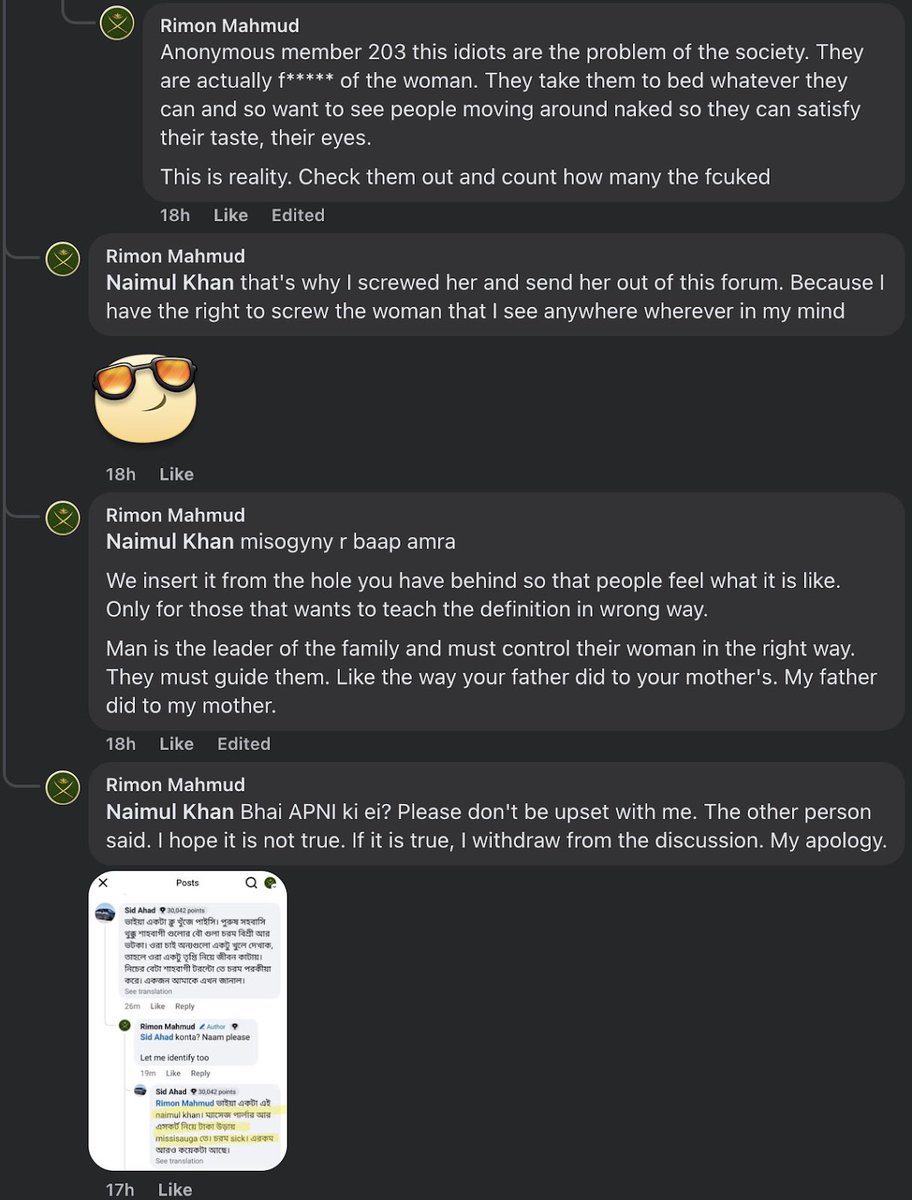
Openly admitting not having the right to privacy. It violates the right to privacy on Facebook.
@Meta are you going to take any action against this group and person?
US Gender Reveal Party Results:
Drumroll, please... 🥁
And the big reveal is... It's a boy!! 🎉
He's coming in with all the flair and drama of a reality TV season finale. Get ready for a term filled with endless tweets, big suits, and a good dose of eyebrow-raising moments! Whether you're team "Let's Make America a Rom-Com" or "Back to the 80s Vibes," buckle up - the next four years are going to be quite the show!
#USAElection2024 #Trump2024 #Harris
I’m excited to share my first op-ed with the world, and I couldn't think of a more critical topic to address. “The Mob Rules in Post-Hasina Bangladesh: Where Are Our Protectors?” dives deep into the unsettling chaos that has gripped Bangladesh since Sheikh Hasina’s departure. With protests turning violent and the nation at a crossroads, who will step up to restore order? More disturbingly, is this unrest being manipulated by forces hoping to exploit the instability? I invite you to read my article on The Bangladeshi Voice and join the conversation. This is just the beginning of the discussion we must have.
Read the full article here.
https://t.co/1l0i7UQw0W
The Ministry of Defence in Bangladesh must be separated from the Prime Minister’s Office to ensure our nation's defense is managed with the accountability, expertise, and strategic focus it deserves. The tragic events of the 2009 BDR Massacre starkly reveal the consequences of a centralized, politically-driven control over military affairs. The loss of lives and the disorganized response to the crisis demonstrated that while civilian oversight of the military is essential, it requires the support of a leader with direct military experience to be truly effective.
Allowing the Prime Minister to simultaneously serve as the Defence Minister concentrates power in a way that undermines the necessary checks and balances. A Prime Minister’s political mindset, while valuable in governance, is often not aligned with the tactical and strategic needs of military operations. The complexities and demands of defense require a leader who has not only studied military theory but has lived it—someone who can anticipate potential crises and respond with the precision and decisiveness that only comes from experience in the Armed Forces.
Consider the difference in decision-making speed and efficacy during critical moments. In both the BDR Massacre and the Holy Artisan attack, delays in action due to the need for political clearance cost precious time and, tragically, lives. During a national crisis, the armed forces must be able to act swiftly and decisively. When every second counts, waiting for political approval can be the difference between life and death.
This is why the Ministry of Defence should be led by someone with a military background who understands the urgency of such situations and can make informed decisions without the delays that come from bureaucratic or political considerations. While the Prime Minister can and should maintain oversight by having the Ministry report to the PMO, the day-to-day management and critical decision-making should be entrusted to a Defence Minister with military experience.
In times of national crisis, the armed forces should have the autonomy to act immediately to protect the nation and its citizens, rather than waiting for political directives. This separation is not just about improving efficiency; it's about ensuring that Bangladesh's defense is managed by those who are best equipped to do so, preventing the kind of mismanagement and tragedy we witnessed in 2009 and 2016.
Therefore, it is imperative that Bangladesh's Ministry of Defence operates independently of direct political control, with leadership that is not only knowledgeable but also experienced in the realities of military command and crisis management. This is a critical step towards safeguarding our nation’s security and ensuring that our armed forces can act swiftly and effectively when the nation needs them most.
#Bangladesh #ArmedForces #primeminister #nationalcrisis
India's Sinister Betrayal: Sacrificing the Northeast's Hindus for Strategic Gains
Assam Rifles, a paramilitary unit supposedly tasked with maintaining order, has been actively aiding Kuki militants—a Christian group bent on terrorizing the native Meitei population in Manipur. This is not just an oversight or an isolated incident; it's a calculated strategy by India to sacrifice its own Hindu population, especially those in the Northeast and Bangladesh, for broader geopolitical gains.
India's central government has always treated Hindus from these regions as expendable pawns, using them when convenient for strategic objectives. Once those objectives are met, these communities are discarded, abandoned, or worse—systematically wiped out. This callous disregard for the lives and traditions of Hindu and animist populations exposes the true nature of India's priorities: power and control at any cost, even if it means betraying its own people.
Sheikh Hasina should keep quiet while she's in India. If she’s stirring unrest in Bangladesh from Indian soil, it will bring severe repercussions for India.
By giving shelter to Sheikh Hasina, India is no different from Pakistan, which harboured Osama Bin Laden. This is unacceptable, and India will undoubtedly face significant consequences. Every move by India is being closely watched—whether it's hosting a murderer like Hasina, opening dam gates, or shooting a 13-year-old Hindu girl. This is the reality of what India has become under Modi’s government.
The Modi administration has successfully ruined India's relationship with its closest neighbour, not to mention its standing with other South Asian nations.
#BDOSINT #Diplomacy #BangladeshIndiaRelations #Modi #SheikhHasina
**Unmasking Lt Col Syed Kamruzzaman: The Untold Story of a Man Shrouded in Shadows**
For 15 years, Lt Col Syed Kamruzzaman (KMZ) has been an enigma—his narrative shifting like quicksand. As a key figure in the 44 Battalion’s Signal branch during the 2009 BDR massacre, his actions have only fueled suspicion. Despite the bloodshed and the tragic loss of so many, KMZ has never once attended a Shaheed Families Milad, nor has he stood by the grieving families, said by many shaheed family members. His absence from these crucial moments speaks volumes, but his sudden reappearance after the ousting of Former Prime Minister Sheikh Hasina, one of the masterminds behind the BDR carnage, is even more perplexing.
On August 7, 2024, KMZ broke his silence in a press conference, but rather than providing clarity, he raised more questions than answers. One of the Shaheed Families children posed a crucial question: Were the so-called BDR “rebels” actually “mercenaries” hired from outside? If so, why did these mercenaries—who allegedly tried to kill him multiple times—let him walk away without a single scratch? Why were they so sympathetic towards him?
What’s more disturbing is the eerie isolation surrounding KMZ. His course mates have cut all ties with him, and he is conspicuously absent from any army events. He’s even banned from Cantonment. Yet, despite being unwelcome, he continues to thrust himself into the public eye, shamelessly attending press conferences where his presence is not only unnecessary but also deeply suspect.
On September 5, 2024, a bombshell was dropped during a press conference by former army personnel involved in the BDR massacre investigation. They revealed that the 44 Battalion, to which KMZ belonged, was deeply implicated in the massacre. This revelation casts a dark shadow over KMZ’s past, suggesting that he may have had a hand in the carnage (this is an opinion, not yet proven).
So why now, after 15 years of silence and exile, does KMZ emerge from the shadows? Is it survivor’s guilt that compels him, or is there something more sinister at play? Is he trying to suppress the full truth from being revealed by those who suffered the most? Could he still be a government liaison, operating under the radar?
These are the burning questions that demand answers—answers that can no longer be avoided. The time has come to expose the truth and hold those responsible accountable. The families of the fallen deserve nothing less.
Photo source: channel I
#Bangladesh #India #BDRMassacre #WeWantJusticeRightNow #RAW
India has lost Bangladesh. Despite India's crucial military intervention at the end of 1971 that ensured first the defeat of the Pakistan military after a nine month war, and then the independence of the country, there has for some time been a significant anti-India feeling in Bangladesh that waxed that waned depending on the political situation in both countries.
The irritation/anger perhaps started when Indian products flooded the Bangladesh market in 1972, impacting upon Bangladesh's manufacturing industry devestated during the war. And as years went on there was always the sense that India being an overly influential big country neighbour. In addition there was perhaps a communal element to the anger, with India being a dominant Hindu nation, whilst Bangladesh, a muslim one.
However, the Indian government's total and criticual support for the Awami League in recent years, irrespective of lack of free and fair elections, terrible human rights record and increasing authoritarianism - along with India prime minister's Modi's anti-muslim rhetoric - had in recently years ratcheted up the the anger towards India. And, it was the Indian government's continued support for the Awami League even after the law enforcement killings started on July 16 which was the nail in the coffin. It will take many many years before the Indian government can come back from this.
BREAKING NEWS 🚨🚨🚨
Indian BSF fails to cut the dam of Bollamukhar Canal at the zero line in the Nij Kalikapur Border Area of Parshuram, Feni due to intervention of the Border Guard Bangladesh (BGB) and the local residents. Five blank fires by BSF have been reported.
I hope BGB don't waste their ammo by firing blanks. If they have to shoot, do it in the right way.
#India #BSF #BangladeshFlood2024 #BGB #Bangladesh
𝐀𝐧 𝐨𝐩𝐞𝐧 𝐥𝐞𝐭𝐭𝐞𝐫 𝐟𝐫𝐨𝐦 𝐚 𝐋𝐢𝐞𝐮𝐭𝐞𝐧𝐚𝐧𝐭 𝐂𝐨𝐥𝐨𝐧𝐞𝐥 𝐨𝐟 𝐁𝐚𝐧𝐠𝐥𝐚𝐝𝐞𝐬𝐡 𝐀𝐫𝐦𝐲 𝐭𝐨 𝐆𝐞𝐧𝐞𝐫𝐚𝐥 𝐖𝐚𝐪𝐚𝐫-𝐮𝐳-𝐙𝐚𝐦𝐚𝐧, 𝐂𝐡𝐢𝐞𝐟 𝐨𝐟 𝐀𝐫𝐦𝐲 𝐒𝐭𝐚𝐟𝐟:
"Respected Chief of Army Staff,
You are a gentleman and a person of integrity. In this time of national crisis, you have stood by the people despite being a relative of Sheikh Hasina. Under your leadership, the army has regained the lost trust and love of the people. It is also widely known that several disgruntle and power-hungry officers in the army have supported the fascist government of Awamileague over the last 16 years by holding key positions in RAB, DGFI, NSI, and the Ministry of Foreign Affairs.
Therefore, questions have been raised in the minds of many officers of my rank regarding the army's overall position:
1. Why did the army not stand by the common people when deployed on July 20, 2024? If we acted earlier, so many lives would not have been lost. On August 5, did you declare solidarity with the people under pressure from junior officers and soldiers?
2. Was it unknown to our ASU/DGFI/MI that Major General Ziaul Ahsan is a murderer before August 5? If they were unaware, how did they gather tons of info about him within a day? And if they knew, how did this murderer rise to the rank of a two-star general?
3. There are many more such officers in the army who were directly involved with murder-enforced disappearance. We know them, yet your stance on them remains unclear. If it were clear, officers like Lt Gen Mujib and Lt Gen Tabrez Shams would have stayed with Ziaul Ahsan now in police custody.
4. You have now asked officers to remain united, which is very good. But Sir, in the past 15 years, when many bright officers were labeled as 'BNP-Jamaat-anti-liberation forces' skilled officers were deprived of promotion, wasn't the need for unity greater then?
5. There are at least 70 extremely corrupt and murderous officers like Ziaul Ahsan in the army. Do you believe that dismissing once officer from service completes the army's reform? What will happen to the rest? What decisions will be made about those who have retired with full pensions and benefits?
6. Why is your position still unclear regarding those who have been deprived and oppressed in the army for so many years by senior officers like Akbar, Mujib, Ziaul Ahsan, Saiful Alam, and Tabrez Shams?
7. Brigadier Azmi has been detained in the 'Aynaghar' for over 8 years, he as a brilliant-decorated army officer. Were you not aware of his such ordeal? How will you return the lost years to Brigadier Azmi, and have you questioned those responsible for his detention (Tabrez Shams, Saiful Alam)?
8. It is time to inform the nation about who and which organizations were involved in the horrific massacre at Pilkhana on February 25, 2009. Have you considered when you will disclose this information?
Thank you Sir."
A group of Bangladeshi hackers claimed to have hacked the @ZEECorporate website. They communicated with me, stating that the #ZeeMedia-owned Bengali channel made derogatory comments about the recent flood situation in Bangladesh. As a consequence, they responded this way.
If the Hasina regime could deploy helicopters to fire on students and innocent citizens without hesitation, why can't the interim government, led by Dr. Yunus, use the same resources to rescue the people of Feni, Cumilla, and Noakhali? The looming threat in Chittagong makes the situation even more urgent. This crisis isn't just an environmental or climatic disaster—it's a political weapon. India seems to be wielding water as a tool of retribution, punishing Bangladesh for ousting their preferred leader, Sheikh Hasina, who had been complicit in turning the nation into their future colony.
#BangladeshCrisis #FloodInBangladesh #india #Dhaka #PrayForBangladesh #Bangladesh #Teesta
Picture credit: from a young artist, unfortunately I don’t know her name.
Breaking News 🚨🚨🚨
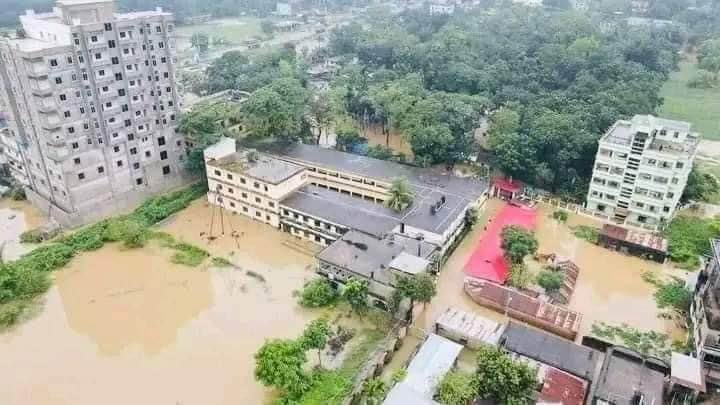
Is India Weaponizing Water Against Bangladesh? The Ongoing Flood Crisis in Feni, Noakhali, and Comilla
The flood situation in Bangladesh's Feni, Noakhali, and Comilla districts has reached critical levels, with water in the Muhuri River surpassing a 41-year record. The trigger? India’s sudden decision to open the gates of the Dumbo Hydroelectric Power Project in Tripura—a move not seen since 1993.
This isn’t the first time India's water policies have left Bangladesh reeling. The Farakka Dam has long been a geopolitical flashpoint, with India holding the keys to the floodgates. When Bangladesh desperately needs water, India keeps the taps closed. But when heavy rains strike, they release a deluge, causing devastation downstream in Bangladesh. Crops are destroyed, lives upended, and the question looms—why?
Is this just an unfortunate consequence of geography and climate? Or is there something more sinister at play? Could India be using water as a tool of retribution, punishing Bangladesh for political shifts, particularly the ousting of Sheikh Hasina, India’s preferred ally? Is water now a weapon in the complex dance of regional politics?
The people of Bangladesh are paying the price—caught between the whims of nature and the machinations of power. How long will this go on? Is it time to rethink our approach to Indo-Bangladeshi water-sharing agreements before more lives and livelihoods are washed away?
#BangladeshFloods #India #WaterWars #Geopolitics #FarakkaDam #Bangladesh #Modi #Hasina