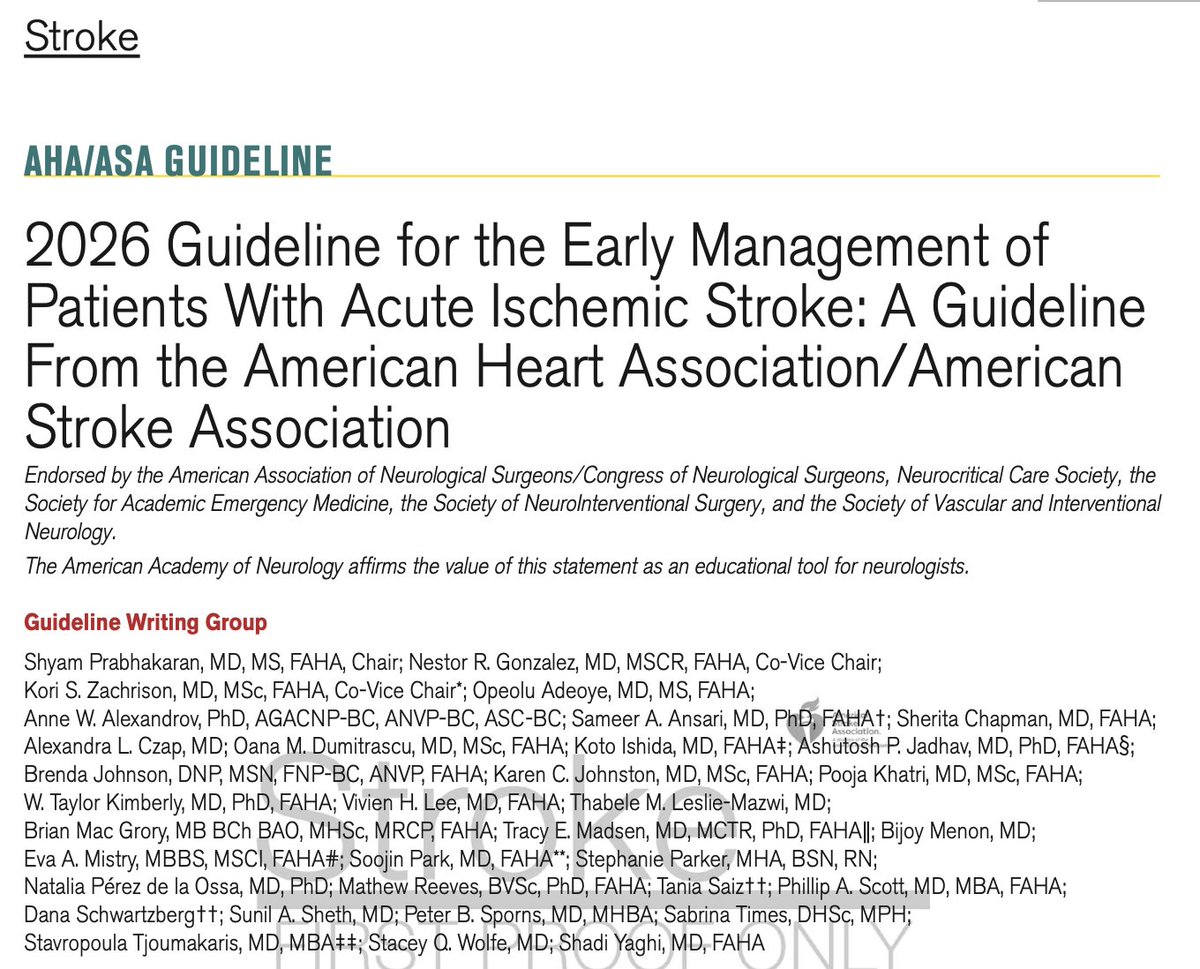
Recién salidas del horno: Guía AHA, 2026, de Evento Vascular Cerebral (EVC) Isquémico. Cambios o puntos relevantes:
🔴 Tenecteplase vs. Alteplase (Cambio Mayor) Se recomienda el uso de Tenecteplase (0.25 mg/kg, bolo único, máx. 25 mg) como una alternativa de primera línea, no inferior a la Alteplase, para pacientes elegibles en la ventana de 4.5 horas. Nota: La dosis de 0.4 mg/kg de Tenecteplase no se recomienda por falta de beneficio adicional y mayor riesgo de seguridad.
🔴 Ictus Leve No Incapacitante: En pacientes con déficits leves que no son incapacitantes (ej. síndrome sensitivo aislado, NIHSS bajo sin impacto funcional) dentro de las 4.5 horas, no se recomienda la trombolisis IV. Se prefiere la doble antiagregación plaquetaria (DAPT).
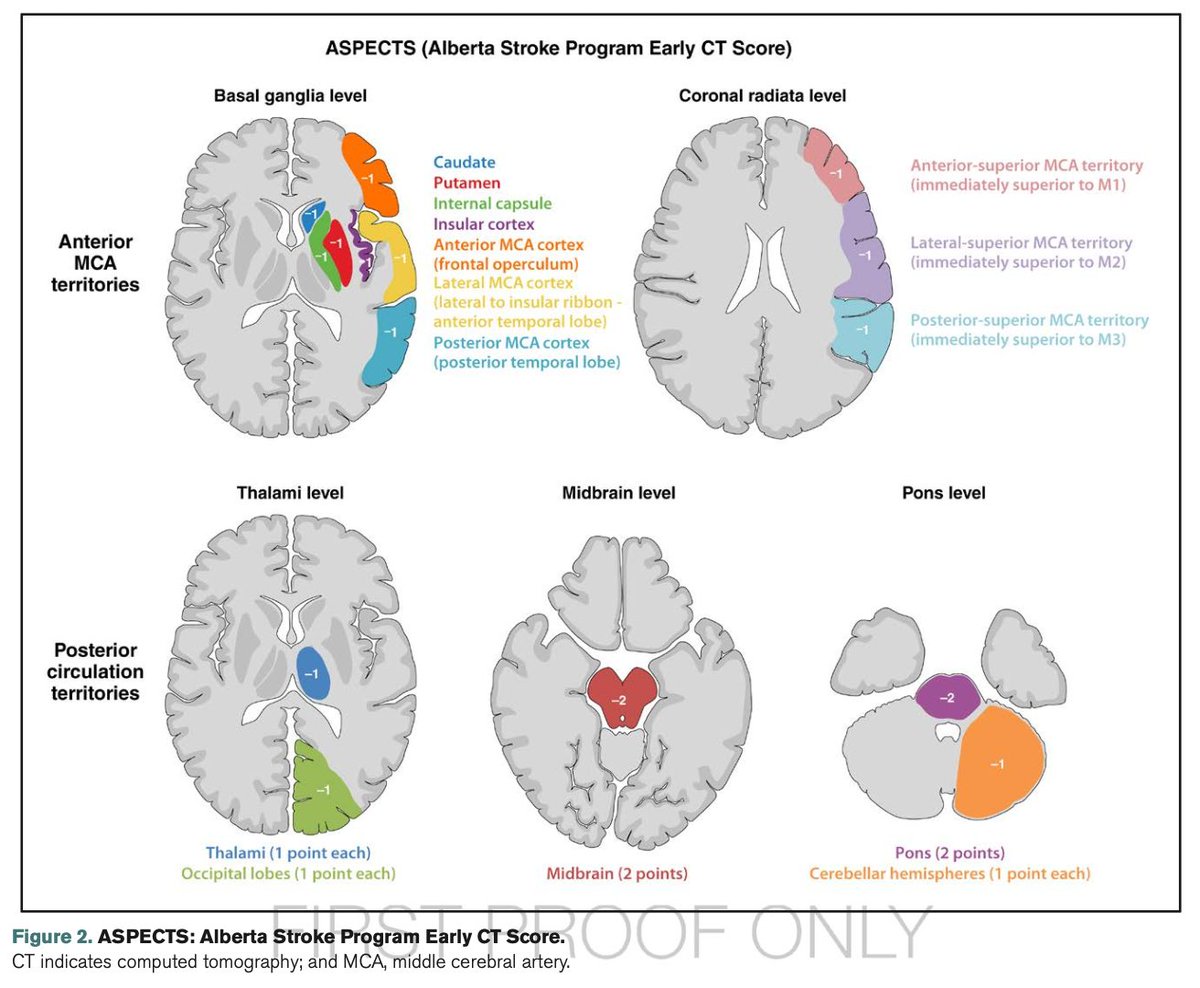
🔴 Trombectomía (EVT) en "Large Core": Se amplía la indicación de trombectomía mecánica para incluir pacientes con infartos de núcleo isquémico grande establecidos (ASPECTS 3-5), (antes eran excluidos).
🔴 Se desaconseja la reducción intensiva de la PAS (<140 mmHg) tras una reperfusión exitosa. Objetivo: TA <180/105 mmHg en las primeras 24 horas.
🔴 Oclusión de Arteria Basilar: realizar trombectomía en pacientes con oclusión de la arteria basilar a las <24 horas si NIHSS ≥10.
🔴 Control Glucémico: mantener entre 140-180 mg/dL.
🔴 Ventanas Extendidas de Trombolisis: Se recomienda el uso de trombolisis IV en ventana extendida (4.5 a 9 horas o ictus del despertar) en pacientes seleccionados mediante imagen avanzada que demuestre mismatch (DWI-FLAIR o Perfusión).
🔴 Nuevas Guías Pediátricas: Por primera vez se incluyen recomendaciones específicas para pediatría
Vamos a revisarlas a fondo para actualizar las apps.
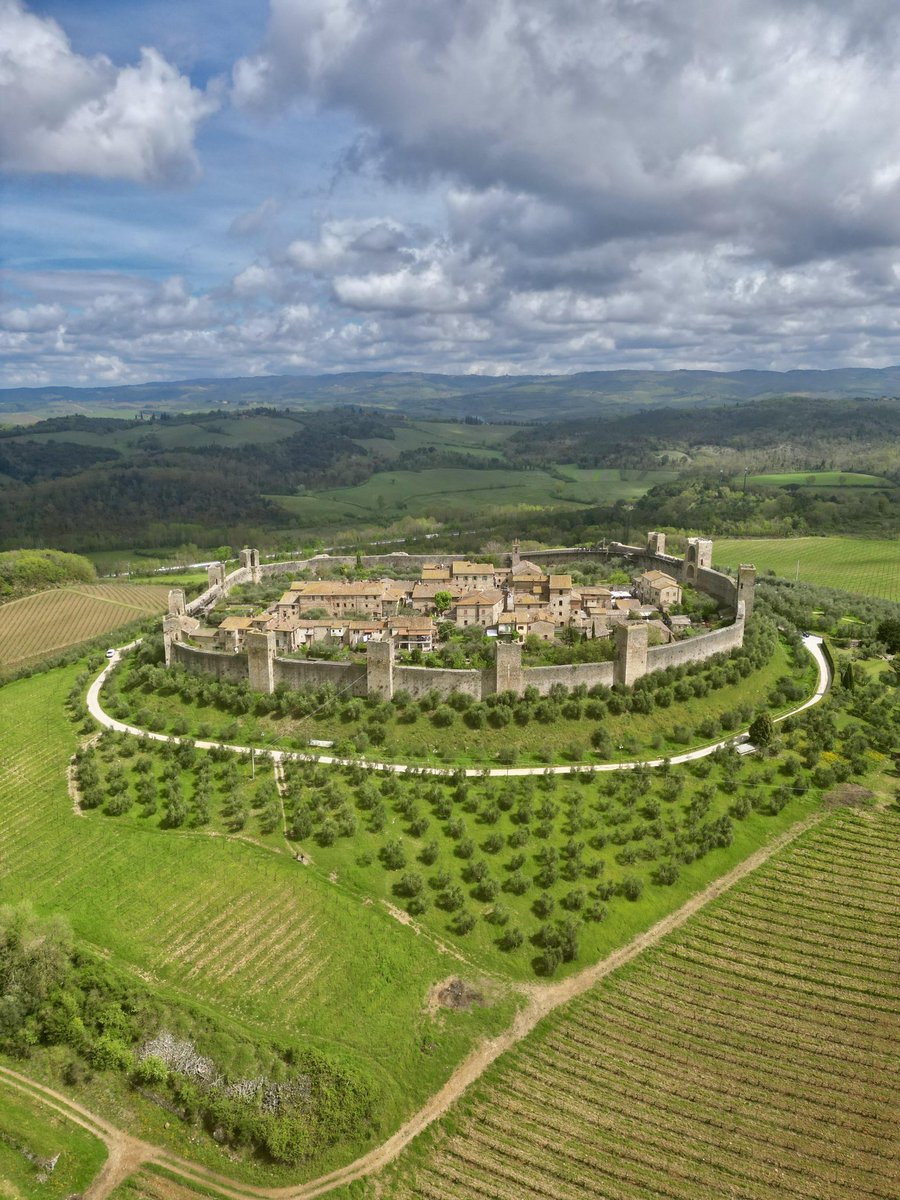
Monteriggioni - the gate of the Middle Ages ...
Monteriggioni represents one of most important medieval walled castles, nestled in south-western end of Chianti, province of Siena, at the the heart of Tuscany, Italy 🇮🇹. It has incredibly preserved an intact structure as a magical, fairy-tale place, capable of taking anyone back in time, to Middle Ages.
In Monteriggioni time seems to have stopped: the landscapes are those typical of a postcard, with a fairytale and dreamy air, with small houses and narrow streets that wind through the towers of the castle. Its perfect circular perimeter makes one suppose it to be an artficial construction while in actuality it was created by just following the curves in the natural ground.
The origins of the village dated between 1214-1219 CE, the Sienese built the Castle of Monteriggioni in order to defend the center and control the surrounding territory. The peculiarity of this building is the circular layout of its walls, which follows the natural course of the hill, thus giving it a particularly irregular shape and very similar, in small, to that of the Wall of China.
Castle of Monteriggioni is the symbol par excellence of the village: built by Sienese at behest of Guelfo da Porcari, Republic of Siena used it as a means of defense from enemy attacks. It is located, in fact, on Mount Ala, from which it offers a privileged view of the surrounding landscape and, above all, on Via Francigena.
In the beginning, castle was surrounded by ditches, useful in case of siege, because they could be filled with coal and set on fire to avoid the arrival of enemies. The structure has long been the subject of clashes between Sienese and Florentines; between 15th-16th Centuries CE, it became the headquarters of artillerymen, while today it is owned by the Griccioli family. Thanks to this system, Monteriggioni has long been an impregnable and unattainable village, so much so that its fall was possible only with a betrayal: the captain of the army, a Florentine escapee, in fact, decided to hand over the castle to the enemy Florence: without fighting. From that moment on, Monteriggioni passed into the hands of the Signoria of Florence, specifically to Cosimo I de’ Medici, and its inhabitants became subjects of Florence.
Even today, the walls of the castle look simply wonderful: this is due to the wise and important restoration work carried out between the twenties and thirties of the 20th Century CE, during which the previously demolished towers were also rebuilt.
The intact fortified wall presents 14 towers along which the guards used to walk and patrol the walls and 2 gates, one called Franca or Romea Gate which faces Rome and other known as Florentine Gate since it heads toward Florence.
The current structure of the village is essentially the original one, the only changes it went through date back to the 16th Century CE, when the towers were lowered and some earth accumulated at the base of the walls and another dating back to 1921 when 3 of the 14 towers were reduced to the level of the walls.
Monteriggioni, therefore, a fundamental place for all those who want to know the history of Tuscany and many battles that took place here during Middle Ages. Village has been included in route of Via Francigena, assuming a new importance, today tourist and no longer military as in 13th Century CE.
#archaeohistories
@CollinRugg Everyone MUST watch this split-screen video of the moments leading up to the attack.
Secret Service had 2 FULL MINUTES.
If not for 𝕏, you'd never see this:
Este vídeo ilustra de manera sencilla el conflicto entre Palestina e Israel:
Lo primero que tenemos que tener claro, es que, Hamás no es Palestina. Como se explica en el vídeo,Palestina está divida en 2 fracciones: - Cisjordania, controlada por la Autoridad Nacional Palestina y a quiénes la comunidad internacional reconoce como representantes legítimos del Estado Palestino y, a su vez, esta autoridad sí reconoce al Estado de Israel; por otro lado, está Hamás en la Franja de Gaza, ellos son un grupo islamita radical musulmán que nace de la hermandad musulmana y cuyo objetivo es la destrucción de Israel.
- Hamás basa sus creencias en el Corán mientras que Palestina es Laica, ambos grupos no comparten ideales, ni se la llevan bien entre sí.
- Mientras Hamás basa su lucha en algo religioso y étnico, Palestina lo ve como un conflicto político.
- Otra cosa que hay que mencionar, es que, el ataque terrorista de Hamás a Israel al parecer se negoció en Teherán (Irán) y cuya finalidad era que Arabia Saudita e Israel no firmaran un acuerdo de paz, pues es bien sabido que ambas naciones con rivalidades religiosas históricas (una sunita y la otra chiita del islam) entre otros conflictos, representaba un “peligro” para Irán.
Para más detalles, vean el vídeo completo.
#neurochallenge del día: ¿cómo se llama ese signo clínico? ¿En qué enfermedad neurológica se observa? ¿Cómo describirías los movimientos?
Pista: Cromosoma 4
#NeuroTwitter#neurology
Síndrome del 8 y 1/2 DER.
-Núcleo del VI derecho: no abd 👁️ der y add deficiente de 👁️ izq.
-FLM der, INO der: 👁️ der no add, 👁️ izq c/nistagmo a la abd.
-Porción fascicular del VII der: parálisis facial periférica der.
OJO!! 🚨 ¡VIDEO SENSIBLE SOBRE MALTRATO ANIMAL!
En la Colonia De Valle, en la @BJAlcaldia, esta señora que la hemos bautizado como "La Patea Perros", se la pasa lastimando a unas pobres perritas pitbull que están encadenadas a una maceta! Nos ayudan #BrigadaDeVigilanciaAnimal@LetyVarela@AndresGuzBJ? 😰 Nosotros nos comprometemos a encontrarles un buen hogar si las rescatan!!
"No seas la razón de que alguien renuncie; sé la razón de que alguien se quede y sea exitoso".
La escuché en la mañana y es perfecta, sobre todo para un ambiente tan hostil como lo llega a ser medicina.
Para los que estén pensando en coger Neuro:
- Es la especialidad más clínica (anamnesis y semiología son fundamentales)
- Vas a dedicarte a explorar lo que nos hace ser lo que somos
- Es de las especialidades más inabarcable - si no la que más-
- Las guardias suelen ser malas