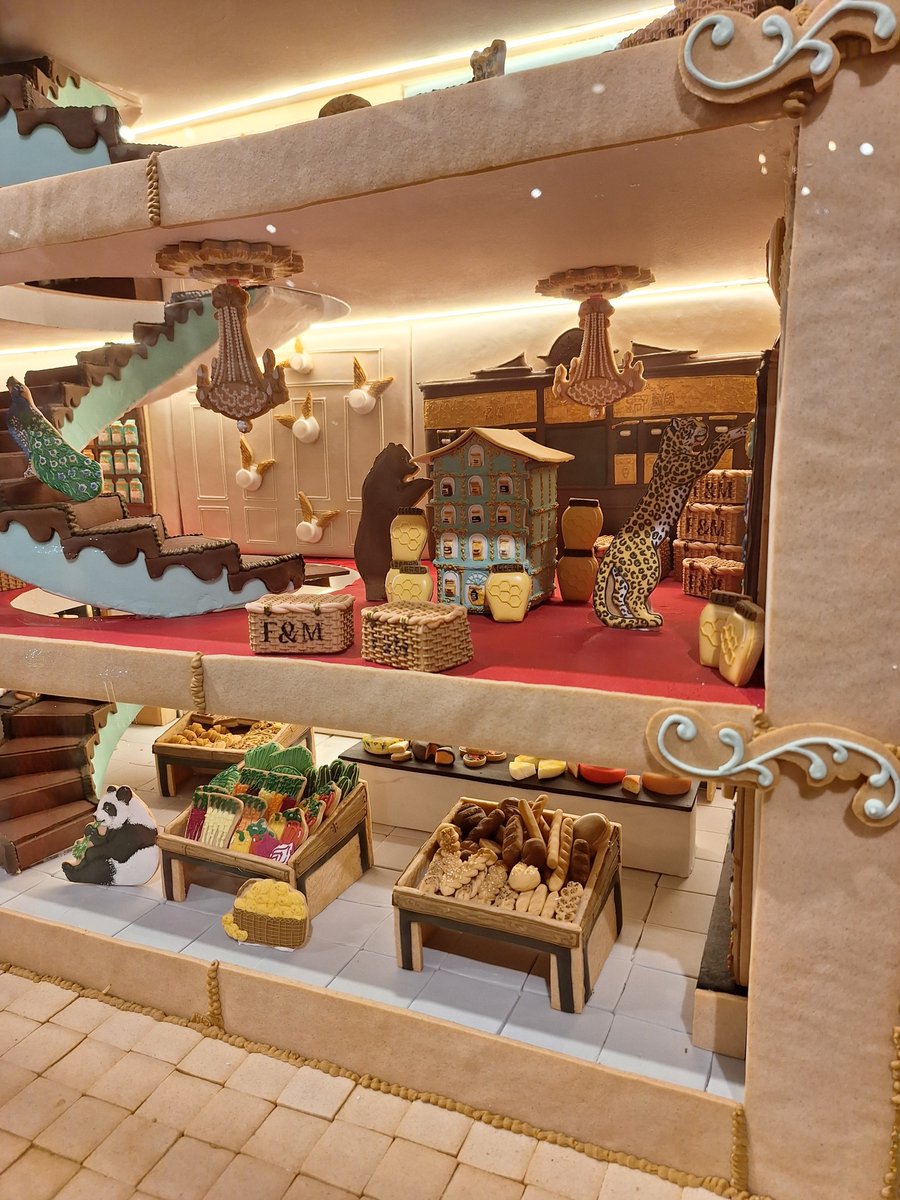
Fortnum & Mason have really outdone themselves with this biscuiterie dollshouse replica of all 6 levels of their store. Three pics in increasing close-up give some indication of the whimsy and incredible detail.
“I work the front desk at a small doctor’s office, and I wish people could see what happens on the other side of the phone.
Every day, older patients call us confused.
They are told to use the patient portal, upload documents, check lab results online, fill out forms before the visit, and confirm everything through a link.
Some of them do not know what a portal is.
Some do not have a smartphone.
Some have one, but they are afraid to click the wrong thing.
Last week, a man in his late 80s called about his test results.
He said, “Ma’am, I don’t mean to bother you, but the computer says I have a message and I don’t know how to open it.”
He sounded ashamed.
That broke my heart.
He should not have to feel ashamed for needing a human being.
Technology can be helpful. I understand that.
But when people who built this country are made to feel helpless because everything became a login and a password, we have gone too far.
Not everything needs to be an app.
Not every answer should be hidden behind a screen.
Sometimes people need a voice.
A patient person.
A real human who says, “Don’t worry, I can help you.”
Progress should not leave seniors behind.
Because one day, the world will move faster than us too.
And I hope someone is kind enough to slow down.
~Unknown
I will never stop shouting this from the rooftops: the most underrated skill you’ll ever develop is the ability to genuinely enjoy your own life. Not someday, when you’ve healed enough, earned enough, or finally figured everything out. NOW. Because your life isn’t waiting for you somewhere in the future—it’s being built in the way you experience this ordinary Sunday, this cup of coffee, this conversation, this sunset, this breath.
Most of the obituaries and tributes to David Hockney will, I imagine, focus primarily on his extraordinary craft and brilliance as an artist. Perhaps they might also mention his brilliance as a communicator (he was such a fine writer and speaker).
But there was something else rather unique about him too. He was also strikingly honest about the tricks/techniques artists use and used to paint. His book Secret Knowledge is a rather wonderful detective work into how renaissance and Dutch golden age painters used glass and mirrors to help them master perspective.
It's a pretty compelling case (see this video clip from a BBC doc he made alongside the book👇) though I'm sure some art historians will raise their eyebrows. Many will be aghast at the notion that greats like Vermeer might have been using lenses and camera obscuras to help them draw and paint. As if it were in some way "cheating". But Hockney was so self-evidently brilliant he was one of the few people who could document this without anyone gainsaying his own talent.
There are very few artists, living or dead, who have this degree of self-confidence. Not just to know their craft, but to be bracingly honest about how it works. One other who comes to mind is Paul Simon: not just an extraordinary musician but is also an extraordinary communicator about the tricks and techniques of how to write and perform music.
For many great artists, the temptation is to cloak their crafts in mystery, like a member of the magic circle. Hockney wasn't having any of it. So yes, he was a legend in all the obvious ways. But also in a few other less obvious ways as well. RIP.
In Italy, recovery often starts with rest, sunlight, and real food.
In Scandinavia, people still walk outside in freezing weather because fresh air is seen as medicine.
In Japan, doctors encourage forest walks to calm the nervous system.
In New Zealand, nature time is literally prescribed.
The body heals better when it feels connected to nature, not disconnected from it.
My heart is full of love for this.
The UK’s first rooftop ICU at King’s College Hospital allows critically ill patients to receive life support outdoors, giving them fresh air, sunlight, and nature to support recovery and wellbeing. Patients reported a 20 percent reduction in pain relief meds required.
HE KNEW THE DOSSIER WAS FAKE. WEEKS LATER HE WAS DEAD IN A FIELD
Dr David Kelly was Britain's foremost weapons inspector. He spent years inspecting Iraqi facilities, earned a Nobel Peace Prize nomination, and knew more about Saddam's arsenal than almost anyone in government.
In 2002, Tony Blair's government published a dossier claiming Iraq could deploy chemical and biological weapons within 45 minutes. Britain went to war on the back of it. No weapons were ever found.
Kelly knew the dossier was rubbish. He said so, quietly, to a @BBC journalist. That conversation ended his career, his privacy, and ultimately his life.
The MOD carefully allowed his name to leak to the press as the BBC's source. He was then hauled before parliamentary committees, stripped apart by his own employer, and thrown to a media frenzy he never asked for.
Two days after giving evidence to MPs, the 59-year-old was found dead in woodland near his Oxfordshire home.
Instead of a proper inquest, Tony Blair asked Lord Hutton to run a private inquiry. Hutton concluded suicide. The inquest was opened, then suspended, and never resumed.
Eight senior legal and medical figures, including a coroner, later wrote to @thetimes saying the verdict was unsafe. They argued the wound found on Kelly's wrist, a severed ulnar artery, would not have caused sufficient blood loss to kill a healthy person.
There were no fingerprints on the knife found beside his body, even though he was not wearing gloves.
In 2011, Attorney General Dominic Grieve rejected all calls for a new inquest. He said the Hutton Inquiry was "tantamount to an inquest" and that further investigation would be dismissed by judges with irritation.
A man challenged the government's justification for a war that killed hundreds of thousands of people. He was publicly destroyed, died in mysterious circumstances, never got a proper inquest, and the people who sent him into that media storm faced no consequences whatsoever.
Tony Blair became a Middle East Peace Envoy the following year. You genuinely could not make it up.
Sources: @BBCNews, openDemocracy, Hansard, @thetimes | Hutton Report
This is the tiny hamlet of Leadmill near Hathersage, and it's a scene that I could stand and watch for ages, as the light shifts through the Hope Valley. Zoom in if you can, to see the swoops of land, the stone walls dividing fields, the little cottages on hawthorn-dotted lanes. There are just so many stories in these landscapes, so many lives and histories, all interwoven with the hollows and hills, and I think we are so much richer for standing awhile and appreciating them.
📍 Peak District, England
I want a peaceful quiet life. No confusion. No drama. No games. No stress. Unrushed mornings. Doing deep work. Books. Some music. Sitting on the porch. Two real friends. Deep conversation. Sipping tea. Watching the sun go down in silence. Peace & good vibes. That'll do.
"Few people know how to take a walk. The qualifications are endurance, plain clothes, old shoes, an eye for nature, good humour, vast curiosity, good speech, good silence, and nothing too much."
~ Ralph Waldo Emerson
The older I get, the more I believe happiness lives in the ordinary. Pets. Plants. A quiet morning coffee. Blue sky. Cotton clouds. Birds singing. The gentle breeze through the trees. A clean, cosy house. Good food. Good hearted simple poeple. So much of life’s beauty is quiet, gentle, and already here. And somehow, one of the sweetest feelings is knowing I get to wake up and meet it all again tomorrow.