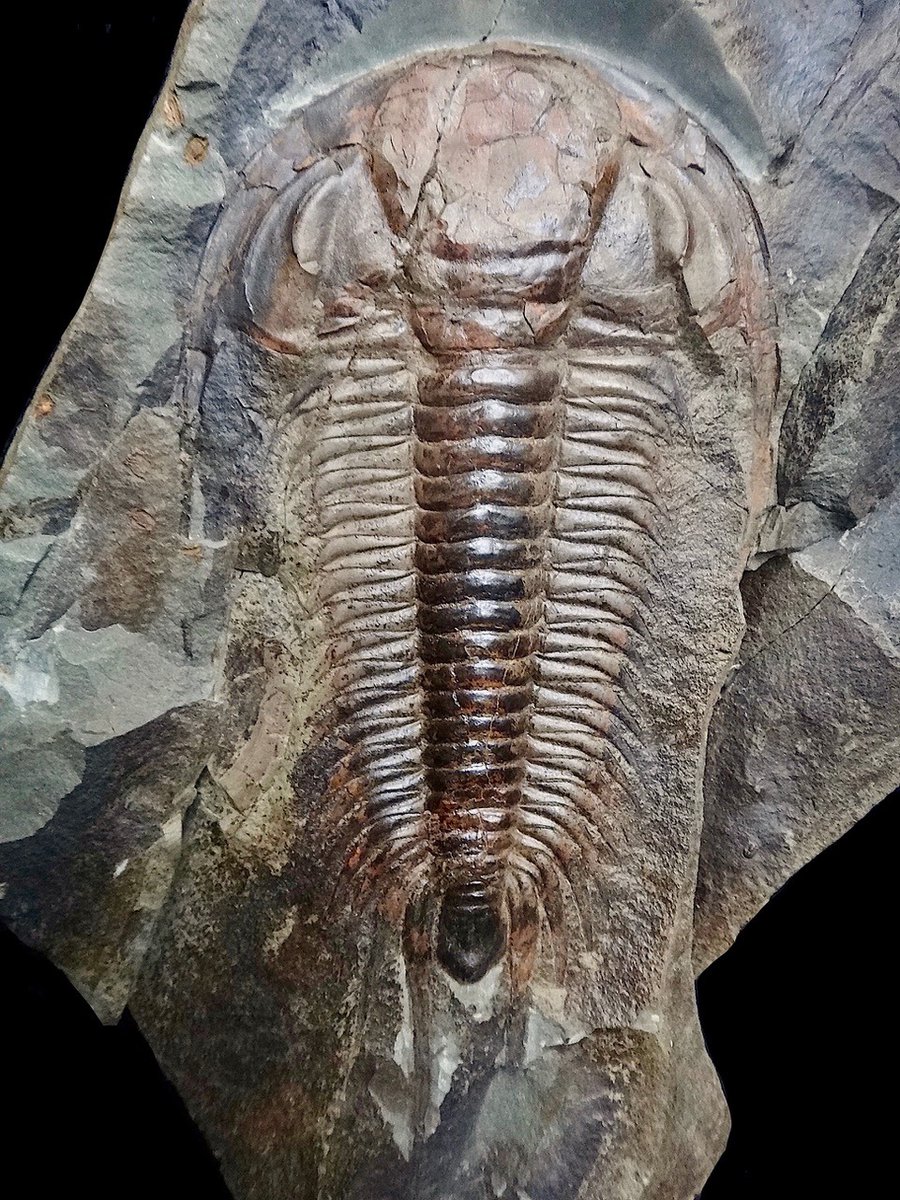
#Trilobite body design showed some interesting modifications over their 250+ million year history. Harpes perradiatus, a #Devonian trilobite from Morocco, extended the cephalon margin as a bizarre filtering-feeding mechanism. #TrilobiteTuesday
image: https://t.co/Y7g2CQHJlv
This is a trilobite eye. Every facet—or little nub—of the eye is a single crystal of calcite. But if trilobites' eyes were pure calcite they'd see the world in duplicates. Ever inventive, evolution found a way ... 1/x
Aquest és un fantàstic exemplar de nàutil fossilitzat amb pirita. Segons el propietari, té una antiguitat d'uns 185 milions d'anys. La piritització consisteix en substituir amb sulfur de ferro (sofre + ferro) les parts dures o buides dels organismes morts. 📹 Yorkshire Fossil.
This #TrilobiteTuesday I give you a nearly complete Paradoxides gracilis, a Cambrian trilobite from the Czech Republic. This beautiful beast is closely related to species found in Newfoundland and Morocco. (photo: @AMNH)
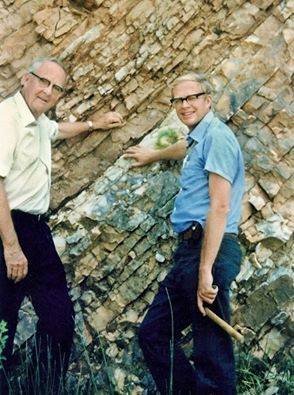
October 30, 1986, Luis W. Alvarez (1911-1988) of UC Berkeley wins the Nobel Prize in Physics 🥇 Together with his son, he promoted the "impact-theory" to explain the mass extinction 65 million years ago 🦖☄
https://t.co/YOGMGMdV1u
By the end of trilobites' crawl through Deep Time, their species count—which once numbered in the thousands—had dwindled down to a precious few. All of the remaining species, like this 1.57-in- (4-cm-) Piltonia, belonged to a single order, the Proetida. #TrilobiteTuesday
#TrilobiteTuesday: YPM6657 (left & top right), holotype of Olenellus getzi & only known olenellid fossil with antennae (credit: @yalepeabody). This isolated, molted (no eyes) cephalon from the Rosella Fm. (BC) seems to preserve similar, but incomplete structures? How come?🤔🤔🤔
Portugal’s Valongo Formation is renowned for the impressive sizes of its trilobites. The fossils unearthed here can reach up to 28 in (71 cm) in length! Pictured is a 17-in- (43-cm)-long Ogyginus forteyi trilobite, considered small by Valongo standards. #TrilobiteTuesday
Según los modelos de Deriva Continental @NatGeo, los continentes se unirán en una nueva #PANGEA dentro de 250 millones de años. Quedarán -como mares interiores- algunos retazos del Atlántico y la Vieja Europa habrá sido empujada hacia latitudes polares. #IGME, #Geología
Trilobites are known from their fossilized shells, but did you know they only covered their upper (back) surface? Some had a mouth shield called a hypostome, though; in this Paradoxides davidis trapezopyge, it's come off and is next to the tail. #TrilobiteTuesday@ManuelsRiver
Paradoxides davidis intermedius, the third P.d. #trilobite subspecies from @ManuelsRiver, Newfoundland. The rectangular pygidium (tail) is, as the name suggests, intermediate in shape between those of P.d. davidis and P.d. trapezopyge. #TrilobiteTuesday@NLtweets