@alexolegimas@infornomics@JulianDJacobs@GoogleDeepMind Most likely because of the mechanism of delivery of these programs — I am wondering if or when or how the UK EU recommended Work Program post 2010 worked out long term — there the issues were of a different nature. Making “discovery” less perceived risky surely is desirable…
It should be obvious that, if behavioral targeting, exploitation of behavioral biases/cognitive limitations prevails, then only a "crowd stochastic noise" revolution can help rebalance power in economies. That is: we need to add more random choices in our day-to-day life.
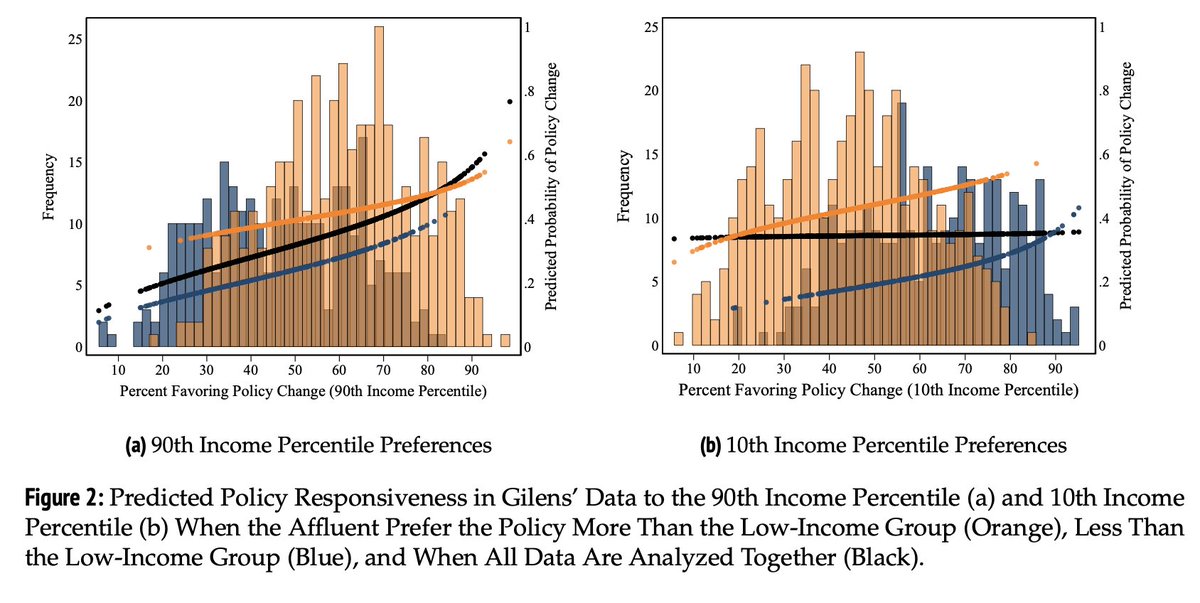
This is a complex way of saying sth "simple". So here is another attempt, which, invariably is also "noisy". The paper's core point is that apparent between group heterogeneity may be an artifact of the observed/latent preference-support distribution.
That is: the estimated...
This is a complex way of saying sth "simple". So here is another attempt, which, invariably is also "noisy". The paper's core point is that apparent between group heterogeneity may be an artifact of the observed/latent preference-support distribution.
That is: the estimated...
Gilens' data shows responsiveness to low-income public opinion for both issues where affluent favor change more & less. Seeming lack of responsiveness is due to a higher rate of policy change when the rich favor more
Article: https://t.co/maFg2KY2Se
Post: https://t.co/7IphIPpF0h
conscious they are doing it for want of producing knowledge or owing to (perceived) status returns in authority markets that have not well adapted to technological change. It may have unintended consequences.
This case is really interesting and one that illustrates the role that licensed occupations in society. I think it also illustrates some arbitrariness, traces of feudalism and highlights how AI may disrupt legal services. A short journey through this "story" with AI....1/N
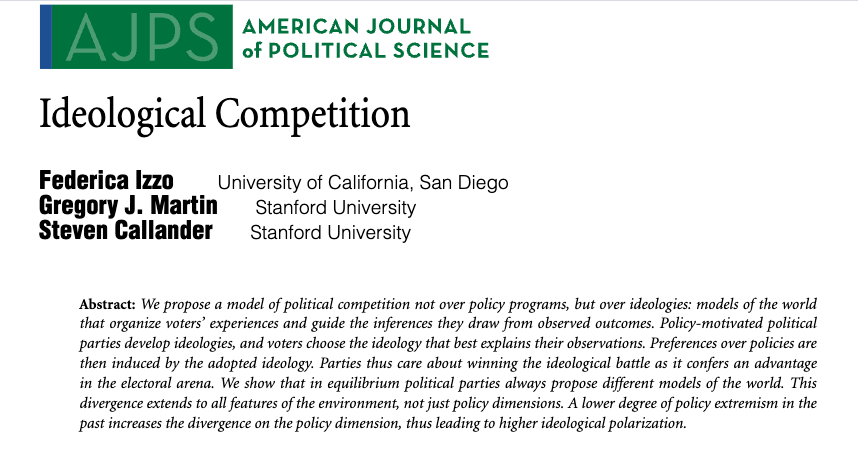
As I read all the expert opinions on how to protect democracy from populism, I keep returning to our simple framework with @edenhofer_jacob. How we got into cycles of excesses of technocarcy and populism, and what we should not do if we want a way out.
https://t.co/THu3DCqAqC
Izzo, Federica, Gregory J. Martin, and Steven Callander. 2023. “Ideological Competition.” American Journal of Political Science 67 (3): 687–700. https://t.co/8N1lgVLxF1.
Levy, Gilat, Ronny Razin, and Alwyn Young. 2022. “Misspecified Politics and the Recurrence of Populism.” American Economic Review 112 (3): 928–62. https://t.co/youutgGf4d.