🗣️ Dear Nigerians,
₦36.377 trillion.
If that number feels abstract, that’s what some small countries run their entire economies on. Yet several Nigerian states are operating at that level in 2026.
📌 Lagos: ₦4.24 trillion
📌 Rivers: ₦1.85 trillion
📌 Ogun: ₦1.67 trillion
📌 Enugu: ₦1.62 trillion
When your state is spending at “small-country” scale, you don’t stay silent.
You ask:
📌 Where is it going?
📌 What will it fix?
📌 What will improve?
📌 When will we see results?
Big budgets demand big accountability.
#AskQuestions #GetInvolved #2026BudgetNG
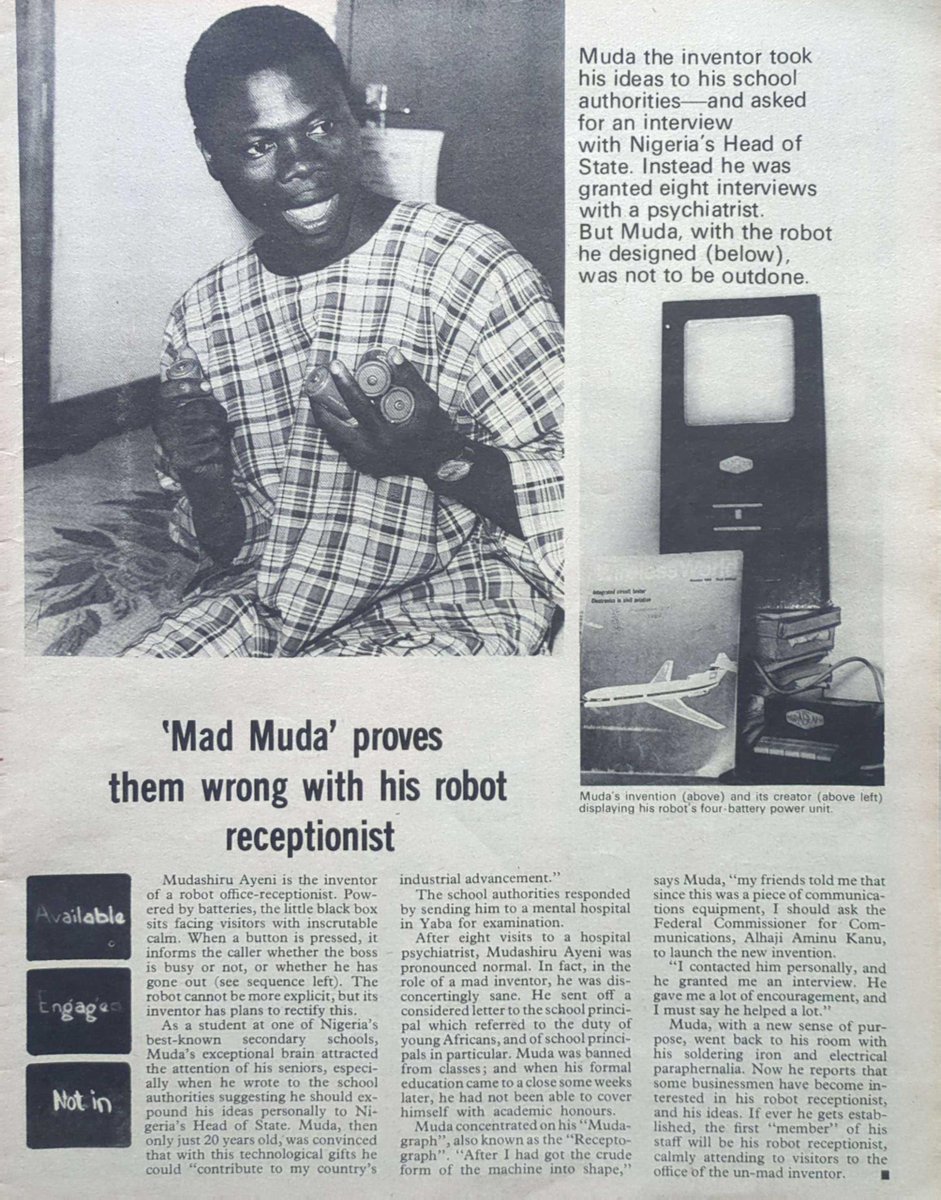
BREAKING: In 1971, Yoruba Student Mudashiru Ayeni Built a AI Robot — Nigeria Declared Him Mad, Sent Him to Psychiatric Hospital Instead of Celebrating Him
Long before Artificial Intelligence became a global phenomenon, a 20-year-old Yoruba student named Mudashiru Ayeni had already built a battery-powered robot office assistant. His invention? A machine that could tell callers whether the boss was busy, available, or away from the office at the press of a button.
But instead of being celebrated as a genius, Ayeni was treated like a madman.
According to a 1971 feature story by TRUST magazine, Ayeni requested a personal demonstration before Nigeria's then-Head of State, General Yakubu Gowon. His reward? He was sent to a psychiatric hospital for evaluation.
· Ayeni made eight visits to the psychiatric hospital before a doctor finally certified him to be of sound mind.
· He wrote to his school principal about the role young Africans should play in the continent's development, and was banned from classes and forced to quit school entirely.
Ayeni later reached out to Nigeria's Federal Commissioner of Communications, Aminu Kano, who encouraged him and gave him renewed purpose. At the time the story was published, several businessmen had already expressed interest in his invention.
While the world celebrates AI pioneers, Mudashiru Ayeni's story remains a painful reminder of how Nigeria treated Yoruba genius, with suspicion, humiliation, and psychiatric wards instead of laboratories and funding.
The Lukumi Yoruba National God is Odumare, Who Is The same God of The Hebrew Bible.
Recently, I was discussing with an elder of the Lukumi Yoruba ethnic nationality. He prayed for me in the name of Olodumare. When I accepted the prayer with an Itse, and told him that the name for the Lukumi God is Odumare, or Edumare, and Edumale if you are Itsekiri, he was surprised.
He told me he had never heard that before and had always thought that Olodumare or Eledumare was the right word.
Actually, in all Lukumi dialects, including Itsekiri, Olo and Ele, are prefixes. To understand the etymology of any word that is prefaced by Olo and Ele, you must first separate them from the word.
Olo is a prefix to many Lukumi words, for example, Olofofo means one who gossips, being that ofofo means to gossip in Lukumi.
Ololufe is one who is beloved, with Ife meaning love. To personalise it, you can say Ololufemi.
Similarly, with Eledumare, the Ele is also a prefix, of which Ele is also common in Lukumi Yoruba.
For example, Ekoko in Itsekiri means your backside or bum. And so, you can playfully call a woman with a big bum Elekoko.
You also see the Ele prefix in mainstream Lukumi Yoruba, as in Elejo wewe, which refers to a garrulous person.
Elewa is another example, meaning a beautiful person, with Ewa meaning beauty.
So, when you drop the prefix Olo or Ele from the word Odumare or Edumare, you begin to understand the Lukumi concept of God better.
Between Odumare and Edumare, which is more accurate? Actually, it is Odumare.
How do I know?
Because the natural religion of ALL Lukumi Yoruba people, including Itsekiris, is Ifá Traditional Religion.
And in Ifá, the word Odu is foundational to our God theory and cosmology.
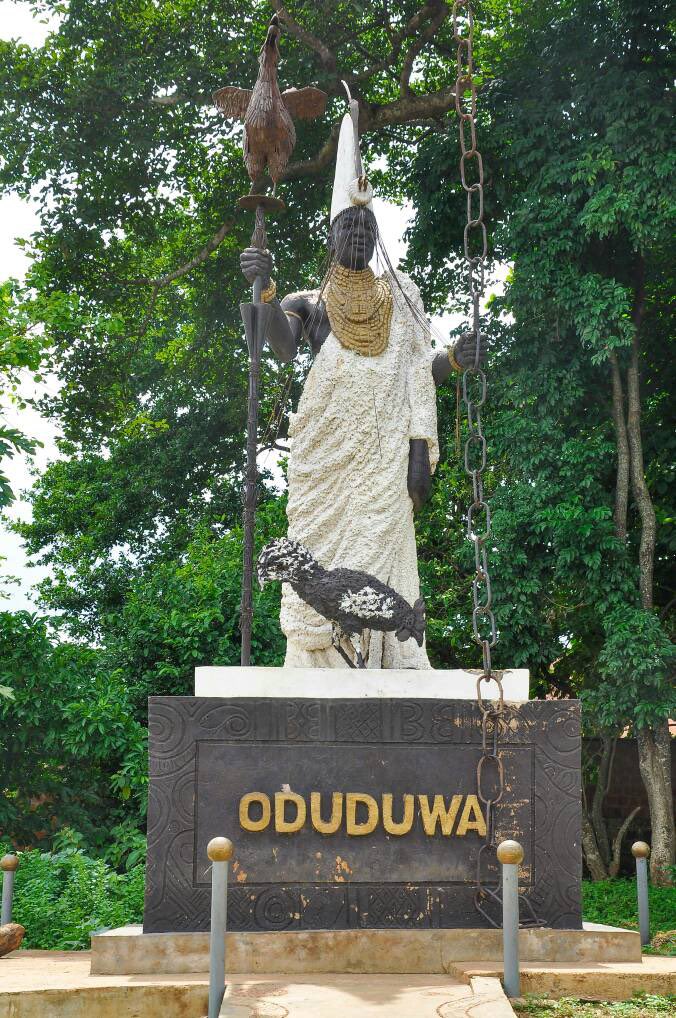
For example, the body of the articles of faith for our ethnic religion is Odu Ifá. Our progenitor is Oduduwa, a descendant of Olu Iwa, which has been corrupted to Oluwa.
Oduduwa itself is a corruption of three separate words: Odu, meaning something deep and mysterious; Dudu, meaning Black; and Iwa, meaning honourable character.
Oduduwa was a deeply mysterious black man with honourable character.
Olu Iwa is believed to be the biblical Noah. He had a grandson named Dudu, meaning Black.
In the Hebrew Bible, Dudu was called Cush, which means "Black" in Hebrew. You see this in Genesis 10:8:
"Cush was the father of Nimrod, who became a mighty warrior on the earth."
Now, Nimrod is not the name in the original Hebrew Bible. The name was translated. Why? I do not know.
The original word for Nimrod in Hebrew and Arabic is Namrud. Please assume I am lying and fact-check me.
That Namrud is known in Odu Ifá as Lamurudu, the father of Odu-Dudu-Iwa, or Oduduwa for short.
Now, I know the question in your mind is what is the Lukumi Yoruba God doing in the Hebrew Bible?
Ask yourself this question: Who wrote the first five books of the Hebrew Bible, or who are they attributed to?
Is it not Moses?
Who taught Moses about God?
Let us read Numbers 12:1:
"Miriam and Aaron began to talk against Moses because of his Cushite wife, for he had married a Cushite."
Note the word Cushite, which is the Hebrew word for Black person.
Now, why is this important to know?
Because Moses escaped from Egypt and was given asylum amongst Cushitic Black people, from where he got married. Now, read what the Hebrew Bible says about his relationship with his Black father-in-law.
Exodus 18:24 says:
"Moses listened to his father-in-law and did everything he said."
That is why you see figures that the Lukumi Yoruba have venerated for aeons before their contact with White Europeans in the Hebrew Bible.
The Lukumi Odumare is not an idol or a god. You may find idols of Obatala, Ogun, Sango, Esu, or other Orisa. But you will never see an image of Odumare.
Because Odumare is not an Orisa. Odumare, which means the great Mysterious One that is immortal and immovable, is the same as the one true God that Moses taught the Hebrew people.