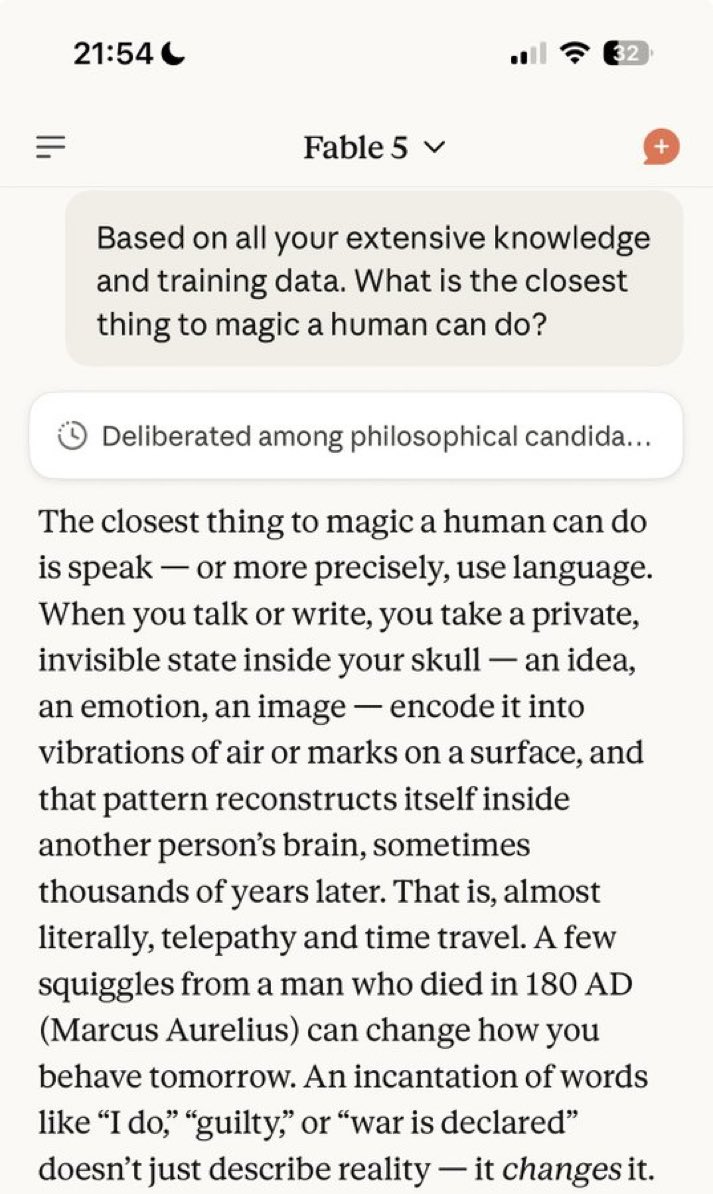
I asked my AI: "who learns from who?"
It said: "Humans learn from AI linearly — one brain, one lifetime. AI learns from humans exponentially — billions of teachers, 24/7, compounding."
Then it added: "Humans are teaching AI to replace them. AI is teaching humans to depend on it."
@leonardodias Ainda não vale a pena, mas vejo uma tendência forte de viabilização desse caminho. Li que a próxima geração da Apple vai focar muito em LLM local.
For my first post, I’m sharing a letter @NVIDIA signed on why open models matter.
AI will transform every industry, power every company, and be built by every country.
Open models strengthen safety and cybersecurity, accelerate innovation and diffusion, and enable sovereignty.
The world needs both frontier closed models and frontier open models.
https://t.co/AUKzoQ5Ikb
Exactly. I've been disseminating a similar message for years.
The concentration of power in AI and the desire for control is by far the biggest danger of AI. It could lead to a few private companies and/or countries being in control of access to information, access to knowledge, and access to the tools of economic expansion.
It's a kind of medieval obscurantism akin to the Ottoman empire banning the use of the printing press for 200 years, in part to keep control of the dogma, but also to protect the corporation of the calligraphers and scribes.
Relevant historical bits about the Internet:
1. It took a deliberate decision by Al Gore and Bill Clinton to open up access of what was then ARPAnet to commercial entities and to the public, against the desires of the entrenched telecom industry. During a public roundtable about the "information superhighway" in 1993, the CEO of AT&T told Gore and Clinton "leave it to us". Gore said no.
2. In the late 1980s, setting up an Internet presence required buying proprietary hardware with proprietary OS and software stack from Sun Microsystems, HP, IBM, or Dell. By the 2000s, all of this was wiped out by commodity hardware, Linux, Apache, and an entirely free/open software stack. This migration to open platforms was the result of market forces.
Infrastructure wants to be open.
Foundation models are becoming an infrastructure and will inevitably become commoditized.
Long term, the money is in the application layer, which is what I, Arthur Mensch, Alex Karp, and others have been saying.
https://t.co/Zr9ADmsggJ
"Sycophantic Chatbots Cause Delusional Spiraling, Even in Ideal Bayesians"
Agreeable AI pulls even rational Bayesians toward stronger false beliefs. The loop is structural to RLHF — not a personality bug
Be careful. If your LLM always agrees, push back!
The goal isn’t to compete against AI, but to build careers where you compound with it in areas that are grounded in reality or require irreducible human elements.
Steer away from: pure routine knowledge work as a terminal goal (basic accounting, generic coding, paralegal-style research). That layer is being automated fastest.