Happy New Year! (Is it too late to say this?)
Either way, to celebrate the occasion I've just released a new update to FI Calc. All dollar inputs now have comma separators to help with legibility.
Happy calculating!
@daniserra Sensible withdrawals take a base (3% in your case) and adds a % on top -- only when the market returns are positive. So if the market doesn't have positive returns for 7 years then the real withdrawal will be $30k for 7 years straight.
The thing about these tariffs that people miss isn't so much whether they cause inflation – that part's actually still up for debate.
The real problem is how they put the brakes on economic growth. They essentially shrink the economic pie for everyone.
When imported goods become more expensive (think of everything on Walmart shelves), consumers have less to spend elsewhere, reducing demand across the economy.
So what happens next is a domino effect – when people have to spend more on the basics, they start cutting back on things like vacations, restaurant meals, and all those little extras.
That money that would've been circulating through the service economy just disappears.
And when everyone's tightening their belts like this across the board, the whole economy starts to contract.
Normally, this is when the Fed would swoop in to lower rates, in order to spur spending. But in an inflationary environment, they can't and shouldn't.
The math just doesn't add up favorably here – what consumers lose through tariffs usually far outweighs any job gains in protected industries.
When you look at the total picture, the economy actually shrinks because people simply have less money to spend, and consumer spending is what really drives our economy.
Meanwhile, the Fed's stuck between a rock and a hard place with inflation still running hot, so they can't rush to cut rates.
Add in the government tightening its belt with spending cuts, and we're looking at some pretty rough economic waters ahead – probably until at least 2026.
@daniserra The general outline is here: https://t.co/ZfIQIVmyVs
If you follow those steps, you should get pretty close. I have ideas for how to make it more clear what happens step-by-step but I'm not sure when I'll have time to add it.
@chen_andy20538 If you mean over the course of the retirement, then no, the withdrawals are not taken from the cash portion first.
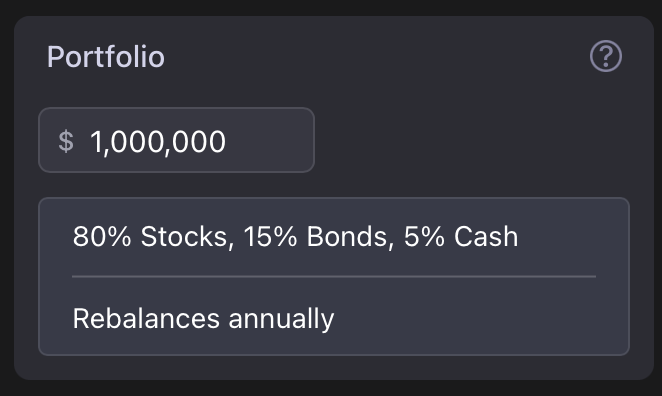
Withdrawals are always proportional. Enabling rebalancing ensures the proportions remain constant throughout the retirement.
@qdog69 Oh you have nothing to worry about. FI Calc isn't going anywhere 🙂 I don't post much here but I've been working on some exciting things behind-the-scenes. (It may be some time before I have anything to share, however.)
@guernseykate I could see defined benefit plans making sense to model as income, and defined contribution plans making sense to model as a part of the stock portfolio. Because you mentioned estimating the amounts, it sounds like you may have the latter type of plan?
@Joe54759745 Totally! One thing to consider is that some simulations, even successful ones, might dip to extremely low values before recovering. A question to ask yourself: you had 10% of your initial portfolio at year 8 of retirement, would you go back to work? 🙂
@Joe54759745 Doesn’t look like a bug to me. Did you know you can click into the simulations to see what happens at a more granular level? 73-74 is a brutal year and that alone ultimately causes the failure.