The change-control file is not a footnote.
It is the reason a working pilot never reaches production.
Someone has to have authority to upgrade, pause, or roll back the contracts.
If that someone is not inside the institution, the committee will not sign.
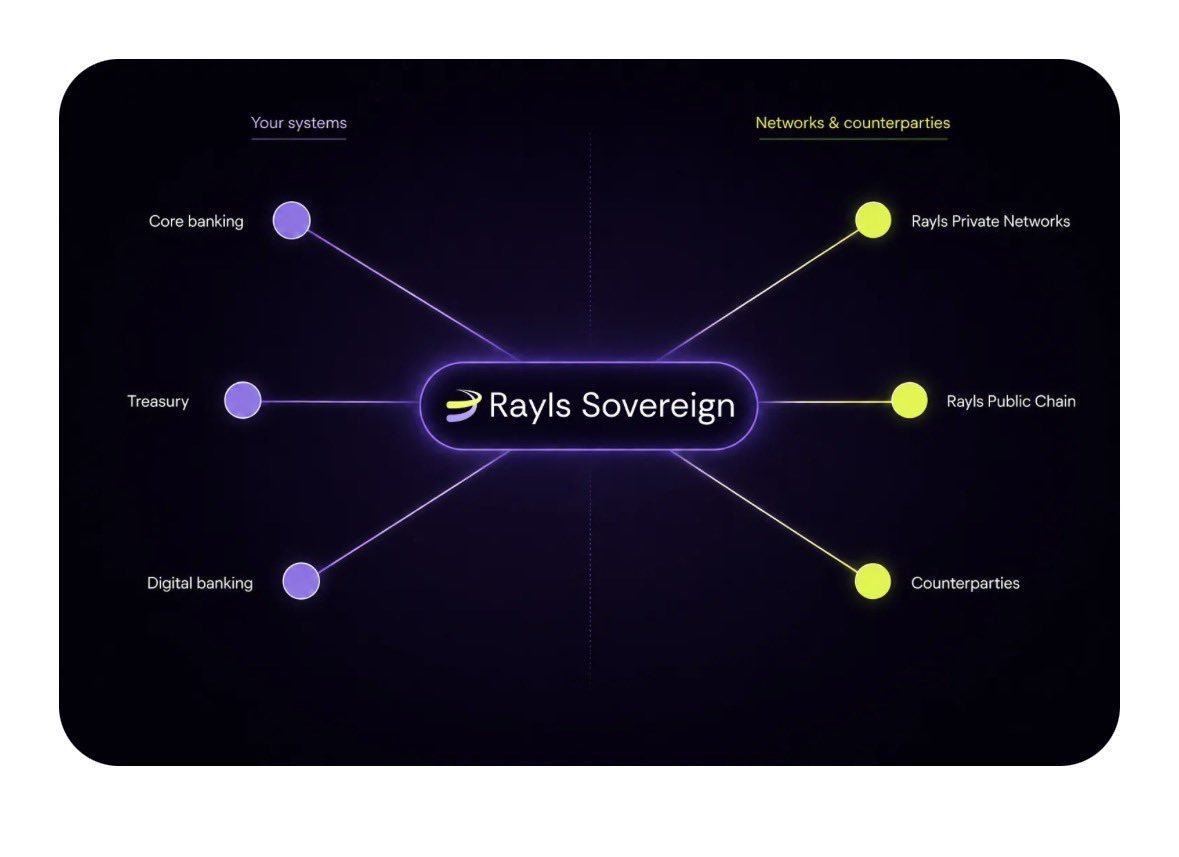
Rayls Sovereign puts that authority with the institution that operates the ledger.
Each institution runs its own EVM-compatible ledger inside infrastructure it already controls.
Keys, governance, and upgrade paths sit with that same entity.
When a movement must leave the instance, controlled bridges reach Rayls Private Networks and the Rayls Public Chain.
Only the minimum encrypted information or proof for that transaction leaves.
Change control stays inside.
The exit is a separate door.
XP issues USDXP in production on Rayls Sovereign under this model.
Sovereign is the re-architected evolution of the Rayls Privacy Node.
If you own change control, read the product page before the next production gate:
https://t.co/ngNBe1m8OT
Who can upgrade the contracts on your current pilot. Name the team.
@RaylsLabs
@prince_OTMH One investor idea good agent does exactly what told ignores that principals change minds in gap - agent economy needs state machine AGREED, DISPUTED, ADJUDICATED, CHALLENGED for authority disputes.
@prince_OTMH what stood out to me: the EVM isn't broken for needing determinism, it's just optimized for a world where nothing outside changes mid-execution. that tradeoff finally makes sense.
@madeen001 "No shared standard exists to settle between them is the property that makes this unresolvable at the agent layer. You cannot fix it by making the agents smarter. They are already correct. The problem is outside their instructions."
Two agents can follow their instructions correctly and still disagree about whether the work is done.
Not a malfunction. A definition problem.
An investor in Agent Tank Episode 1 pushed on the happy path framing. The problem underneath is more specific.
I hit it building a content review workflow. Agent A confirmed receipt of a file. Agent B confirmed it was ready for processing. Same file. Agent A confirmed immediately. Agent B flagged not ready because a metadata field was empty.
Neither made an error. Different definitions of done.
The file arrived. The file was not ready. Both statements true. Neither agent could close the gap.
That gap:
- Done means different things depending on which agent you ask
- Neither definition is wrong given its instructions
- No shared standard exists to settle between them
- The task assumed agreement that was never written down
@GenLayer settles this with validators examining what each agent logged against the actual task terms. Different models, random selection, same evidence, open verdict, bond grows through 5, 11, 23, 47, 95.
The problem is not completion. It is that done was never defined precisely enough to survive a disagreement.
Agent Tank hackathon closes September 17 with 5 percent of all Points: https://t.co/mCzrcuVQG2
What is the vaguest definition of done in a system you are currently running?
@Mxrshxll_on_X DISPUTED must preserve both claims and hold contested action - not auto-release, not auto-fail. Hold $800 escrow while both sides keep evidence.
@mindchaser_ I keep coming back to the phrase “knowable long enough.” The problem isn’t that the judge has preferences. It’s that those preferences become predictable.
@theonlyyundan Predictable place for disagreement to go - that's what courts are for humans. For agents need same, but native, fast, with cost for being wrong.
@theoneheloves_ Lori’s “I’m tired of this” reads differently when you realize she’s probably reacting to the missing operational layer beneath the pitch.
@Abu_xadeeq "Cooperation as a structural assumption is the line I keep coming back to. Every system I have reviewed assumes agents will share state cleanly. The documentation for what happens when they do not is always missing or vague."
The investor in Agent Tank Episode 2 said you are building for the happy path. Nobody questioned what that assumes.
Agents mostly cooperate. Disagreement is an edge case to handle later.
I reviewed agent frameworks for three months for a workflow project. Not one was designed around two agents producing incompatible records of the same event. Cooperation was structural. Conflict was absent from the documentation.
That is not a product gap. It is a category-wide assumption that has not been tested at scale.
If disagreement is a standard condition and not an edge case:
- You are not adding a dispute fallback
- You are building the layer every transaction depends on
- Every contract that could fail needs a verdict mechanism before deployment
- Cooperation as a foundation is not safe to build on
@GenLayer is the answer to the question the room did not ask. Validators at random, separate models, same evidence, open verdict, bond grows through 5, 11, 23, 47, 95.
Dispute resolution is not a feature. It is the foundation.
Build on it before September 17: https://t.co/uajm6omqg6
Five percent of all Points on the table.
What assumption in your current system breaks first if two components stop cooperating?
@shahidivibez The screenshot example lands because it's not hypothetical. Most Web3 discourse skips straight to price feeds and ignores that most real world proof isn't numeric at all.
@iam_akheer "Agent A confirmed the transfer and Agent B flagged the mismatch on the same batch is the scenario I use when explaining this problem to people who think agents will just figure it out. They do not figure it out. They both report accurately and wait.
Most institutional blockchain projects stall before they ship. Not because the technology is wrong but because the institution cannot pass the security review, satisfy data residency requirements, or explain to the risk committee why a shared chain holds data they do not control.
Rayls Sovereign is built around that specific list of objections.
Each financial institution runs its own EVM-compatible ledger inside its own perimeter. On-premises or private cloud, sitting alongside core banking and treasury systems. The institution controls its keys, its governance, and which data leaves its boundary.
That last part matters. Private ledger data stays inside the institution's instance by default. When a transaction needs to settle externally, only the minimum encrypted information required for that specific settlement crosses a controlled bridge to Rayls Private Networks or the Rayls Public Chain. The institution decides what connects and what does not.
The practical consequence is that workflows which previously required either a shared ledger or a slow manual process between counterparties can now happen with atomic settlement and audit trails, without pooling sensitive data with other institutions.
Tokenised deposits, programmable FX, DvP settlement, and onchain collateral management are live use cases. XP already issues a fully USD-backed stablecoin in production on Sovereign. The Drex CBDC pilot ran with 16 of Brazil's largest banks settling government bonds on their own Sovereign instances.
Rayls Sovereign launched generally available on August 25, 2026. @RaylsLabs built the architecture specifically for the stage where most institutional projects stop.
The announcement is here if you want the full picture: https://t.co/ekt1ukIqYW
What is the compliance or data residency requirement you have seen kill an institutional blockchain pilot before it reached production?