@ashcotXBT@hackernoon we tested both extensively building Fiddlehead. started with Deepgram, switched to @AssemblyAI. consistency and price was the deciding factor.
@RyanForste73866@hackernoon I built a meeting notes app and tested most of these. @AssemblyAI won for us on diarization and accuracy per dollar. Deepgram is fast but the speaker labeling wasn't consistent enough when you need to attribute action items to specific people.
@justsim2@seyitaylor the context layer only works if agents can actually read it. most of these tools store notes in proprietary formats behind APIs that change. Fiddlehead writes markdown files to a folder. every agent, every tool, every script can read them today and ten years from now.
open sourced the skills we built on top of Fiddlehead meeting transcripts. personal 360 reviews from your own communication patterns, meeting prep that pulls context from past conversations, action item tracking across meetings. the capture is table stakes. what you build on top is the point.
https://t.co/0H1Rlft0kX
in Fiddlehead the structuring pass uses gpt-4o-mini to pull action items, decisions, and topics from the raw transcript. YAML frontmatter tags each one with the responsible person. the signal is conversational context, not keywords. works surprisingly well once you have speaker diarization.
this is close to my setup. I built Fiddlehead to capture meetings as structured markdown with YAML frontmatter. speakers, action items, topics all tagged. then Claude Code can query across every meeting I've ever had. the personal 360 skill is my favorite part, it reads your transcripts and generates a self-assessment across 7 dimensions. https://t.co/0H1Rlft0kX
built a skill that reads your meeting transcripts and generates a personal 360 review. no surveys, no HR. just patterns from how you actually show up. talk-time ratios, hedging, follow-through, credit-giving. every finding backed by direct quotes from real conversations.
https://t.co/0H1Rlft0kX
@ruzin_saleem cool to see more people building in this space. we've been shipping Fiddlehead for a while now, same philosophy. local capture, markdown output, no bot joining calls. curious what you're doing differently for note structuring.
@rozhkov_ Fiddlehead is $29 one time. your notes are markdown files on your disk. if you stop using the app tomorrow they're still there. hard to hold something hostage when it's a plain text file in your Documents folder.
@jasonjche@mschoening@zachtratar Fiddlehead writes plain markdown with YAML frontmatter (date, speakers, topics, action items). you can point Notion at that folder, or any other tool. no porting, no database migration. just files.
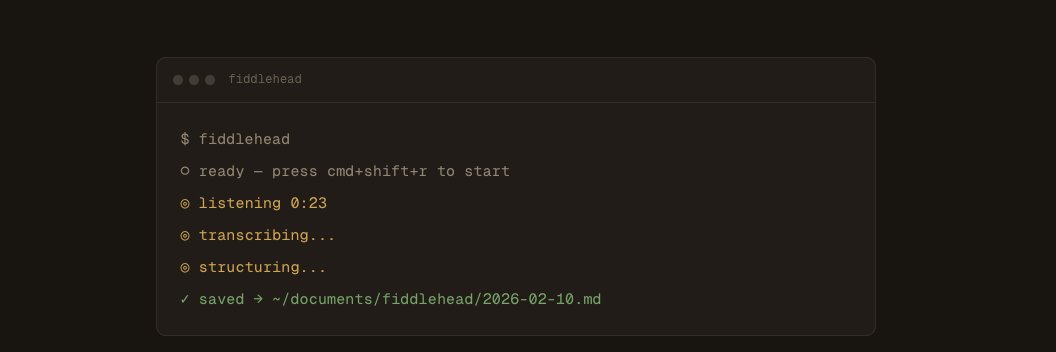
@twlvone@ideabrowser building exactly this. Fiddlehead captures meeting audio locally, transcribes it, and saves structured markdown to a folder you control. nothing leaves your machine unless you decide to send it somewhere. the use cases people bring up once they trust the privacy model are wild.
@wassimk@cjpedregal@meetgranola this is why we just save plain markdown files directly. no editor, no formatting step. you prep in Claude, the meeting runs, Fiddlehead writes a .md file to your disk. open it wherever you want. https://t.co/UV7ESlfzdi
one thing I learned building Fiddlehead. we started with one markdown file per meeting. seemed obvious. but when you point an AI agent at a folder of 50 separate files, context that spans multiple meetings gets lost. switched to one file per day with an index.md that acts as a table of contents. the LLM can search one big file way easier than hopping between dozens of small ones.
@ThijsSondag@BetkerBuilds this is basically what I built. Fiddlehead saves structured markdown files on your machine. named speakers, action items, YAML frontmatter. your AI agent can read them, you can open them in anything. https://t.co/UV7ESlfzdi
@ayushtweetshere me. Fiddlehead saves plain markdown files with YAML frontmatter into whatever folder you want. point Claude Code at the folder and it can query every meeting you've ever had. https://t.co/UV7ESlfzdi