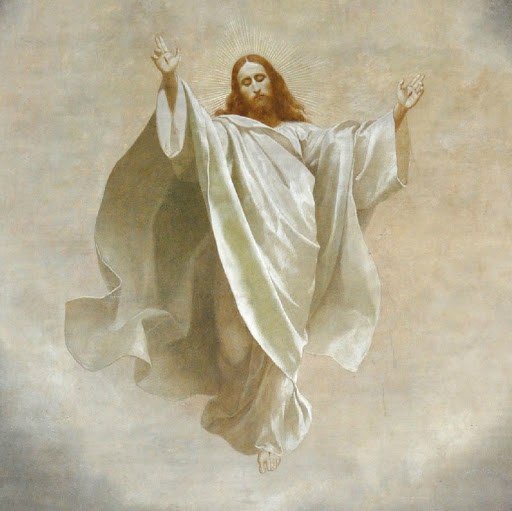
Happy Ascension Day to all Christians around the world. 🤍✨🌸
May this blessed day bring hope, love, and peace to all nations. May kindness, compassion, and unity shine brighter in our world, and may every heart be filled with comfort, strength, and hope for better days ahead. 🕊️🌍💐
Wishing peace, happiness, love, and endless blessings to everyone around the world today and always. 🌷🙏✨
#HappyAscensionDay #Ascension #AscensionDay #Assyrian #Syriac #Christian
This is the thought the devil most often throws to us: “First fix, then pray.” It sounds reasonable, but it's a devilish trap.
For years, Our Lady listened to the prayers of a robber and did not chase him away. What happened next will change everything you think about prayer. He was a robber, a rake, a killer; that was his job. And yet, he prayed to the icon of the Virgin every day, asking her for help in his case.
He prayed and went to rob, prayed and went to commit a crime, and it went on for years. And the Virgin did not chase him away. One day, he stood before the icon again to pray before he went on another crime, and suddenly he saw Christ’s hands and feet open wounds, bleeding like on the cross. Terrified, he cried, My Lord, who did this? And he heard a reply from the icon: You and people like you. With your sins, you crucify My Son again. This was the response of the Virgin. Terrifying! A real horror!
The bandit fell to his knees. Our Lady began to beg Christ for the robber to be forgiven. The first time, silence; the second time, silence; and the third time, a response: Now his sins are forgiven because of you, that is, because of the Virgin.
The bandit kissed the wounds of Christ on the icon and became a different person. Here comes the name of the icon “Unexpected Joy,” joy of forgiveness that he no longer expected; joy that, frankly, he didn't deserve.
Can you pray when you're wrong? St. Ignatius Bryanchaninov responds directly: Prayer is the cry of the fallen man to God. Not the righteous, not the winner, not the holy, but the fallen man. Prayer is not a height to be earned, it is an admission that you have fallen and alone, without God, you cannot get up.
St. Theophan the Recluse says: “If you still don't know how to pray properly, pray as you can, with one thought: God, have mercy on me, the sinner!” Nothing more is needed. Even in the very moment of sin, you can call on God. Remember the Apostle Peter; he sank and, just at that moment of disbelief, cried out: “Lord, save me!” and Christ immediately stretched out his hand to him. If there is even a spark of hope in your heart, cry to God; do not wait until you drown.
Acto de Consagración a Santa Filomena.
.
Ilustre virgen y mártir, Santa Filomena, cuyo nombre y milagros son conocidos
hasta los confines de la tierra,
complaceros con la confianza que ponemos
en vuestra interseción, al venir a encomendar
a vuestra especial protección la salud de nuestra familia.
.
Obtened para nosotros salud de cuerpo y alma, ya que en nuestros tiempos tenemos necesidad
de las dos. Hacednos fuertes en palabra y obra de nuestras vidas y procurar la gloria del Sagrado Corazón de Jesús por medio del Triunfo del Inmaculado Corazón de María.
.
Santa Filomena, rogad por nosotros, (Repetirlo 3 veces)
Remember, O most gracious Virgin Mary, that never was it known that anyone who fled to thy protection, implored thy help, or sought thy intercession was left unaided. Inspired with this confidence, I fly to thee, O Virgin of virgins, my Mother; to thee do I come; before thee I stand, sinful and sorrowful. O Mother of the Word Incarnate, despise not my petitions, but in thy mercy hear and answer me. Amen 🙏
🔸 January 17 - Saint Anthony the Great 🏜️ 🔸
Today, we commemorate Saint Anthony the Great, the Father of Monasticism who flourished in the Egyptian desert.
St Anthony was born in the village of Koma in Egypt near the Thebaid desert (today Qiman al-Arus) in 251, and was taught the Christian faith by his parents.
In church, St Anthony was inspired by the Gospel passage; “If you want to be perfect, go, sell what you have and give to the poor, and you will have treasure in heaven; and come, follow Me.” (Matthew 19:21).
He therefore sold the property he inherited after the death of his parents, and began to live an ascetic life in a hut.
The young monk was troubled by the devil with temptations, lewd thoughts, carnal feelings, and doubts about his chosen path. But he overcame the evil one by meditating on Christ, and the thought of eternal punishment.
Understating that the devil would attack again, St Anthony intensified his efforts by fasting for longer and praying from night until dawn. Seeking complete silence, he moved into the desert and lived in an abandoned fort by the Nile.
After 20 years here, St Anthony attained the highest state of spiritual calmness. Many people came to him for guidance, and soon his cell was surrounded by monasteries. He was a spiritual father to all those who came into the desert seeking salvation.
In 311, during the persecution of Christians by the Emperor Maximian, St Anthony went to Alexandria, wishing to suffer with the holy martyrs. He openly ministered to those in prison, and encouraged them to embrace their suffering for Christ.
When the persecution of Christians was ended by the Emperor St Constantine the Great, St Anthony returned to the desert. Bestowed by God with the gift of wonderworking, he was able to cast out demons from souls and heal the sick by his prayers.
His fame became so great that he even received letters from St Constantine, and was invited to attend the Synod of Nicaea in 325 where he gave an eloquent defense of Orthodoxy against the Arian heretics.
Having spent 85 years in the desert, St Anthony died peacefully in 356 at age 105. His biography was written by St Athanasius the Great.
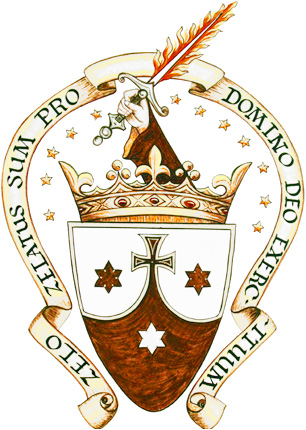
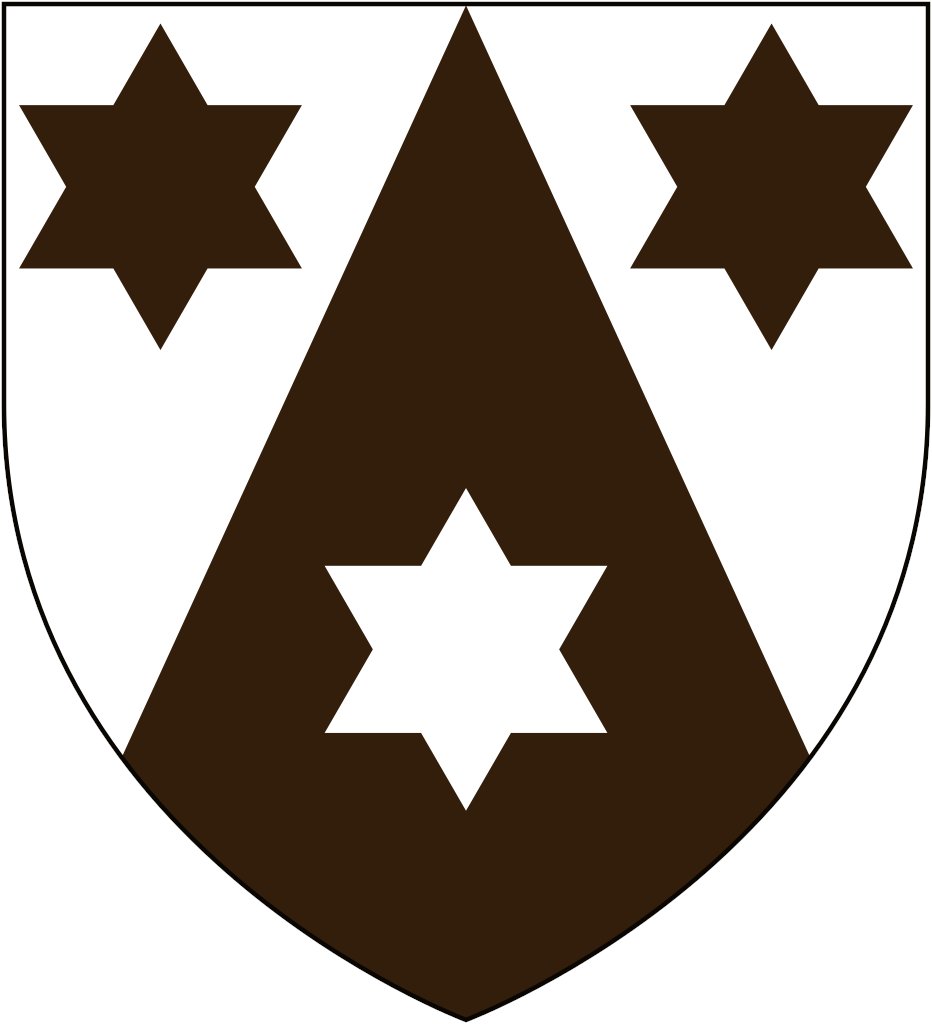
𝗧𝗵𝗲 𝗖𝗮𝗹𝗰𝗲𝗱 𝗖𝗮𝗿𝗺𝗲𝗹𝗶𝘁𝗲𝘀
Properly named Ancient Observant Carmelites, are the oldest & unreformed branch within the Carmeli order, despite that however, they are relatively small in numbers. The name "𝘊𝘢𝘭𝘤𝘦𝘥" refers to...
Today, July 17th, is the feast of many saints, including the Sixteen Carmelites.
When the revolution started in 1789, a group of twenty-one discalced Carmelites lived in a monastery in Compiegne France, founded in 1641. The monastery was ordered closed in 1790 by the Revolutionary government, and the nuns were disbanded. Sixteen of the nuns were accused of living in a religious community in 1794.
They were arrested on June 22 and imprisoned in a Visitation convent in Compiegn, there they openly resumed their religious life. On July 12, 1794, the Carmelites were taken to Paris and five days later were sentenced to death. They went to the guillotine singing the Salve Regina. Before each sister climbed the podium they knelt before their abbess and asked, "Permission to die mother?"
They were beatified in 1906 by Pope St. Pius X.
The Carmelites were: Marie Claude Brard; Madeleine Brideau, the subprior; Maire Croissy, grandniece of Colbert Marie Dufour; Marie Hanisset; Marie Meunier, a novice; Rose de Neufville Annette Pebras; Anne Piedcourt: Madeleine Lidoine, the prioress; Angelique Roussel; Catherine Soiron and Therese Soiron, both extern sisters, natives of Compiegne and blood sisters: Anne Mary Thouret; Marie Trezelle; and Eliza beth Verolot.
The martyrdom of the nuns was immortalized by the composer Francois Poulenc in his famous opera Dialogues des Carmelites.
Sixteen Carmelites, pray for us.
Today is also the feast of,
St. Acllinus, St. Alexis, St. Andrew Zorard,
St. Ansueris, Bl. Antoinette Roussel, Bl. Ceslaus,
St. Charbel, St. Clement of Okhrida, St. Cynllo,
St. Ennodius, St. Felix of Pavia, Bl. Frances Brideau,
St. Frances de Croissy, St. Fredegand, St. Generosus, St. Hedwig of Poland, St. Hyacinth, Bl. Juliette Verolot
St. Kenelm, St. Marcellina, Martyrs of Scillitan,
St. Nerses Lambronazi, St. Nicholas, Alexandra, and Companions, Bl. Pavol Peter Gojdi?, Bl. Rose Chretien, St. Theodosius, St. Theodota, St. Turninus,
pray for us!
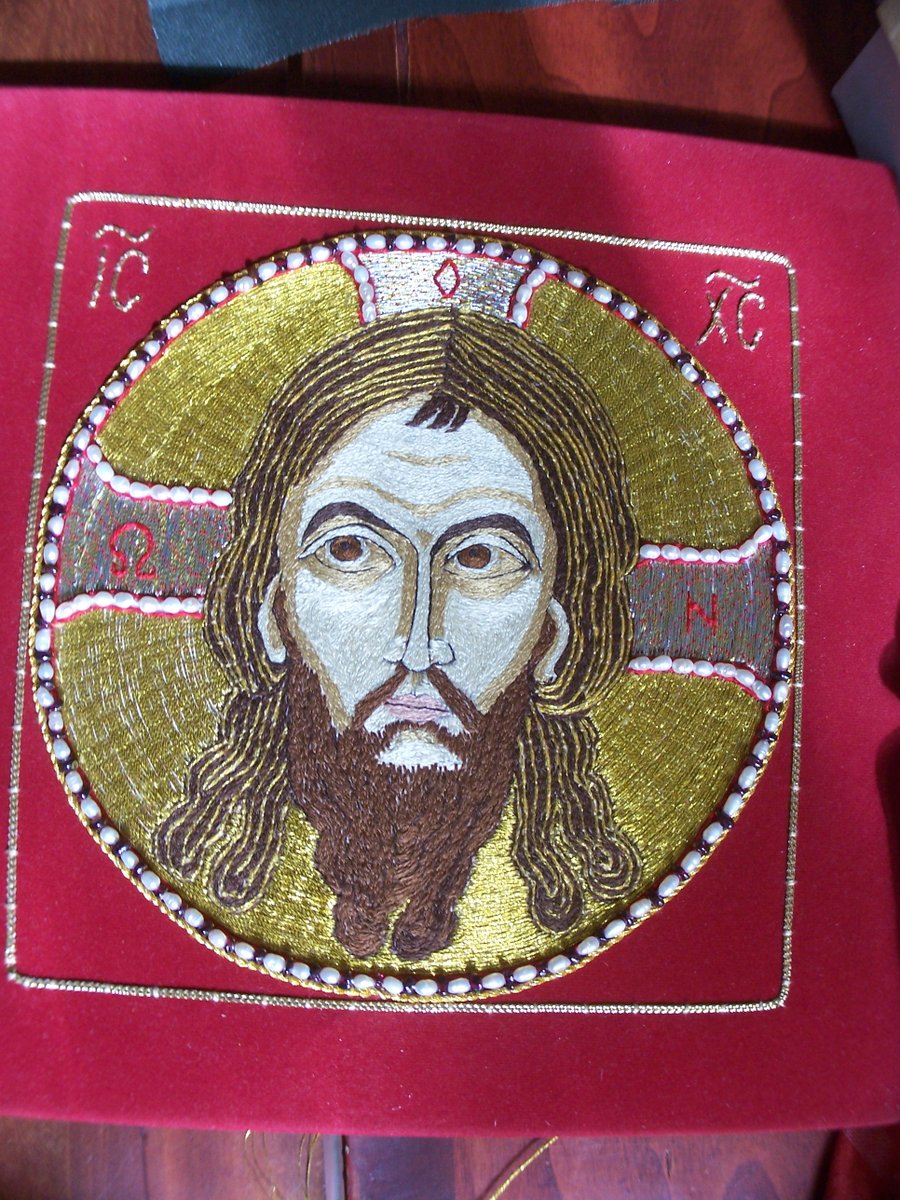
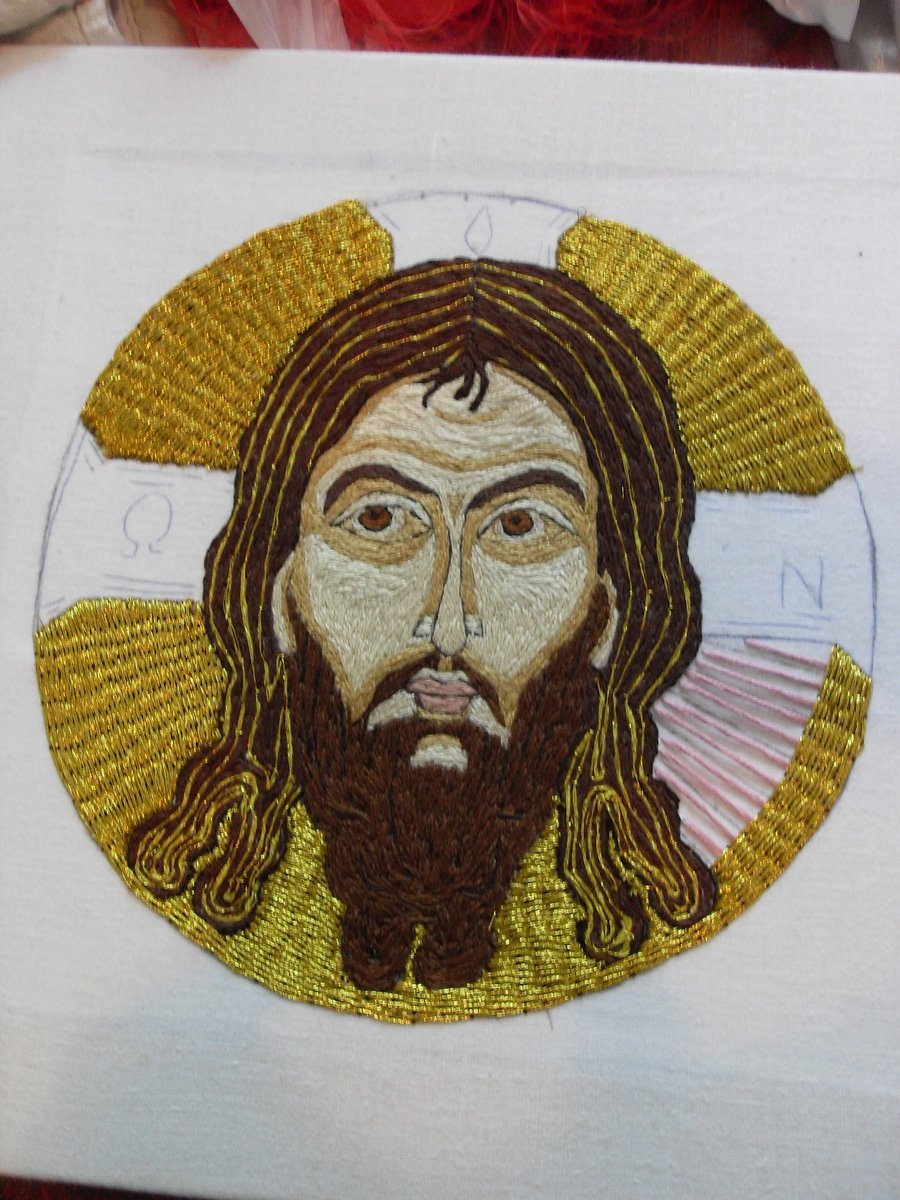
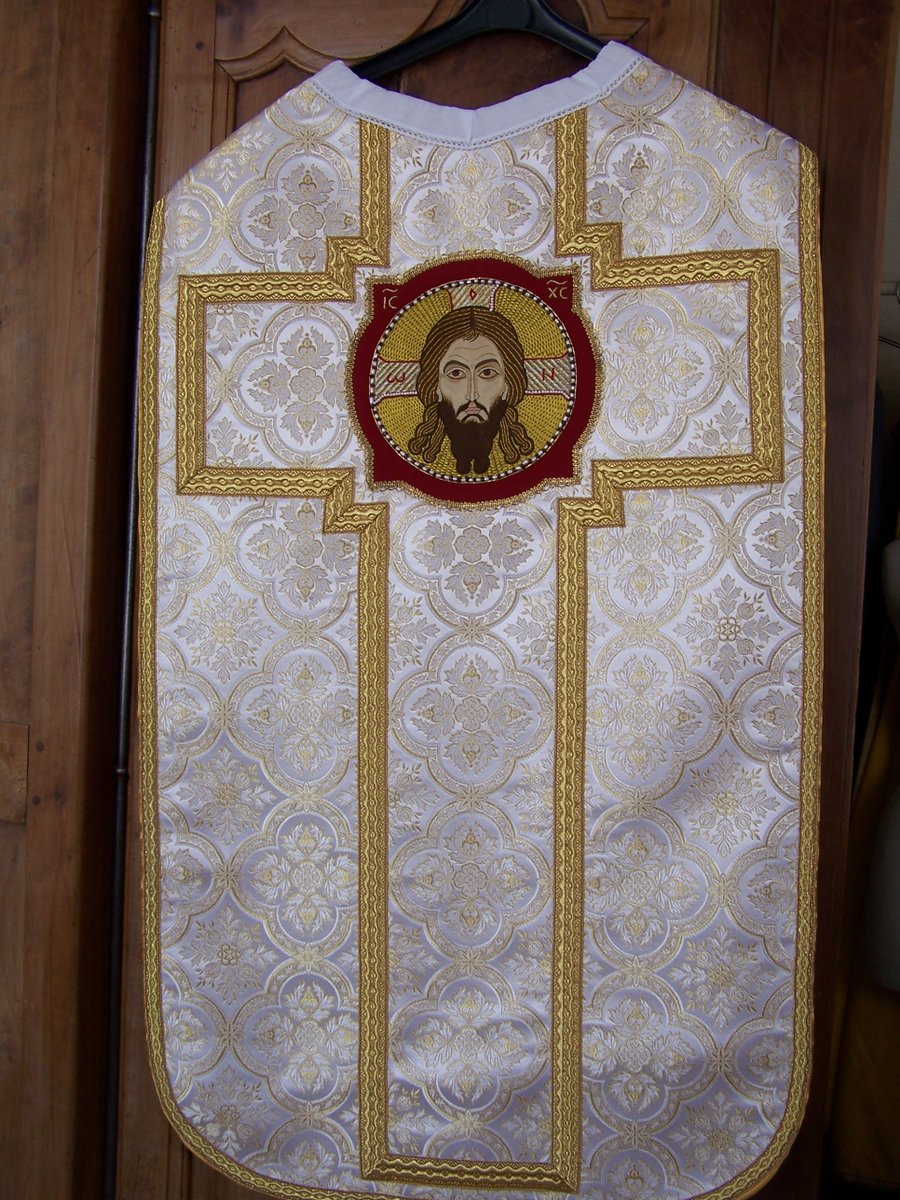
Under her guidance, my first embroidered icon had been embroidered. This one had been attached to a newly made at that time on a chasuble made by Belgium Carmelites.This definitely caught me to vestment making. 3 years later, begun the business. Icon called "Not-made-by-hands"
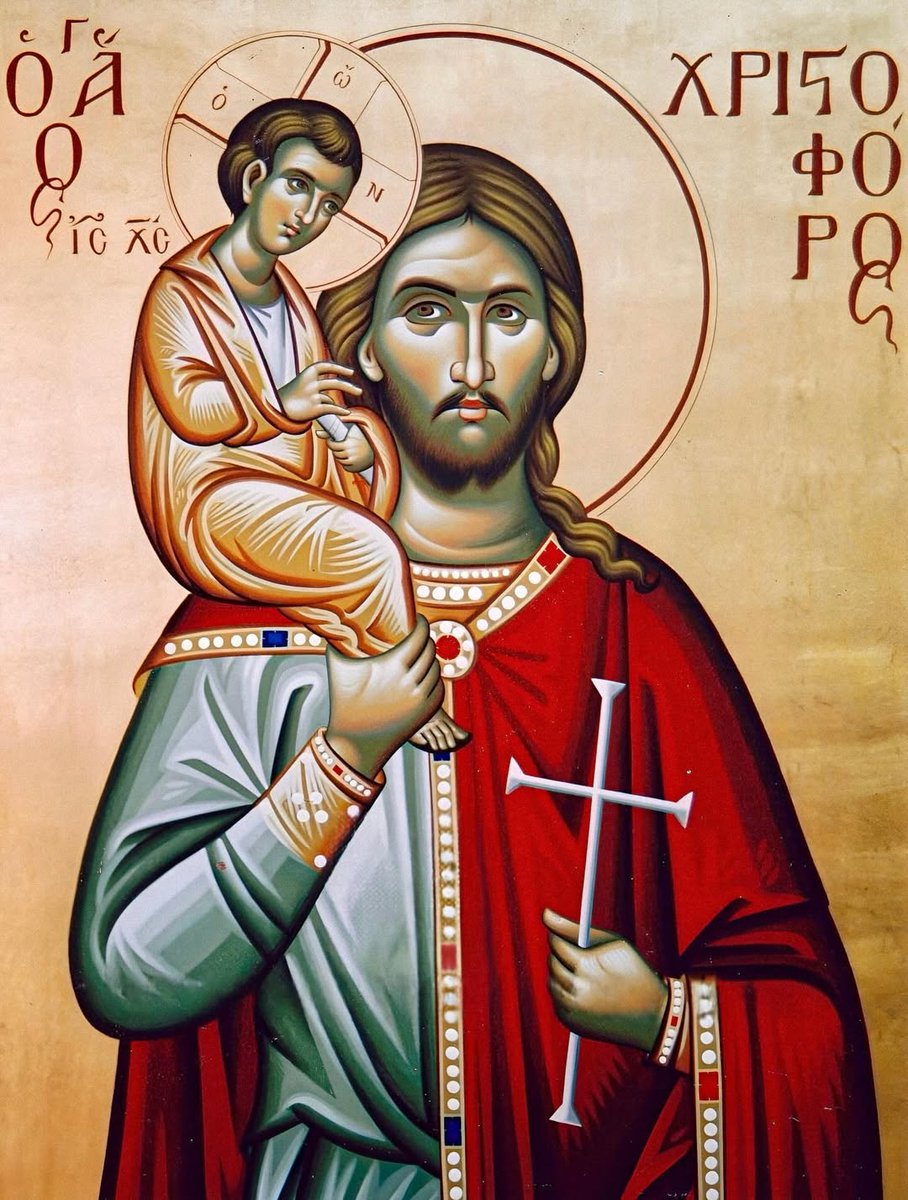
🔸 May 9 - Saint Christopher 🔸
Today we commemorate the Great-Martyr Saint Christopher of Lycia, the patron saint of travellers. He suffered during the reign of the emperor Decius (249-251). St Christopher was born with the name Reprobus, and lived in Lycia in modern-day Turkey. He was a man of great stature and strength, and fearsome in countenance. According to tradition, Reprobus once came across a hermit in the desert who instructed him in the Christian faith. Reprobus asked the monk how he could best serve Christ, and the hermit suggested that he could become an ascetic and focus on intense fasting and prayer.
Sensing that his calling lay outside monastic life, Reprobus asked the hermit if he could serve Christ another way. The hermit suggested that because of his size and strength, he could help people to cross a dangerous river where many perished in their attempts. Reprobus performed this service for some time. One day, a small Child asked to be taken across the river. While crossing the river, the Child seemed to become extremely heavy, and Reprobus had much difficulty carrying Him across.
Upon reaching the other side, Rebrobus said to the Child, “You have put me in great danger. I do not think the whole world could have been as heavy on my shoulders as you were.” The Child replied, “You had on your shoulders not only the whole world, but Him who created it. I am Christ your King, whom you are serving by this work.” The Child then vanished. Reprobus was then baptised with the name Christopher meaning “Christ-bearer”, and went into the city of Lycia and rebuked the pagans for persecuting Christians.
By his preaching, he converted thousands to Christianity. He was arrested and brought before the emperor who summoned two harlots, Kalliniki and Akylina, hoping they could entice the martyr to offer sacrifice to the idols. But St Christopher instead catechized the harlots, and both ended their lives as martyrs after they confessed their faith in Christ before the emperor. St Christopher was nailed on a bronze instrument over a flame. Emerging unharmed from this and many other tortures, he finally received his eternal crown by beheading.
🔸 May 9 - The Holy Prophet Isiah 🔸
Today we also commemorate the Holy Prophet Isaiah. One of the four major prophets of the Old Testament, he lived 700 years before Christ. He is especially revered for the clarity with which he prophesied Christ’s Passion. Isaiah was from Jerusalem, and was raised in the fear of God. Reaching the age of maturity, he entered into marriage with a pious prophetess and had a son Jashub. Isaiah was called to prophetic service during the reign of Uzziah, king of Judea, and he prophesied for 60 years during the reign of kings Joatham, Ahaz, Hezekiah and Manasseh.
The start of his service was marked by a vision in which he beheld God sitting in a majestic heavenly temple on a high throne encircled by six-winged Seraphim. After this, Isaiah heard the voice of the Lord, “Whom shall I send, and who will go to this people?” to which he answered, “Here am I, send me” (Isiah 6:8). God sent him to the Jews to turn them away from impiety and idol worship, and to repentance. Isaiah left his book of prophecy in which he denounces the Jews for their unfaithfulness to God.
Among many things, he predicted the captivity of the Jews in Babylonia, their liberation by the emperor Cyrus, and the destruction and renewal of the Temple. Most importantly, he prophesied with clarity the coming of Christ the Savior. He foretold of His birth to a Virgin, and even described the suffering of the Messiah for the sins of the world: “He has borne our griefs and carried our sorrows... He was wounded for our transgressions, He was bruised for our iniquities... and by His stripes we are healed” (Isiah 53:4-5).
The Prophet Isaiah also had the gift of wonderworking. When Jerusalem was besieged, the Israelites were exhausted with thirst, and Isiah drew water from a spring beneath Mt Sion by his prayers. It was at this same spring that Christ sent the blind man to wash, restoring his sight. For his warnings of God’s judgment on the Israelites, as well as his criticism of the impious idolater and brutal Jewish king Manesssah, Isaiah was martyred by being sawn through with a wood-saw. Part of his skull is preserved in the Hilandar monastery on Mt Athos.
Our Lady of Pompeii (also known as Our Lady of the Rosary of Pompeii) is a well-known Marian devotion in the Catholic Church centered in Pompeii, Italy.
The devotion began in the late 19th century through Blessed Bartolo Longo, a former lawyer who converted to Catholicism after a life far from the faith. Deeply transformed, he dedicated his life to helping the poor, promoting the Rosary, and rebuilding spiritual life in Pompeii, a town that had fallen into poverty and neglect.
He had a strong devotion to the Virgin Mary and encouraged people to pray the Holy Rosary with trust in her intercession. In 1876, he began building a shrine in Pompeii dedicated to the Blessed Virgin Mary. What started as a small church project eventually grew into the Shrine of Our Lady of the Rosary of Pompeii, which became one of the most important Marian pilgrimage sites in the world.
The devotion is strongly connected to the Rosary itself. The message of Our Lady of Pompeii emphasizes prayer, repentance, charity, and trust in God’s mercy through Mary’s intercession. Many miracles and answered prayers have been reported by pilgrims who pray the Rosary with faith at the shrine.
Pope Leo XIII and later popes supported and encouraged this devotion, recognizing its spiritual impact. Today, the feast of Our Lady of Pompeii is celebrated on May 8th, a day especially dedicated to praying the Rosary for peace and grace.
At its heart, Our Lady of Pompeii reminds believers that no situation is too broken for God to restore, and that through the Rosary, hearts can be renewed and lives transformed.