Message Queues & Event-Driven Patterns are the backbone of every scalable modern system - Netflix, Uber, and Atlassian all run on them.
Most engineers know the basics (“just throw a queue in there”), but interviewers destroy you with the deep follow-ups:
“How do you guarantee exactly-once processing when a Kafka broker dies mid-replay?”
“How do you handle poison messages without crashing your entire consumer fleet?”
“What happens to your Sagas during a partial failure at 50k events/sec?”
These 20 must-know Message Queues & Event-Driven Patterns take you from high-level overview to production-grade depth that actually ships reliably at scale.
Save this thread. Read till the end.
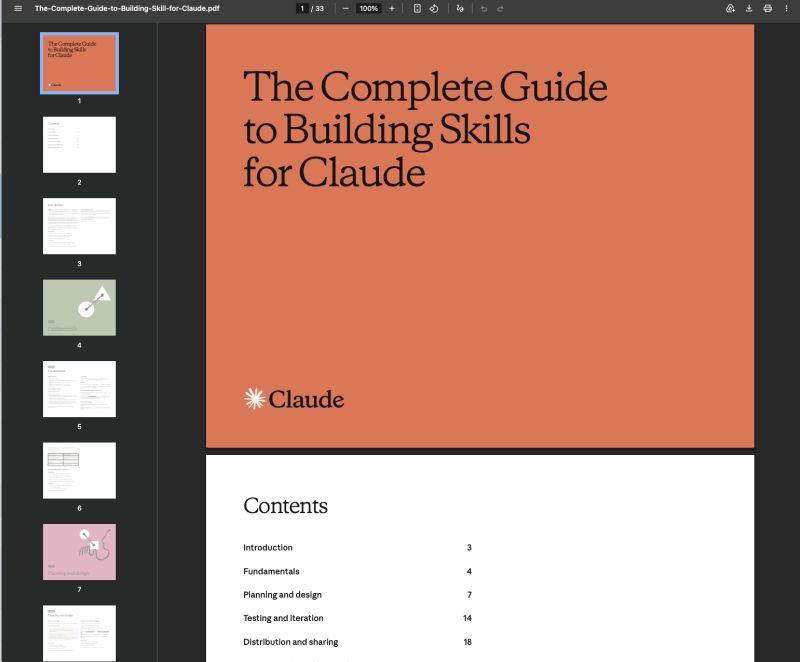
🚨 Anthropic dropped a FREE 33-page playbook revealing Claude's very own cheat code:
The 'Skills' folder.
Spend 30 minutes building it,
and you’ll never have to explain your process again.
Top-tier users don't just type commands, they build systems.
Grab your free copy of Anthropic's official guide to building Claude skills right here: https://t.co/giATfp8BZw
Everyone is learning Next.js and AI tools.
Almost no one is learning how databases actually work at scale.
CMU Advanced Database Systems (Full 22-lecture playlist)
Master these rare skills:
• How real query execution & optimization engines work
• Columnar storage, vectorized execution & modern OLAP
• Why Snowflake, Redshift & DuckDB changed everything
• Distributed database failures & the “one DB to rule them all” myth
I stopped solving LeetCode problems.
My solve rate went up.
Here's what happened:
You open a problem. You vaguely remember seeing something similar. You piece together a solution from memory fragments. You hit Submit. It passes. You mark it "solved" and move on.
But you didn't solve it.
You recognized it.
And the proof is simple - come back to that same problem in 2 weeks. If you can't rebuild the approach from scratch, you never understood it. You just remembered it long enough to pass.
I hit this wall after ~300 problems. My solve count was going up. My actual ability wasn't.
So I flipped the process.
Instead of solving first and checking solutions after, I started reading solutions FIRST. Not to memorize them - but to reverse engineer them.
I'd ask:
> What's the underlying trick here?
> What property of the input makes this trick work?
> Where else does this same property show up?
That shift changed everything.
Suddenly, sliding window wasn't "a technique for substring problems." It was a response to a specific constraint structure - a contiguous subarray/substring with a bounded condition. Once I saw the structure, I stopped missing it.
Binary search wasn't "search in a sorted array." It was a tool for any problem where the answer space is monotonic, even when there's no array at all.
Two pointers wasn't a trick. It was what naturally falls out when the input has a symmetry or ordering you can exploit from both ends.
I stopped learning problems. I started learning the WHY behind each pattern, and mapping which problem signals point to which pattern.
That's when I went from "I've seen this before" to "I know exactly why this works here."
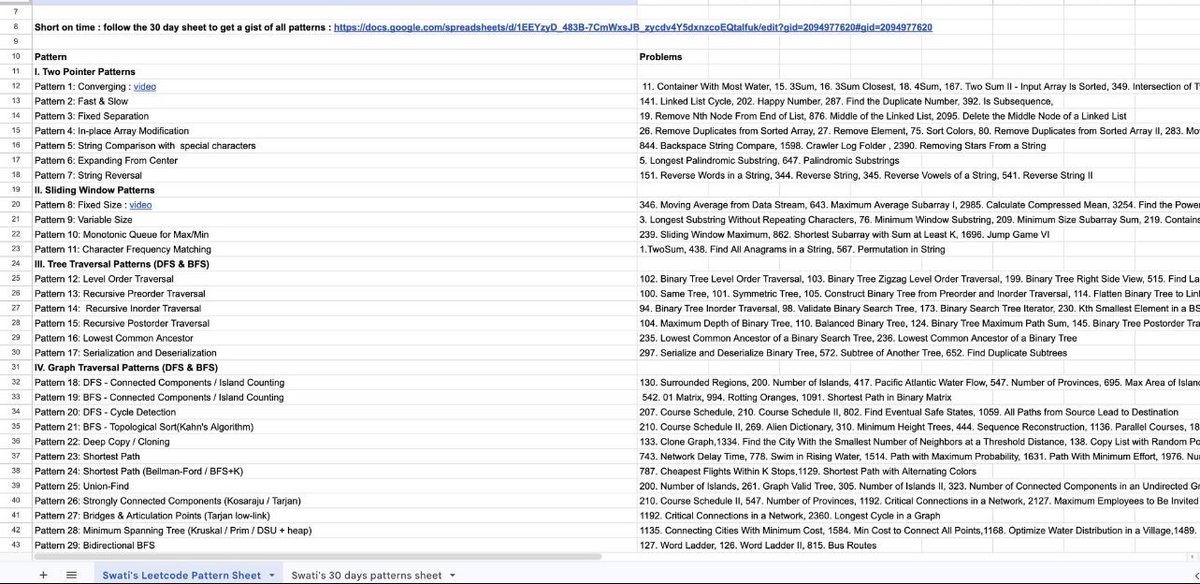
I've now mapped ~90 distinct patterns across 400+ problems. Each pattern has a trigger - a set of signals in the problem statement that tell you it applies.
Building something around this. More soon.
But if you're grinding right now and it feels random - it's not a volume problem. It's a system problem.
Stop solving more. Start understanding deeper.
Patterns sheet : https://t.co/aRQTT0VQKJ
I ignored DSA for the longest time.
Placements felt far away
And honestly… it just felt overwhelming.
Then interviews got closer.
Suddenly I was solving 5–6 questions a day
Jumping between random sheets, GFG, whatever I could find.
But something felt off.
I couldn’t remember what I solved 2 days back.
Every question felt new again.
No pattern, no structure, just noise.
It felt like I was working hard
But not getting sharper.
That’s when I switched.
I started using a DSA patterns sheet
(https://t.co/EP2ckVy7Ww)
And things finally clicked.
Instead of “solving questions”
I started recognizing patterns.
Sliding window felt familiar
Binary search wasn’t random anymore
Graphs stopped being scary
Now when I see a problem
I don’t panic
I think
“Okay, I’ve seen this pattern before”
That’s the difference.
Not more questions
Better structure.
Wish I had started this earlier.
I'm Boris and I created Claude Code. Lots of people have asked how I use Claude Code, so I wanted to show off my setup a bit.
My setup might be surprisingly vanilla! Claude Code works great out of the box, so I personally don't customize it much. There is no one correct way to use Claude Code: we intentionally build it in a way that you can use it, customize it, and hack it however you like. Each person on the Claude Code team uses it very differently.
So, here goes.
How to set up claude code and pay $3 a month with help from @Zai_org’s GLM4.5
I honestly was skeptical at first but I legit didn’t notice any difference. It’s like nothing changed
With 3x usage I haven’t hit their limit yet. May be different with others but so far so good!
Second giveaway! 🍻
1,000,000 safemoon ($14,600 worth of tokens currently)
Split between 10 winners
⏰24h to enter to win! ⏰️
To Qualify:
- Comment a goal you have for yourself for 2025 ✅
- Like ✅
- Repost ✅
- Follow me ✅
Good luck, everyone! ❤️
The Happy New Year survey is being conducted today! How was 2023 with Over? I hope that another happiness awaits you in the coming new year, so please share a little bit about what you most wish for 2024. There is no set answer. Over hopes your wishes come true. #HappyNewYear!