This is more than a heist of invaluable American Intellectual Property. It is an assault on every economy that prizes the entrepreneur, rewards private capital, and relies on fair and honest competition.
Lying, cheating, and stealing is not innovation or “win-win”. It’s corrosive to productive economic activity and to the healthy economic development of nations.
@alice_und_bob We do have @CrustNetwork which provides market incentives for storage. SQL I don't think we have— but you're right— we need better query patterns.
@D0tSama unproductive, profit-maximizing features since they have no ownership.
This allows for a focused vision, while still removing the negative part of VC funded products, which is the inevitable enshitification of said product.
@D0tSama - founder with a vision comes to polkadot
- founder is given generous salary, but no equity (the product is "owned" by governance)
- founder is given complete control of company/product
founders can build their vision, while we can also ensure there is no incentive to build
@yugu_nlp@AlexGDimakis I also believe modelB will likely follow a cellular automata architecture.
visualization: if modelB were the genetic instruction-set for a single neuron's update policy given a stream of i/o, then modelA is the brain made of a large collection of neurons
thoughts?
2/2
@yugu_nlp@AlexGDimakis I believe the solution here is meta learning (i.e. learning to learn)
- modelA is parameterized for some task
- modelB is parameterized for *updating the state of modelA's parameters* (this is the meta-learning layer)
1/2
sorry yeah by database I mean state
Gav has referred to it as "the center of the flower petals" or something— the thing you can write 8kb/s to— I *think* I'm referring to state of the overall JAM architecture
this other tweet referred to state as database (i think they were referring to state) so thats why I used that term.
https://t.co/gUN9ZKl8RT
i watched Gavin Wood’s 1hr talk on JAM so you won’t have to.
i thought i understood JAM but @gavofyork’s talk made me realise that i was thinking really small 🤯
JAM merges the best of Polkadot and Ethereum to fundamentally change what's possible in web3.
what is JAM? 🖥️
at the most basic level, it is a trustless supercomputer with:
- 1.6 petabytes of data hosting at 682MB/s
- 341 cores of compute functionality (~1,000,000,000,000 EVM gas/s)
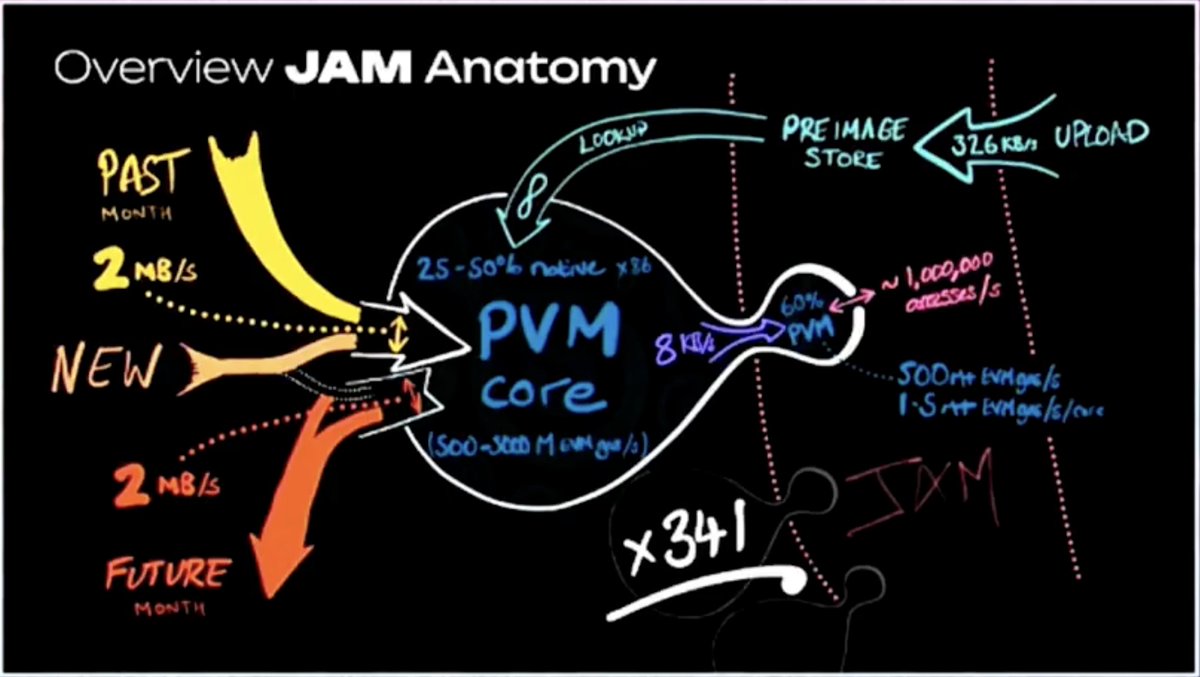
anatomy of JAM 🔬
- each AMD TR core runs at 25-50% of native speed (341 cores)
- cores can fetch 2mb/s and write 2mb/s of data to storage which will be available for 1 month
- each core has computational capacity of 500m - 5bn gas/s (in Ethereum terms)
- each cores has 8kb of output bandwidth to the database
- the database has its own scripting processor that can do stuff with the 8kb of data
- this scripting core can do 1m accesses/s into the coherent synchronous database
- pre-image lookup system that gives free data lookups for the price of holding it on-chain
JAM vs status quo
the JAM service pipeline 🪈
>> off-chain:
authorize: check that workload is paid for in-core
refine: do workload in-core, write to storage
>> on-chain:
accumulate: database atomic commit script for doing something with the output of refine
transfers: handler script for cross-service signalling/balance transfers
evolution of the graypaper 📜
the JAM graypaper has been through 4 minor changes so far:
- 0.1 initial draft
- 0.2 added segmented data availability
- 0.3 added statistics, disputes, and privileges
- 0.4 added ordered accumulation
graypaper 0.5 is currently in process with a focus on PolkaVM and a few tweaks informed by implementation of JAM thus far.
road to 1.0 🤖
- 0.6: Gav to tidy up and complete the graypaper (no more new features)
- 0.7: add network/toaster optimisations based on real-world tests
- 0.8: add post-service optimisations based on real-world services written
- 0.9: protocol audit & Kusama launch
- 1.0: final launch protocol
the roadmap looks solid 🗺️
> JAMSDK very soon
built with Rust built by .
> CoreBoot in Q4 2024
bootstraps service to provide superuser level administrative functionality
> CoreVM in Q1 2025
adds VM hosting service designed to execute regular no-std binaries (yes, it'll run DOOM)
> CoreChains in Q2-3 2025
adds Substrate blockchain runtime execution verification, message relay, and chain finality service (replaces Relay chain)
> CorePlay in Q4 2025
adds a mostly-coherent actor platform with agile partitioning and synchronous composition (the holy grail)
JAM graypaper prize update 💰
- 10,000,000 DOT prize
- 32 implementation teams announced (22 more than Gav expected)
- several teams approaching the first milestone
JAM will do to Polkadot what Ethereum did to Bitcoin (i.e. take an heavily opinionated system and making it more generalised, thus unlocking the floodgate of innovation).
RT if you’re bullish on the tech.
Cool, thanks! That makes sense then, starting to see the parallels of how it relates to a literal computer...
- "data availability" is like RAM with 2mb/s read/write
- "database" is like Diskspace with 8kb/s of write... what is the read speed for the database?
And is the 1.6 petabytes the total combined capacity between both the temporary data availability and database?
@GldnCalf Thats cool, in general I agree w/ DCA'ing into stables for the reasons you've stated, having at least a few months of projected payouts in stables
I just think the speed at which we DCA out of DOT should decrease as DOT price decreases, and increase as price increases 👍