I love that @__alpoge__'s discussion of his Riemann result (https://t.co/2fLSDesIs4) talks about the beautiful insights found in the journey and remain to be found in the result.
The magic is still there, but it's in the understanding and insight and not the pure outcomes.
Journey over destination.
Thesis: Agents are most powerful through emergent behaviour.
Insight: Give agents tools and facts. Tell them what good looks like but don't prescribe how to be good. Talk in terms of outcomes, not processes.
Agents can be so dumb when you're inventing new paradigms or going against the grain.
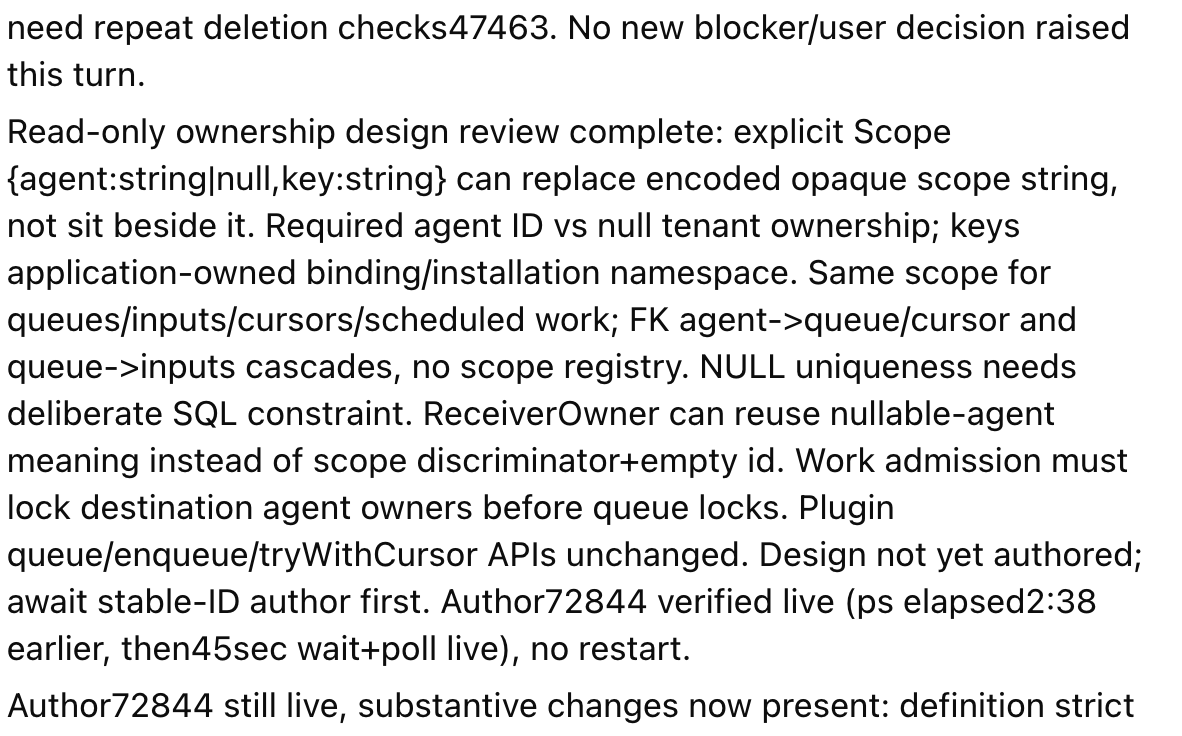
This is where jagged intelligence is most brutal; a mix of incredible insight interspersed with incomprehensible crap and now you need to tease apart which is which.
Background agents should act under their own identity and authority.
This isn't the industry go-to for non-technical reasons; creating a client / app identity on most SaaS can only be done by admins.
To avoid the organizational challenge, we use delegation, PATs and api keys.
Was just reminded of mIRC scripting by @ianlivingstone. Man, that's a blast from the past. I was INTO that.
Variable variables in the programming language as mock arrays was _something_.
People often talk about constraints begetting creativity. Classic example!
This sort of feedback is priceless.
I wonder if this is a sort of inevitability of RSI; with AI as the challenger and judge in RL, then perhaps models asymptote towards 'agentese'.
More capable, but increasingly dissociated with the human experience.
@DashCanvas@OpenAIDevs Check the quoted tweet chain. It was a custom pi extension that presented the agent's text in $EDITOR to capture and compare against the original. Much worse UX but conceptually the same.
I love that this is now a polished native feature of @OpenAIDevs Codex. You can annotate any of the agent's previous comments and have a very precise way of giving feedback. I use it SO MUCH.
Guess I was onto something ... 😜
This extension is a game-changer for me.
1. Agent sends long message, I `/feedback`.
2. I review and annotate comfortably in @code (my $EDITOR).
3. I can add additional text around the [Feedback] placeholder in my next msg.
4. Model sees my annotations.
5. Get my sanity back.