Iterative Reranking as a Compute-Scaling Method for LLM-based Rankers
Proposes iteratively applying listwise LLM rankers to refine search results, trading compute for quality gains on difficult queries like comparative and multi-attribute searches.
📝https://t.co/Bij1DkL3ef
Today @giulio_deras presented two works in the poster session of #ICTIR25
Eclipse: Contrastive Dimension Importance Estimation with Pseudo-Irrelevance Feedback for Dense Retrieval
https://t.co/PMHvo5HbXp
and as a proxy presenter:
QPP-RA: Aggregating Large Language Model Rankings
With just 3 lines of code, our lightweight saver lets you update EcoTaskSet with new training dynamics. Simple, fast, and ready to use:
https://t.co/Sq2D8BWbqf
GREEN: an inference-time method using our new dataset EcoTaskSet to recommend Pareto-optimal models balancing accuracy and emissions. Our UI lets users choose dataset & accuracy-emissions trade-off and recommends the best model
📚https://t.co/PJ4pnQJ9JF
💻 https://t.co/Fw5GDh3AF8
Our paper "Are Convolutional Sequential Recommender Systems Still Competitive? Introducing New Models and Insights" was accepted at #IJCNN! 🎉
With the right modifications, CNN-based SRSs can in some cases outperform attention-based models like SASrec by up to +53% in NDCG@10! 📈
“The Role of Fake Users in Sequential Recommender Systems”, authored by @filippobetello has been accepted as an #oral presentation at the @RobustRecSys workshop, co-located with @ACMRecSys 24 in Bari. Filippo’s second work on #recsys#robustness after a paper accepted at #ECIR.
A workshop organized by members of our group, co-located with @ACMRecSys 24. Don’t miss the opportunity to submit your paper! They are waiting for LBR& DEMO notifications of acceptance!
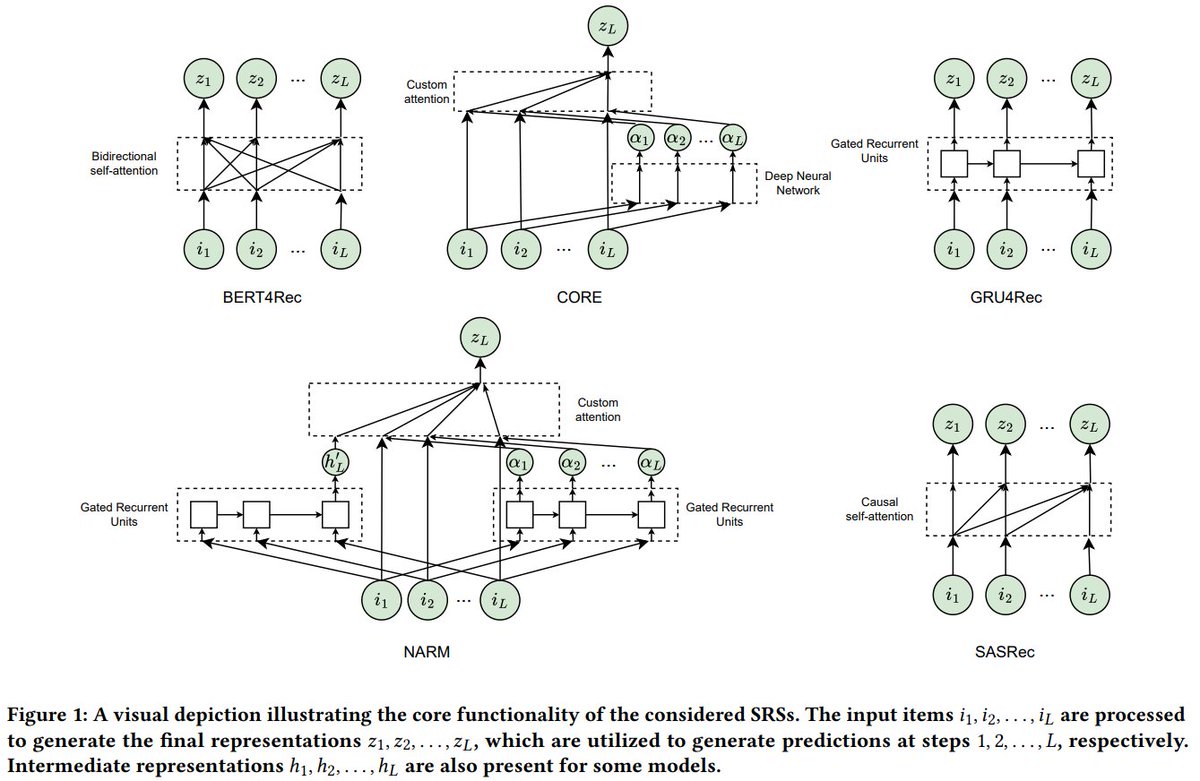
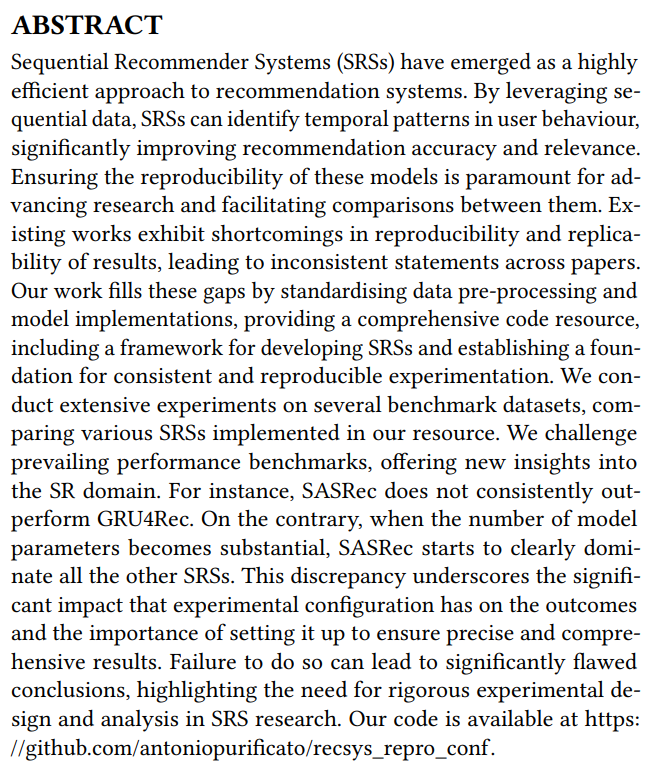
A Reproducible Analysis of Sequential Recommender Systems
Addresses reproducibility issues for Sequential Recommender Systems and challenges existing benchmarks, revealing several surprising insights about model performance.
📝https://t.co/5cZYQfpcTX
👨🏽💻https://t.co/Q0yvIKZN8Z
Unraveling the mysteries of the mind just got a little easier! Have a look at our latest paper "Learning Visual Stimulus-Evoked EEG Manifold for Neural Image Classification" published in Neurocomputing, Elsevier.
Link: https://t.co/Ns8E0HYclK
#EEG#DeepLearning#Elsevier
Using a novel architecture, that employs riemann geometry and deep learning techniques, we were able to classify images seen by a subject with up to 86% accuracy using only the EEG signal.
@ImPushMish@fabreetseo and the resulting ranked lists of suggestions share merely 10% of the ground truth items. These insights underscore significant implications for real-world recommender system applications. Access the preprint version here https://t.co/B0zZdx2KHI to read the full details.
Thrilled to announce that our full research paper, "Investigating the Robustness of Sequential Recommender Systems Under Training Data Perturbation" (co-authored with Federico Siciliano, @ImPushMish, and @fabreetseo ), has been accepted at the #ECIR24 conference.
🧵
@ImPushMish@fabreetseo In our study, we delve into the effects of item positioning within chronologically ordered training sequences. Our findings reveal a substantial impact: removing the most recent items can degrade NDCG@20 by as much as 60%..