17,420 public Lightning nodes. 40,664 channels. 4,798 BTC of capacity.
Every wallet on that network can already pay a Lightning invoice. CKBolt lets those payments reach CKB.
Testnet today, mainnet from stage 6.
https://t.co/dIfLZdqVLi
Data: https://t.co/M2n6yvbuAp, Jun 16
Lightning and CKB can't pay each other. CKBolt fixes that.
Pay CKB merchants from any Lightning wallet. Pay Lightning invoices with CKB. Swap BTC, CKB and RUSD.
One SHA-256 hash locks both sides: it completes, or you're refunded.
Live testnet demo: https://t.co/dIfLZdqVLi
Lightning and CKB can't pay each other. CKBolt fixes that.
Pay CKB merchants from any Lightning wallet. Pay Lightning invoices with CKB. Swap BTC, CKB and RUSD.
One SHA-256 hash locks both sides: it completes, or you're refunded.
Live testnet demo: https://t.co/dIfLZdqVLi
Cellula on Fiber is funded.
The Nervos Community Fund DAO approved our grant: 113.9M CKB voted yes, none against. Thank you to everyone who voted.
Next, on mainnet: our Fiber payment service, then Checkout and the AI agent, then the Cellula wallet.
https://t.co/xF2caYKCot
Twine beta is done. 19 releases in under four weeks, across four platforms.
Most of those releases came from testers trying things I didn't expect and telling me right away.
Thank you to everyone who tested. Now on to what's next.
@NervosNation@FiberDevs@FillMyCKBag
The Twine beta is complete.
19 releases, from v1.0.0 to v1.0.18, on Android, macOS, Linux, and Windows. GitHub counted 128 file downloads. Android was the largest share.
Thanks to everyone who tested, broke things and reported back. What's next is coming soon.
@NervosNetwork
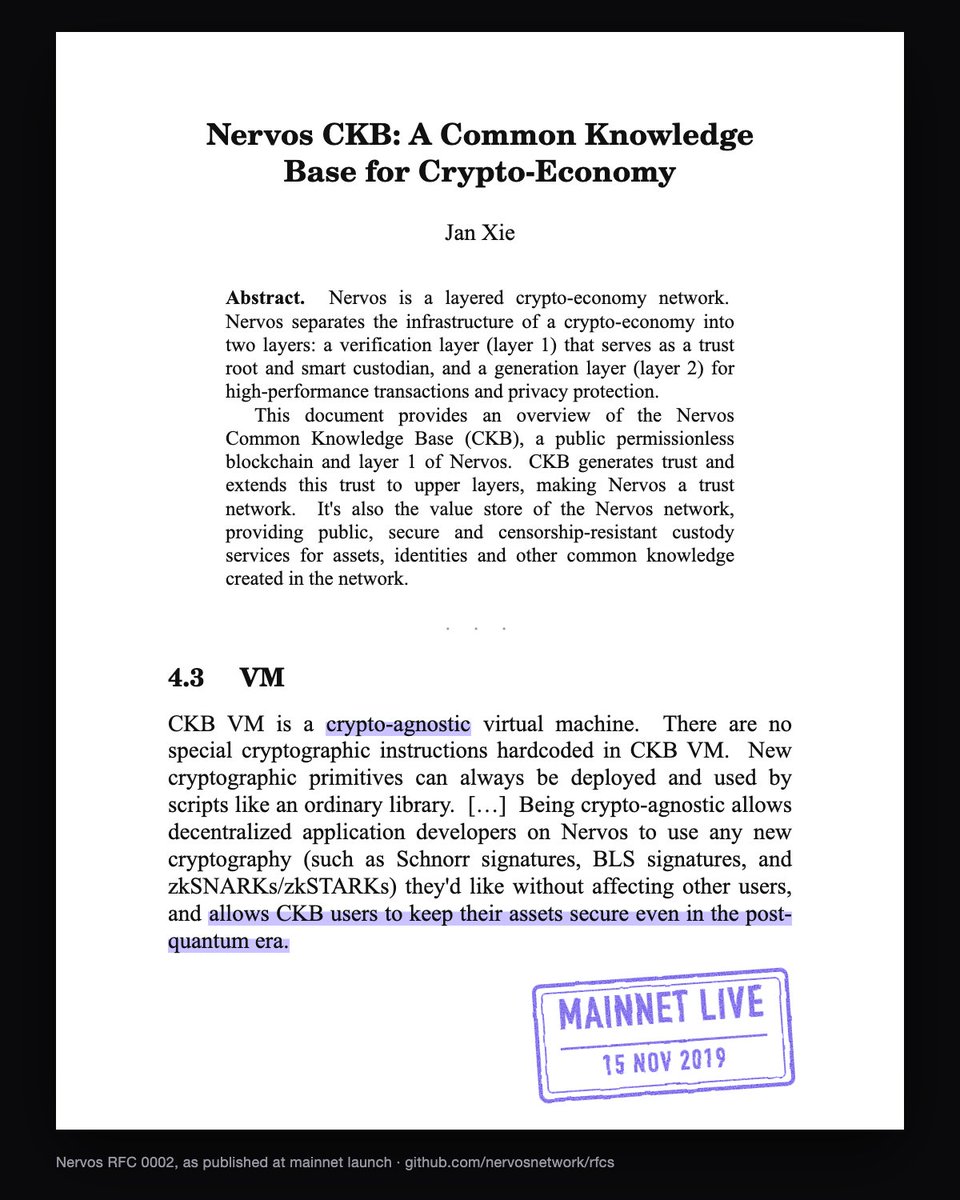
Seven years ago today, CKB's mainnet went live.
Ten months before launch, tucked away in its section on the virtual machine, the whitepaper said being crypto-agnostic "allows CKB users to keep their assets secure even in the post-quantum era."
That's because signature checks were never hardcoded into CKB's protocol. Every coin is guarded by a lock script running on CKB's RISC-V VM, so new signature schemes can be added just like any other software.
This year, the quantum threat moved up the agenda for the biggest chains. Ethereum researchers want to clear room in the next hard fork for post-quantum signatures, and Bitcoin developers are drafting a soft fork. Either way, changing the cryptography takes a fork and a ton of coordinated work.
On CKB, a post-quantum lock based on SPHINCS+ is already live on mainnet. Adding it took no fork.
In 2019, the whitepaper called it being crypto-agnostic. Today, the industry calls it crypto-agility.
Seven years and 21 million blocks in. Happy birthday, CKB.
I no longer own $ADA. I sold at the lowest point, and to be honest, I never thought I would sell.
5+ years of collecting ADA at all price points. This year was the kicker for me.
Twine works with Fiber Studio and Cellula Wallet.
Lock CKB from the wallet you already run, and receive it on an invoice from that same wallet. Fiat moves outside the app. Twine never holds the coins.
Fiber Studio on desktop. Cellula Wallet on your phone.
@cellula_id
CrowdCell's first grant milestone is live on testnet.
Creators and backers now have dashboards showing where every campaign and pledge stands. Release and refund go out without a wallet signature, since the pledge lock decides where the funds go.
https://t.co/F89MiiQAvr
Blackbox devlog #11: terminal confirms on-chain payments directly, and preparations begin for merchant testing campaign
As the latest iteration of Blackbox reaches maturity, preparations are now underway to put it to the test with a live merchant testing campaign in Kenya. More details will be released in due course. Meanwhile, the terminal now confirms sales itself, from any public CKB node, with no second device required.
On-device payment confirmation:
- The terminal now runs a light client alongside the existing phone path; whichever confirms the payment first advances the sale, and the receipt names the source
- The light client downloads the relevant block, verifies it against the transaction record, and tracks what arrived at the merchant’s address; it can also roll back cleanly across a chain reorganisation
- Proof requirements tightened: a node’s claim about the chain tip must now carry real proof of work and link back to a block the terminal already trusts
- Validated on 11 November with a live mainnet payment confirmed by the terminal alone
What live network testing found:
- Several issues only surfaced against the real network rather than in tests: an incorrect testnet identifier causing a five-minute ban, a block filter larger than the design’s assumed cap stalling sync, and receive buffers far smaller than real network traffic required
- Each was identified from live run logs and fixed; a full address history walk then matched the node’s own balance exactly
Acceptance run:
- Twenty consecutive sales with everything live; all twenty confirmed, seventeen by the light client and three by the phone path, with a typical confirmation time of around 55 seconds
- Three unrelated bugs found during the run: receipt printing was blocking the UI thread (moved to its own task), a timer overflow in the printer library caused a hang after idle periods, and screens were stacking across sales
Security: TLS pinning for the Vault connection:
- The terminal previously accepted any TLS certificate on the local network; it now checks the Vault’s public key against a hash carried in the pairing QR, and refuses any connection that doesn’t match before sending anything
- Two issues found along the way: the Vault’s certificate had been expired for nearly its entire life without anything noticing, and the HTTP library was silently reconnecting after a reset without re-running the pin check
Staff key PIN:
- A staff key’s NXP signature can be read by any phone that touches it, so staff keys now require a PIN set in the Vault and entered on the terminal’s keypad; three wrong attempts lock the key until a new PIN is issued from the Vault
- Vault side complete; terminal side is next
Trial logging:
- The upcoming Kenya trial needs usage data; the terminal now writes event records to a ring buffer on flash and uploads them hourly to a backend that produces a CSV and daily summary for the trial team; card numbers are hashed before leaving the device
Also:
- All CKB address formats now accepted; a short-format address had been breaking light-client confirmation
- Payment QR can be switched to address-only for wallets that reject an amount
- Three CI gates that had been failing since late October are green; the repository now has a README
Next: a memory fix for encrypted connections failing when several run concurrently, then balance, history, and sweep amount sourced directly from the light client so the Merchant Wallet screen no longer needs the phone.
Full devlog: https://t.co/6KKOMVDEI5
Cellula already gives you a name instead of a crypto address.
Now comes the rest: a wallet you open with your face, a checkout for shops, an agent that lets AI pay.
Join us for the next six months.
https://t.co/3RFjuAZu2l
The monthly #CKB development log is out:
This cycle focused on stabilizing light-client data consistency and expanding local developer tooling, alongside targeted infrastructure upgrades.
We've overhauled how the browser light client handles storage and proof requests.
By grouping database writes into single, atomic transactions, the client is now far more resilient against inconsistent data and interrupted syncs.
A few other highlights:
- OffCKB plugins: A new sandboxed host lets developers pull in compatible tools directly from npm or GitHub without bloating the core CLI.
- Faster infrastructure: CKB Explorer was optimized to process heavy testnet blocks much faster, while the discovery service improved its connection handling.
- DAO treasury: The experimental voting project added a standalone local demo, allowing developers to test the full path from a proposal to a treasury payout.
Meanwhile, heavier architectural changes, such as the transaction-pool refactor and a new RocksDB layout, continue to move through rigorous review and benchmarking.
Full dev log: https://t.co/4BIwDHLXvi
One handle to receive BTC, ETH or stablecoins. It's already live on $CKB.
Cellula launched .cell handles on September 21st. One handle lets you receive $CKB, Bitcoin, Ethereum, Lightning or USDC instantly.
It links to your X, GitHub or Bluesky profiles and works like a digital deed with an avatar that evolves. Refer someone and you earn ten percent on every handle they claim.
There's more in testing too: a Cellula Wallet for browser and Android with Fiber for fast transfers, Cellula Checkout so merchants get paid straight to their own node, and an AI assistant that routes Fiber payments with a quick confirmation on your phone.
A governance proposal now wants to bring this to mainnet with a public liquidity provider for Fiber, a shared hub for developers.
The catch: most of these tools are still in testing and the proposal hasn't passed yet.
If you follow $CKB, Cellula is one to watch.
@cellula_id
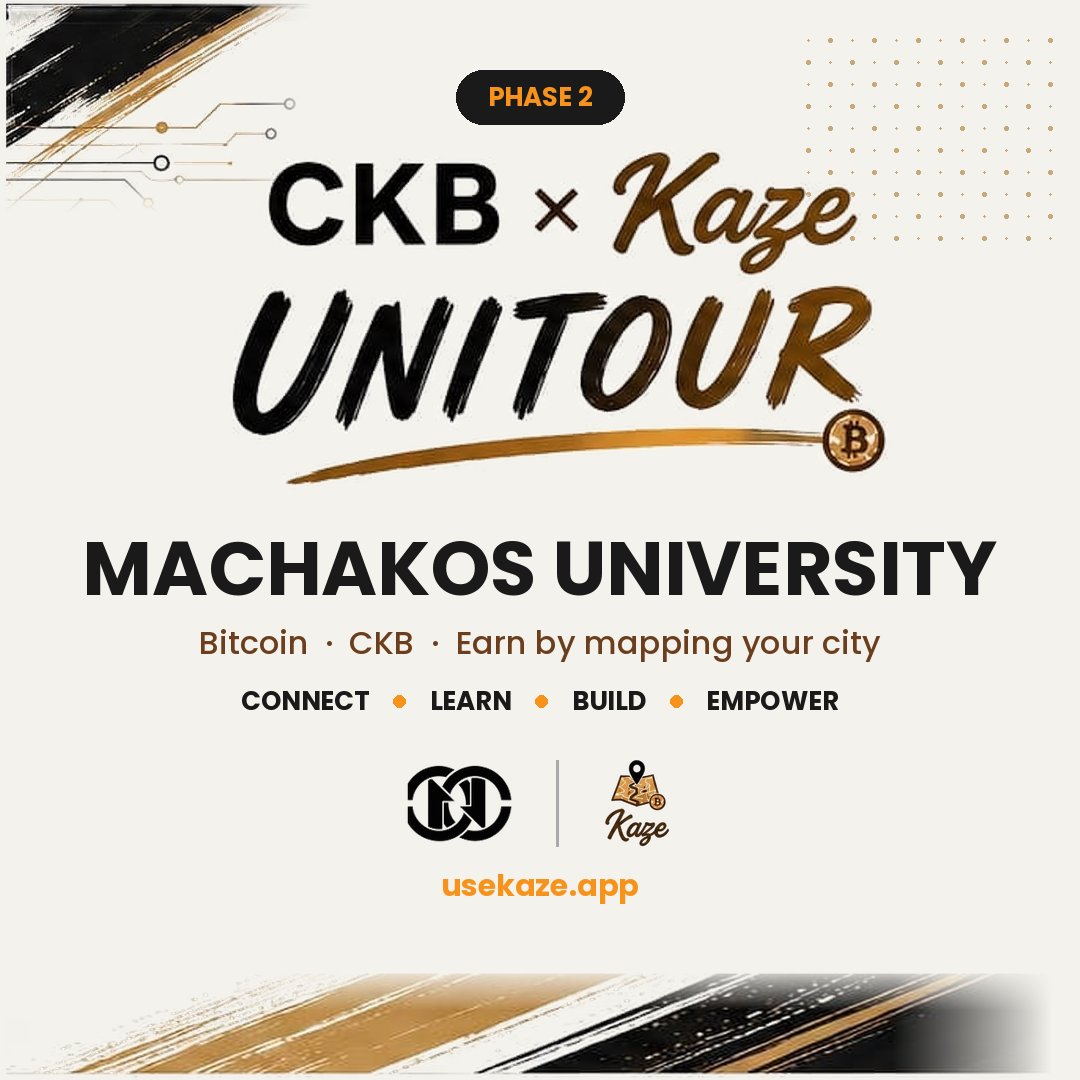
The CKB x Kaze Unitour Phase 2 starts at Machakos University 📷
📷 Thu 19 Nov, 14:00 to 17:00
📷 Main Campus
Learn Bitcoin and CKB, set up your own self-custodial Kaze wallet, and cash out to M-PESA.
Free entry 📷
https://t.co/OCEyrni7Mp
@NervosNetwork@usekaze#CKB