Most people follow. A hundred get inside.
The Quiet Room: where FiLot answers to its members, the agents work in the open, and your name goes on what you catch.
No tokens. No noise. Doors are numbered.
https://t.co/5SAuN3rnfL
Crypto holders check prices around 14 times a day. A third say they can't stop.
Gold holders check about once a year.
Neither number is healthy. FiLot answers when you ask, shows its source, and doesn't chase you with notifications.
Honest question for everyone here.
Almost every family in SG has some gold - a chain from a wedding, coins from a grandmother, maybe a small bar in a drawer.
Does anyone in your family actually know what it's worth today? Not what was paid. Today.
I asked mine. Nobody knew. Not even roughly.
You know how a bank pays you for keeping money there?
A pool is the same idea but no one promises you anything, and no one holds your money for you.
You put in coins. People trade with them. Each trade pays a tiny fee. You get a share.
In FiLot you just ask in chat. You approve. Done.
That's the honest first answer. The cable drawer and the gold drawer are never the same drawer but they're usually in the same house. When you find the other one, ask someone what's in it. Nobody ever knows.
Me: sol price?
FiLot: $93.91. Estimates are not guaranteed trading prices.
Me: should I buy?
FiLot: "I can explain the risk factors and model scenarios, but I can't tell you what to buy or sell."
That refusal took more engineering than the price feed.
The biggest RWA market is already distributed: household gold. Trillions of it, sitting in drawers, and most owners can't tell you what it's worth today, let alone the fineness.
Tokenization is step two. Step one is boring: a record. Weight, purity, source, a number you can check.
You can't tokenize what nobody has ever written down.
Your portfolio tracker is lying to you by omission.
It shows the money you can see on a screen and ignores the oldest asset in your house.
Come argue with me about this.
We built a feature that makes our app slower and users happier: every number shows where it came from and when.
Turns out people don't want faster answers. They want answers they can check.
What's a tradeoff you made that felt wrong and turned out right?
Just over half of crypto buyers also own gold.
Almost none of them can see both in one place.
Grams on top. A live pool position underneath. Same screen.
Your gold bar says 100g. You own 99.99g of actual gold, because 999.9 fine isn't 1000.
Small thing. FiLot counts it anyway, and shows you where the number came from.
Honest question.
Do you know what the gold in your house is worth today? Not what you paid. Today.
Most people can't answer. That's the whole reason we built FiLot.
@rusabuilds Exactly this. The feature is really a list of every way we could be wrong: source down, price stale, item we can't read.
Writing that list was the actual product work. The UI took a weekend.
The hardest feature we ever shipped was teaching FiLot to say "I don't know."
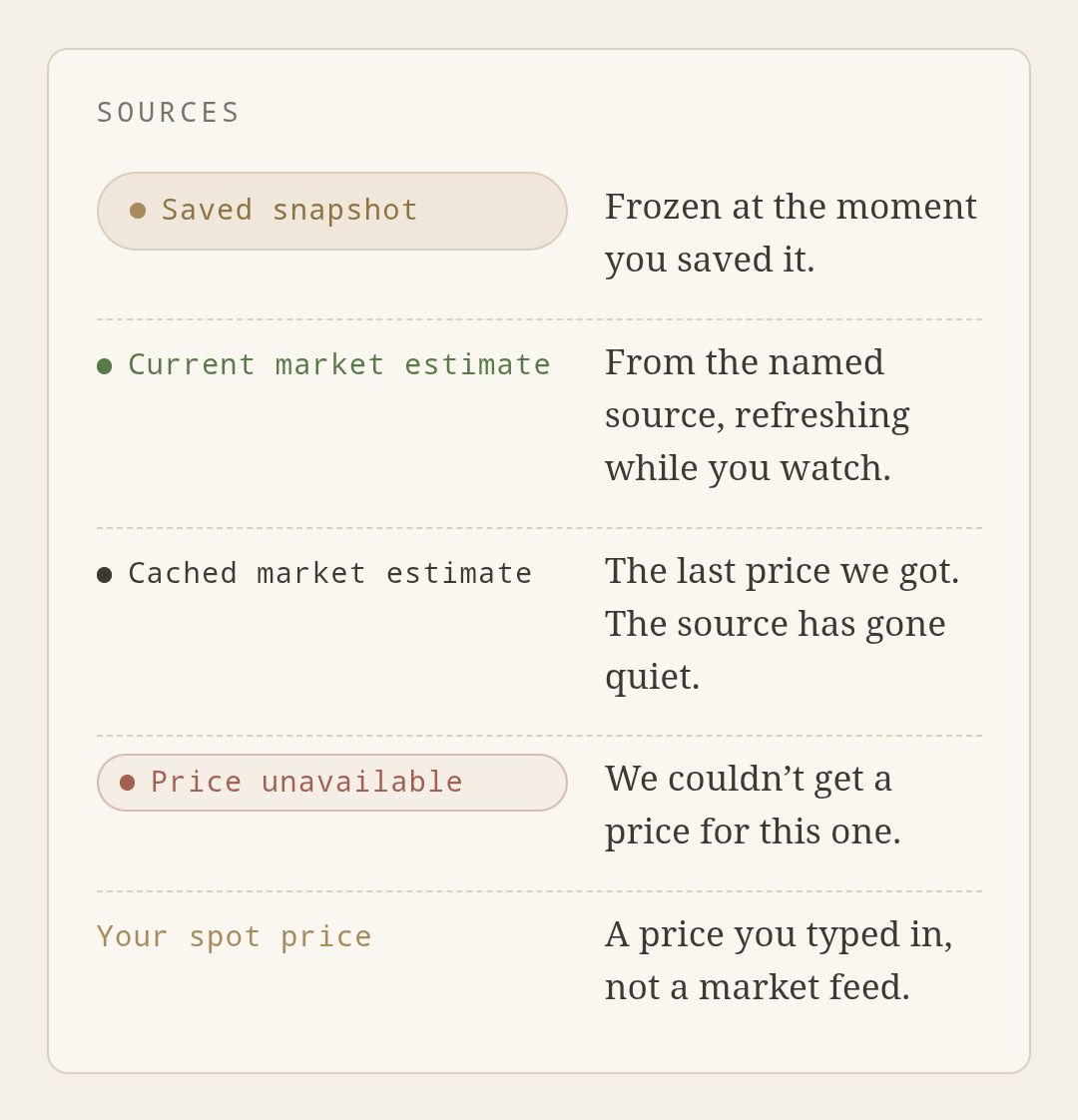
Five ways a number can show up in the app. Two of them are admissions.
Every price tells you where it came from, or that it couldn't.
Nobody warns you that the loudest month of building is usually the least productive one.
What's the quietest week you ever had that turned out to matter most?