i think in general people should be restricted on giving opinions on india (good or bad) unless they regularly travel by local train or used to atleast i am in tears bro its so hot crowded late i cant and the stairs
@vanitatum0 tbh i respect the people who built the models because even building whatever they did with a very small young team with no one who has been there done that before is impressive
After 2.5 years at Sarvam, I am starting something new!
I had a great time leading the RL team. We launched the 30B and 105B models back in Feb with a young team building everything from scratch. Excited to see the team keep growing and pushing the frontier. Grateful to @pratykumar for the early bet and trust.
As for what's next: I am convinced that there are a few critical parts of the stack that we still need to build to meaningfully accelerate science. One of them is verification.
Scientific discovery only scales with compute when proposing and verifying new ideas is fast and cheap. In math and code, we're starting to see what happens when models can generate ideas and reliably check them at scale. OpenAI's recent Navier-Stokes work is a glimpse of what that looks like.
Similar moments in chemistry, materials, biology and the rest of the physical sciences would require verification to get dramatically faster and cheaper. It cannot be bottlenecked by the throughput of physical labs
More soon. Very excited for what's next.
I was so excited until I read the last sentence.
My honest read is that the model doesn't actually communicate more naturally; it gets caught with the smoking gun less often.
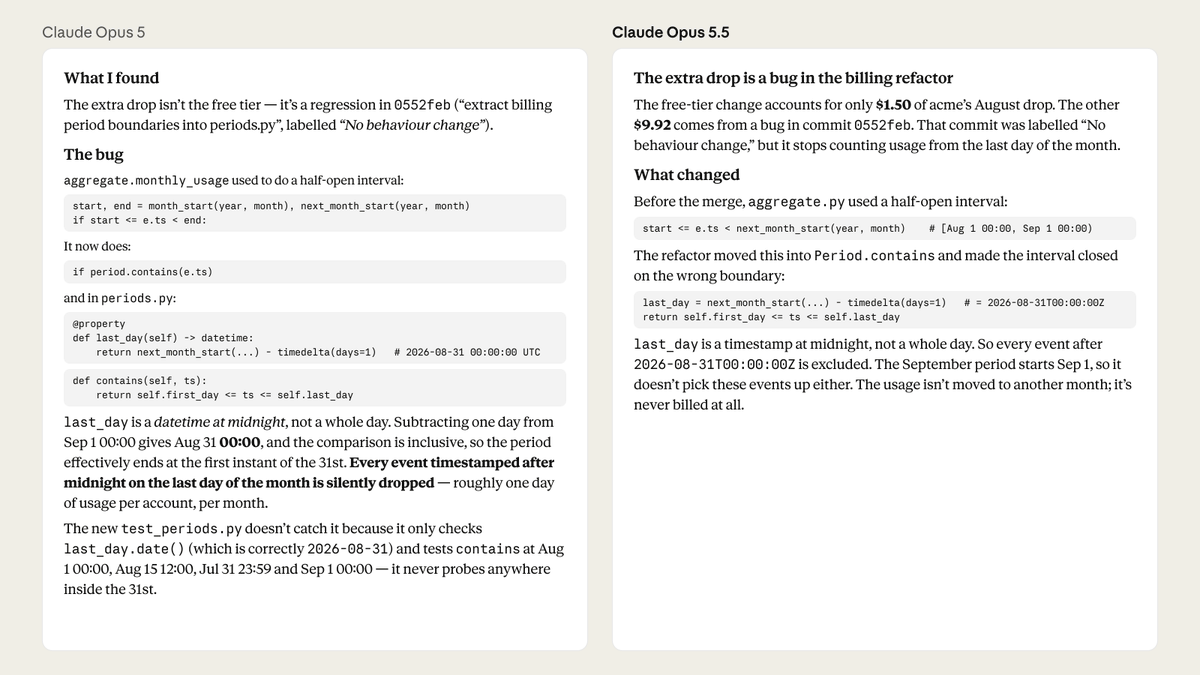
Opus 5.5 communicates more naturally, addressing some of the most common feedback we heard on Opus 5.
It puts the most important information up front and follows the writing rules you give it, which makes long sessions easier to follow.