End-to-end AI filmmaking platform. Write, break down, budget, storyboard and schedule films up to 90% faster. One workspace for writers, producers and studios.
GTA VI was delayed twice rather than launch unfinished.
Most filmmakers do the opposite: send the festival a rough cut, get a no, then learn the finished film can’t be resubmitted.
Before you submit: picture locked? Sound mixed? Colour done? Can you resubmit later?
Your script. Your decisions. One place for the rest.
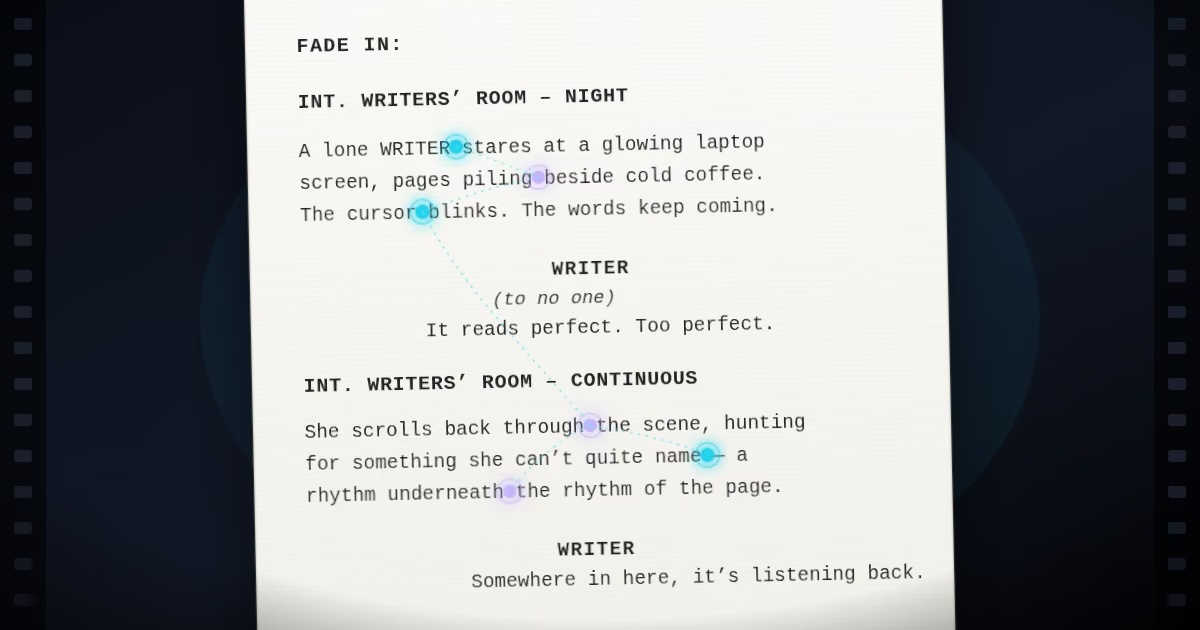
Write, break down, storyboard and schedule your film in FinalBit.
Black Friday: 50% off annual, 30% off 3-month plans. Ends Dec 1, 11:59 pm PT.
Claim it: https://t.co/9DnpXTDLeV
Just watched Kill Code (2026), and it's a perfect example of how NOT to use AI in filmmaking.
why noInteresting concept, solid cast (Harvey Keitel, Frank Grillo, Tyrese Gibson), but poor storytelling, weak dialogue, questionable action choreography, and on top of that, sloppy AI-generated shots that don't even match the live-action footage.
AI won't save a movie from bad filmmaking.
It can be incredibly useful in pre-production, planning, and VFX work. But generating more pixels doesn't mean creating better cinema.
Let humans make films. Let AI handle the boring stuff.
Movie magic isn't generated by a prompt.
https://t.co/IdU8QJ3mnW
AI costs more. (Sometimes.)
AI was supposed to make films cheaper. A Korean AI studio founder just warned it could make features cost more than shooting on 35mm.
Speaking at the Taiwan Creative Content Fest last week, Kim Kwang-jib of Studio Meta-K said AI is already cutting costs on commercials (reported by Variety). Features are different. Runaway token fees and piecemeal revisions could leave producers paying more than in the film-stock era.
We think he's naming a problem that's older than AI.
"Piecemeal revisions" is where film money has always leaked:
the scene rewritten on the day,
the location swapped after the budget was locked,
the reshoot nobody scheduled.
AI doesn't remove that problem. It puts a meter on it.
Every "one more try" now has a price.
Our belief: films are won or lost in planning, not only in talent. That's even more true with AI.
What planning looks like before anyone generates a frame:
1. Lock a script version, and number every draft after it.
2. Break it down: scenes, cast, locations, page counts.
3. Decide which shots are worth AI and which are cheaper to shoot.
4. Set a revision budget, the way you'd set a reshoot budget.
Plan first. Generate second.
Just watched @A24 ’s Primetime with Robert Pattinson, and I genuinely think he deserves an Oscar for his performance.
But while watching, I kept thinking about how beautifully the film was shot. The performances, atmosphere, emotions, and all those little creative decisions that make a movie memorable.
At the same time, I recently read about a fully AI-generated movie in China that completely flopped at the box office.
And it made me think: People don’t want to watch AI slop.
Don’t get me wrong. From a technology perspective, what AI can generate today is incredibly impressive. But beautiful visuals and realistic scenes don’t automatically make a great film.
Something is missing. The human perspective, emotions, storytelling, and creative decisions behind every scene.
This is exactly what we believe at FinalBit.
AI absolutely has a place in filmmaking, but it shouldn’t replace filmmakers.
Let AI handle the mechanical, repetitive, time-consuming parts of production. Let humans focus on storytelling, creativity, and bringing their vision to life.
We don’t need AI to make more movies. We need AI to help humans make better movies.
That’s the future we’re building towards at @finalbitai
.
Curious what others think. Would you actually pay to watch a fully AI-generated movie in a cinema?
His last performance as Professor X hasn't been seen yet.
Sir Patrick Stewart passed away this week at 86, less than two months before Avengers: Doomsday, his final appearance as Charles Xavier.
When it reaches cinemas, we will see him one last time in the role he made his own.
For a generation of fans, he didn't just play Professor X. He became him.
He came to the role from the stage, after years with the Royal Shakespeare Company. He brought that same calm authority to a telepath in a wheelchair, and suddenly a comic book world felt real. When Xavier spoke, you listened.
What he gave the X-Men:
🦸 2000: X-Men. He brought Xavier to the big screen for the first time, alongside Hugh Jackman and Sir Ian McKellen, and helped bring Marvel's mutant heroes into the mainstream.
🧠 2000–2017: He led the X-Men across the series. His friendship and rivalry with McKellen's Magneto became the heart of the franchise.
💔 2017: Logan. He showed us a Xavier we'd never seen: older, fragile, still fighting for the people he loved. For many fans, it's the performance that defined him.
🌀 2022: He returned in Doctor Strange in the Multiverse of Madness, his first appearance in the Marvel Cinematic Universe.
Over more than two decades, he turned a comic book mentor into one of the most beloved characters in film.
Thank you for the stories, Sir Patrick.
Paramount and Warner Bros. are now one company, which means fewer people who can say yes to your film. If you make independent films, here is the short version. 👇
https://t.co/bbu2EJf68h
About 3,000 AI films were submitted to one festival this year.
Then so we typed “movies without AI” into Google.
It already suggests: “best movies without AI.” “New movies without AI.”
Both are true. And it’s changing what “made by humans” is worth.
A few things I noticed this week:
→ A UK sales company started labelling its films “No AI Used”, inspired by A24’s disclaimer on Heretic (Deadline, Feb 2026).
→ A free “Human Provenance in Film” standard launched in May, with three tiers: No AI Used, Assistive AI and Generative AI.
→ Audiences aren’t against AI everywhere. In one US survey, 62% were fine with AI special effects, but only 24% accepted an AI lead actor.
Here’s the catch: anyone can write “human-made” on a poster.
Proving it is harder.
A small habit worth starting on your next project: keep a simple log of where AI was used and where it wasn’t. Dated drafts, raw footage, edit files. Ten minutes a week.
Because festivals and buyers are likely to ask how you made your film, and “trust me” won’t be enough.
Would you be ready to answer that question today?
Is the Warner Bros and Paramount merger ultimately good or bad news for moviegoers? Theaters get guaranteed blockbusters, but market competition drops significantly.
Share your take below.
The most expensive line on an indie call sheet is usually
"Parking: on site."
It looks fine when you write it at midnight. Then the grip truck turns in at the wrong gate, someone walks up the road looking for signal to call the AD, and the day starts 40 minutes behind.
One test before you send tomorrow's sheet: hand it to someone who's never been to the location and ask where they'd take the truck. If they have to think about it, so will your crew.
We made a free call sheet template built around this, with a short guide to filling it in.
Comment to get the editable template for free.
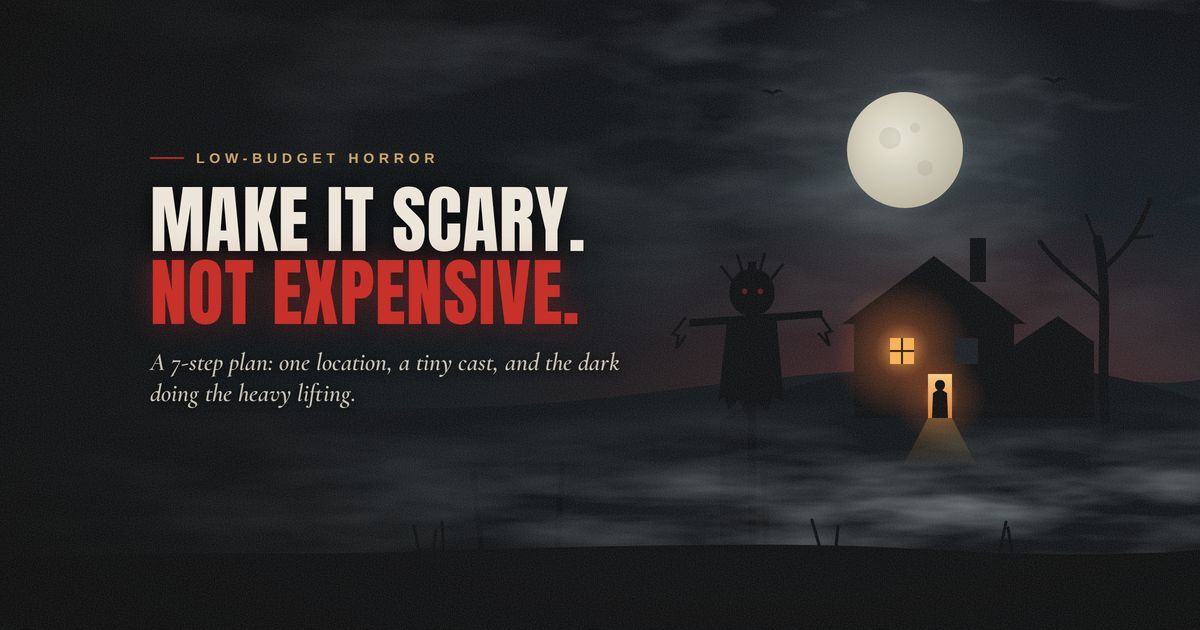
Horror is the one genre where a small budget can look like a choice, not a compromise.
-Paranormal Activity cost $15K.
-The Blair Witch Project cost $35–60K.
-Obsession cost $750K and passed $400M this year.
What they share: small casts, simple locations and a plan built around their limits.
We turned that into 7 practical steps for your next shoot, from finding free locations to planning night scenes without blowing the budget.
Swipe through 👇 and save it for your next project.
Which step would help you most right now? Tell us in the comments.