🧩New DIY for scientific publications: our data and behavioral analyses scripts are finally available at https://t.co/yCSthGoT5u! Any comment is welcome 💡
Our review with @FindlingCharles on the origin, impact and function of computation noise in human learning and decision-making is now out (no paywall) in Current Opinion in Behavioral Sciences: https://t.co/uSjDqLrXMf Main points below: (1/25)
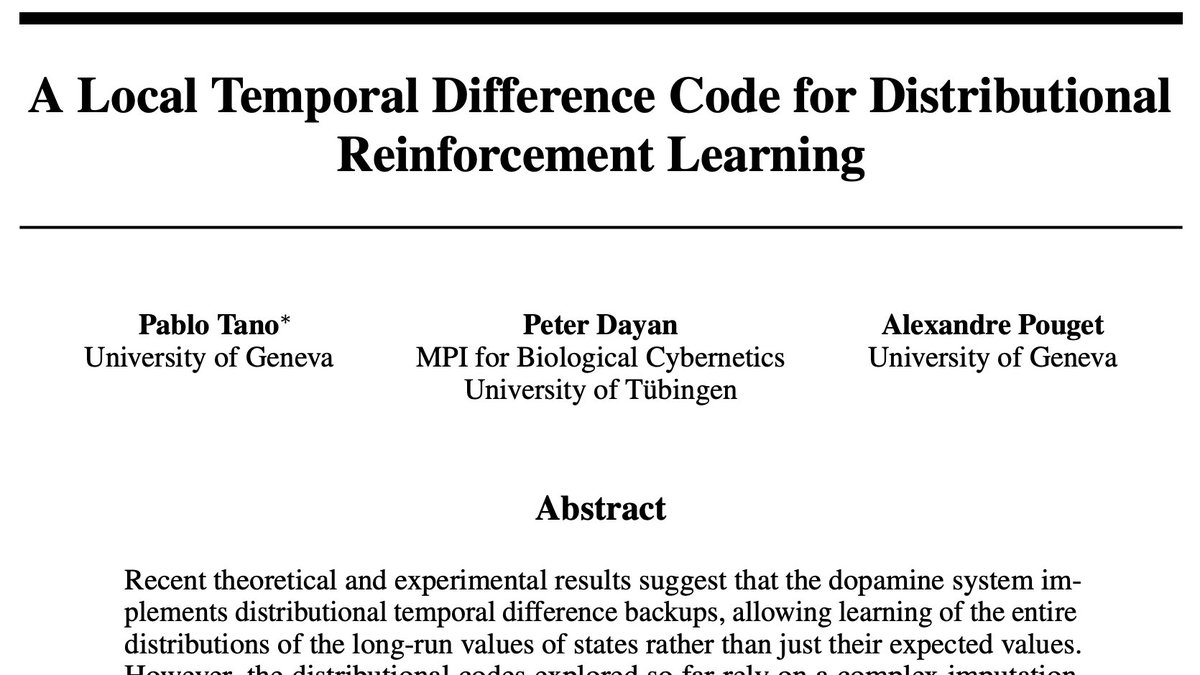
Very happy to share our paper in #NeurIPS2020 with @pouget_alex and Peter Dayan!
(1/10) We present the Laplace code, a neurally-plausible Temporal Difference rule for Distributional Reinforcement Learning.
Paper: https://t.co/HjtqZxEvKK
Video: https://t.co/NuhnQtea2R
Very happy to share this work at @NatureHumBehav with Nicolas Chopin and @KoechlinE on the properties on inference noise in changing environments! Across simulations and experimental work, we show that noisy agents performs as well as more complicated agents that track volatility
Glad to share our new paper https://t.co/c8ZZkdVvmg in @NatureHumBehav entitled "Imprecise neural computations as a source of adaptive behaviour in volatile environments" by @FindlingCharles, Nicolas Chopin and @KoechlinE. The Weber Law in inferring stable state beliefs is key!
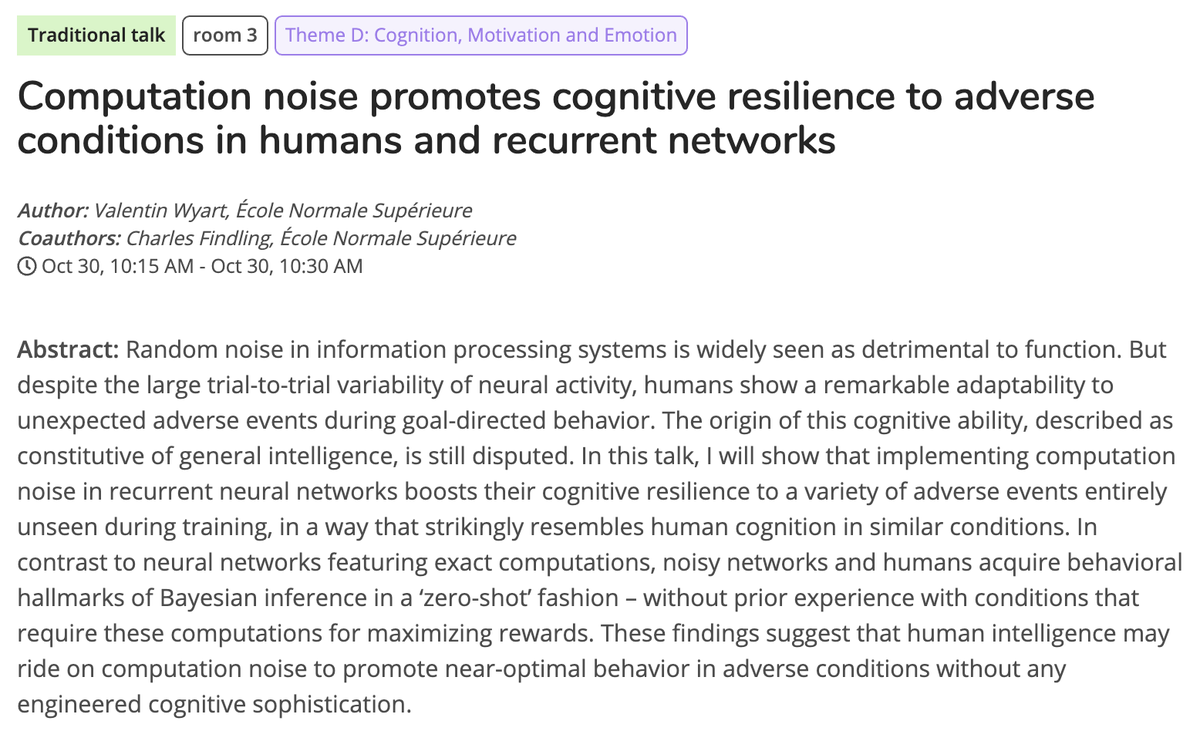
Interested to hear about the surprising benefits of cognitive noise in adverse conditions? Tune in to @neuromatch#nmc3 room 3 this Friday at 09:15 UTC, new work led by @FindlingCharles.
Abstract: https://t.co/ELL0wOp52a
Preprint: https://t.co/27FFgPRRPO
Thanks for reading, I hope you’ll find it as compelling as we do! For more information, check out the preprint on @biorxiv_neursci: https://t.co/GkI40xe6YQ (15/15)
These results show how computation noise promotes zero-shot adaptation to unexpected adverse events without purposeful cognitive sophistication. (14/15)