Google just gave Gemini a body.
Gemini Robotics 2 can control humanoid robots from feet to fingertips — walking, crouching, reaching, handling objects, and completing multi-step tasks in the real world
It can:
→ coordinate the entire body
→ use five-fingered hands and grippers
→ recover when a step fails
→ work together with other robots
→ run locally without constant internet access
→ adapt to a completely new robot body with just a few hours of data
One model checkpoint already works across multiple robot types.
This is no longer an AI that only tells a robot what to do.
It sees, reasons, plans, moves — and finishes the job.
The chatbot era was only the interface.
The next AI race is physical.
https://t.co/5rtjawdmzH
watch a robot get told "clean up the watering can" once — and just... do it. walk to the table, pick it up, cross the room, put it away
that's Gemini Robotics 2, and it's the first AI model to control an entire humanoid body, not just the arms.
three models, one system:
the "brain" (ER 2) plans multi-step tasks and can coordinate MULTIPLE robots working together
the "body" (Robotics 2) handles whole-body movement + hand dexterity precise enough to tie a knot or seal a ziplock
the on-device version adapts to a completely new robot body in hours, not months, with under 200 examples
Google just quietly shipped the "one brain, any robot" future
https://t.co/gPGNxXf2Qa
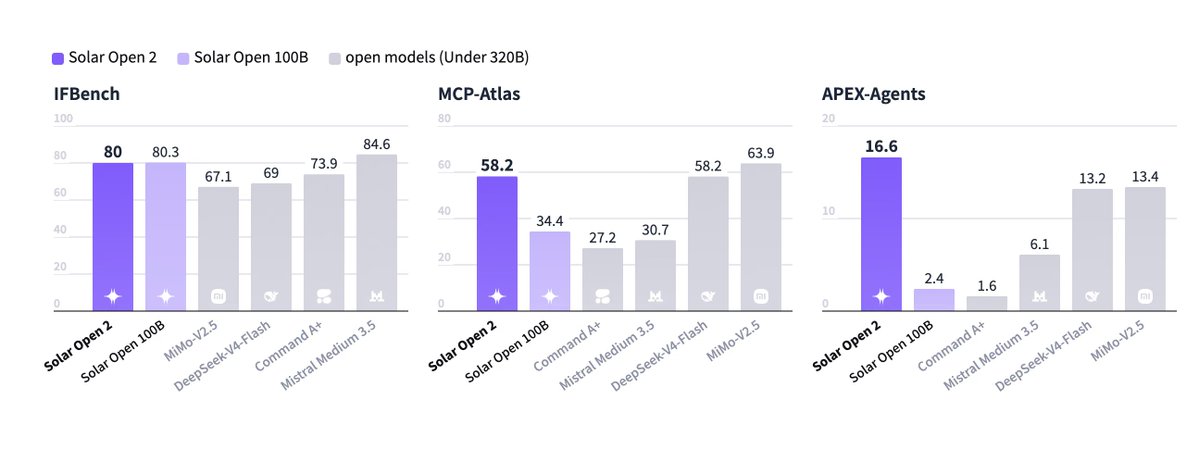
a drop-in replacement for DeepSeek-V4-Flash (284B), Command A+ (218B), and Mistral Medium 3.5 (128B dense) - that's up to 8-10x cheaper to run
it beats all three on reasoning and knowledge benchmarks while only firing up 15B active params per token. even edges out MiMo-V2.5, a 310B model built specifically for agentic tasks, on 10 out of 16 benchmarks - including reasoning, coding, and instruction-following
skips RoPE entirely. hits 1M token context natively. plugs straight into Claude Code AND Hermes Agent, no proxy, no wrapper, just a few env vars
open weights. right now. no waitlist.
Solar Open 2
https://t.co/Nmr3U11JHr
someone built a free, open-source Palantir and it just hit 74,000 stars on GitHub
World Monitor pulls from 500+ news feeds, 65+ data providers, and tracks military, economic, and disaster signals in real time — then correlates them into an actual "something's happening here" alert
🌍 3D globe + WebGL map with 56 layer types
📊 Country Instability Index scoring 31 countries live
💹 tracks 29 stock exchanges + commodities + crypto
🤖 runs fully local with Ollama, zero API keys needed
🖥️ native desktop app for Mac/Windows/Linux
built by one person. 25 languages. 6 different site variants (finance, energy, commodity...) from a single codebase.
this is what "situational awareness" tools used to cost governments millions for
https://t.co/z0PXxkXx1P
imagine Google Earth, but it's free, open-source, and you can drag-and-drop your own map files into it — no download required, works right in your browser
that's GeoLibre. it went public 2 months ago and already has 3,000+ people starring it on GitHub
what makes it cool:
🗺️ works on your laptop, in your browser, on your phone — all the same app
🔒 your data never leaves your device (nothing gets uploaded anywhere)
🌕 you can even switch the map to the Moon, Mars, or other planets
🛠️ 700+ built-in tools, all free, zero setup
basically someone built a serious mapping tool that used to require expensive software or a computer science degree — and made it as easy as opening a website
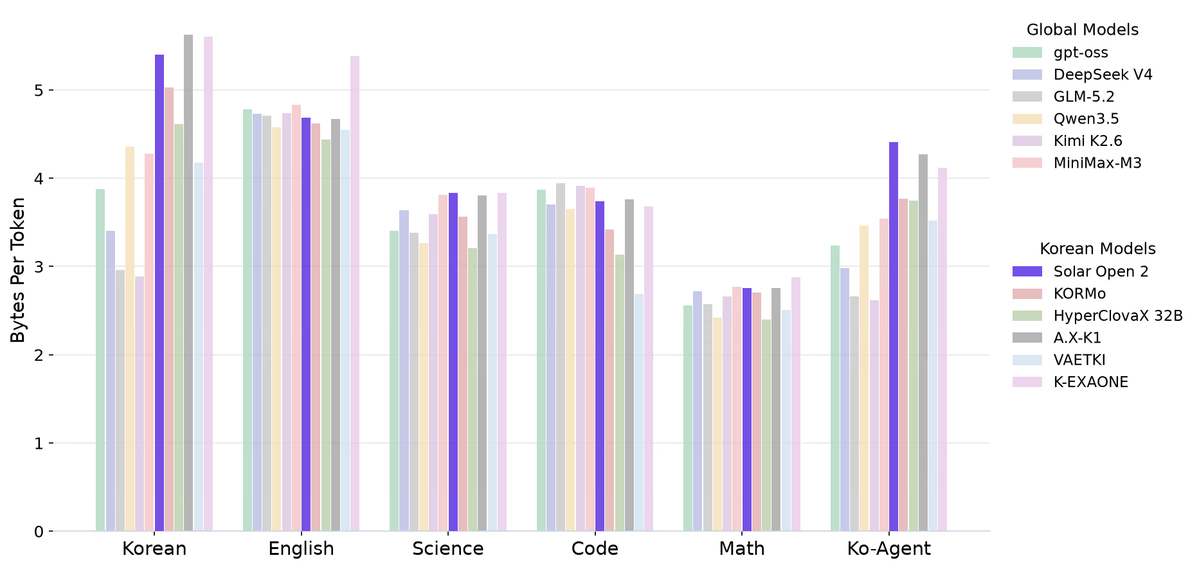
while everyone's fine-tuning the same 3 open-source architectures, this Korean lab said "nah" and built a 314 BILLION parameter model completely from scratch.
Motif-3-Beta:
🧠 ~314B total params, only ~13B active per token (MoE sparsity go brrr)
📏 256K context, natively — not "extended," not duct-taped
⚡ 384 experts, 8 fire per token + 1 shared expert always on
🌐 fully multilingual
and they invented their OWN attention mechanism (Grouped Differential Latent Attention) and their OWN activation function (Grouped PolyNorm) because apparently reusing existing architectures was too easy
weights are fully open, no gatekeeping, no access request
this is still the BETA. final version drops soon. imagine what that looks like
https://t.co/TOwSc9Q5if
China quietly dropped a model that reads a 100+ page PDF in one pass — not page by page like everything else...
It's called Unlimited-OCR. Just 3B params. Runs locally.
Most OCR tools slice your document into pages and lose the thread between them. This one processes the entire document in a single shot — "one-shot long-horizon parsing."
→ 32K token context — holds the whole doc, not just a chunk
→ Multilingual out of the box
→ Handles single images AND multi-page PDFs via a dedicated infer_multi mode
→ 100% local, no API keys, no cloud
→ Works with Transformers, vLLM, SGLang, Docker, plus ready quantizations for llama.cpp and Ollama
→ MIT license — do whatever you want with it
Cloud OCR (Textract, Google Vision, Azure Doc Intelligence) costs $1.5–15 per 1,000 pages.
This runs on your own hardware. For free. Forever.
Baidu says it straight in the model card: built to "push DeepSeek-OCR one step further."
100% open source
Microsoft just dropped a 4B image model that's punching WAY above its weight class
Mage-Flow beats Qwen-Image (20B), FLUX.2 (32B), and FireRed-Edit (20B) at generation AND editing... at a FRACTION of the size. we're talking 5-8x smaller
how? they didn't just scale up. they rebuilt the tokenizer from scratch. Mage-VAE does encode/decode with 12x-22x fewer compute ops per pixel than FLUX.2's VAE — the bottleneck just disappeared
one checkpoint. any resolution from 512 to 2048. any aspect ratio, including absolutely unhinged ones like 512×2048 (4:1 panoramas, no cropping tricks needed)
and the Turbo variant generates a full image in 0.59 seconds on a single A100. editing in 1.02s. using ~18GB of memory — less than almost everything it's beating
MIT licensed. open weights. Python API + CLI + Gradio app included. runs on your own GPU, no API key, no rate limit
the "just make it bigger" era of image models might be over
link👇