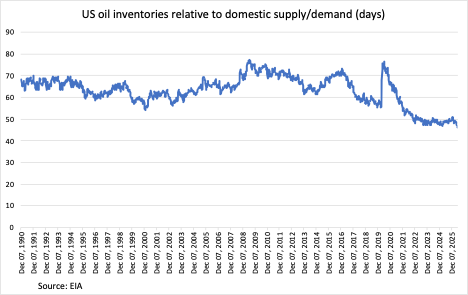
@EIAgov ...and if we measure US #oil inventories in days of domestic supply+demand, they are now the lowest on record, with data back to 1990. (Note: total inventories divided by 4-week moving avg of crude production plus product supplied.) @EIAgov
Domestic #oil situation tightening quickly, weekly @EIAgov data shows. Since March 20th, total US oil inventories have gone from a 91 million bbl y-o-y surplus to a 64 million bbl deficit. Domestic inventories are now the lowest since 2004. https://t.co/3hOgKVL02b
Best Q ever! I was on a panel @ScharSchool@mvhaydencenter this evening discussing the Hormuz situation. Check out the final Q: at 1:14:50. 😉 @CES_Baker_Inst
https://t.co/Jy4UjU5Que
Normally cautious execs at America’s biggest energy companies are sounding the alarm: oil prices (& prices @ the pump) will keep rising if Hormuz remains closed. They clearly are not rejoicing in this moment, even if it might help their bottom lines. https://t.co/xA5CJxbB9D
UAE quitting OPEC+ this week follows research @jimkrane, @Dr_Ulrichsen & @finley_mark sketched in 2023, when they warned Abu Dhabi might gain more by leaving the group. Their @BakerInstitute analysis offers insight into the UAE's logic: https://t.co/giWLyjVekz
Quoted in this @evanhalper@washingtonpost story on prospects for Iran's oil sector. Answer: facing challenges but not as bleak as the US Administration says. @CES_Baker_Inst https://t.co/kfTPa0dIRn
@JavierBlas@EIAgov Note that EIA considers oil held by Chinese (national) companies as strategic, but does not do the same for inventories held by US companies. Not debating the nature of national companies, just flagging the distinction!
A cease-fire with Iran may not lead to a sharp drop in prices at the pump, writes @finley_mark ⛽️
In a @nytimes op-ed, he explains how lost inventory, risk premiums, and shifting “normal” conditions could keep #OilPrices elevated.
Read more: https://t.co/Z2B1BUdi4f #oott
Oil markets rallied after the cease-fire, but don’t expect quick relief at the pump.
Disruptions in the Strait of Hormuz, reduced shipping, and rising insurance costs are keeping global supply tight. According to our nonresident fellow, @finley_mark, U.S. households could still face sustained high fuel prices and ripple effects across the economy.
Read his full analysis in @nytimes: https://t.co/MixJnNi1vW
@Rory_Johnston Thanks! Would gov't-forced rationing be categorized under this system? There is clearly significant demand reduction (if not destruction) happening on that basis. I've noted elsewhere that markets can balance on price (demand destruction) or quantity (rationing).