A clueless, running-on-empty caricature of provincial conservatism and clearly a stupid attempt to signal to the base that something is being done on the economic policy front when in fact nothing is being done.
I figured this would eventually happen, but not as quickly as it seems to be happening and, for this, Paul Krugman should get credit. For years mainstream economists were unable to understand how trade and globalization work because they were locked into trade models that implicitly assumed that trade was balanced (except, occasionally, over short time periods) and that capital flowed towards its most productive use. That is why their understanding of trade had no relevance to the actual world of trade that emerged in the 1970s and 1980s.
But this couldn't last. As the problem of unbalanced trade became more obvious , and as policymakers were increasingly forced to ignore the advice of their economists and respond to real problems, mainstream economists would eventually begin to recognize how, in an unevenly globalized world, countries that aggressively intervene in their domestic economies and externalize the costs through trade surpluses are also effectively intervening in the domestic economies of countries that supposedly remain committed to "free trade".
Most economists still don't understand trade. But with Krugman now acknowledging that tariffs and other forms of trade intervention can be expansionary under some conditions and contractionary under others (as Ragnar Nurkse explained as long ago as in his 1944 book), I suspect that younger economists will develop a completely different understanding of trade, and one that is perhaps a little more realistic.
WSJ: "Germany’s famously open economy was its greatest economic asset, delivering almost 20 years of uninterrupted growth and turning it into one of the biggest winners of globalization."
I think I would have framed this differently.
Germany's trade competitiveness for a long time was based on its ability both to suppress household income growth relative to productivity growth (as it did, for example, after the 2003-5 Hartz reforms), and to keep its currency cheap (as it did, for example, through adoption of the euro).
Under our current form of globalization, in other words, we experience an example of the Kalecki paradox, in which wage-suppression policies that allow one country to grow faster than its trade partners are actually bad for overall global growth – to the extent, anyway, that consumer demand drives investment among its trade partners.
In this system, all countries are under pressure to suppress wage growth in order to expand manufacturing and retain manufacturing employment, but the "winner" is the one who is able to do it most effectively.
For many years, when much of China's high saving was directed into domestic investment, Germany was one of the main winners from this system. But as Chinese investment became increasingly unproductive, Beijing began trying to rein in the debt needed to fund so much unproductive investment.
This process, of course, took off after the 2021-22 property crash, and once that happened, Germany's ability to benefit from the Kalecki paradox evaporated, as it quickly became one of the main losers of the system.
The point is that the problem isn't China. The real problem is a system that rewards countries for implementing policies that undermine overall global growth. The good news is that for many years, when Germany was able to exploit the global trade regime, it was also one of the greatest defenders of this system. Now that it is on the losing side, German policymakers are increasingly recognizing how damaging a system it is.
There is nothing new about this. If you read the economic debates between the UK and the US in the 1920s, a period when US productivity soared even as wages remained stagnant, it was the UK that complained about the trade imbalances. The US insisted that its huge trade surplus was simply the consequence of more efficient manufacturing techniques and harder-working people. The US of course abandoned that argument in the 1970s, when it lost its trade surplus.
In the economic debates of the 1980s, it was the US who complained about trade imbalances, and Japan who insisted (what else?) that its huge trade surplus was the result of more efficient manufacturing techniques and harder-working people. No one in Japan makes such a silly claim anymore.
In the 2000s, of course, Germany rather patronizingly explained to the rest of Europe that if only they could become as efficient in manufacturing and as hard-working as the Germans, they too would be in just as good a shape. So much for that claim.
Meanwhile our trading system continues to reward policies that depress global growth by putting downward pressure on wage growth, or that, alternatively, force the world to encourage rapid increases in debt in order to counter the impact of lower wage growth.
That is why the real solution isn't a global alliance against China. While this may help defuse current tensions, it won't change a system that will continue to reward bad behavior – i.e. household income-suppressing policies – by allowing countries to externalize the costs of this bad behavior through large, persistent trade surpluses. And this means that it will continue to support increases in income inequality within countries.
https://t.co/9g6zh3ET99
A must read (or must listen): https://t.co/2uGt1XhA8V . A dystopian but unfortunately surprising convincing of what could happen if Europe does not catch up on AI. It moved my prior. (and it is, despite the gloomy conclusions) a fun read.
Merz has a good chance of eclipsing Merkel as the worst post-war Chancellor. Like Thatcher, Merkel was ruinous but politically effective, capable of wielding power. Merz is an arrogant country bumpkin who, it seems, is entirely in over his head
Colin Farrell pushes back against actors who say they "just lie for a living":
"I get it! That's cute. I kind of want to say the same and take the piss out of it all, but is it not potentially more truthful than the human experience we have every day on the street?"
Watch Variety and @CNN’s #ActorsOnActors now at https://t.co/MotEGAYRhy and on the CNN app.
@tikatakahsv Das Polzin ohne Zweifel an RYK festhält signalisiert seine Expertise.RYK tut unserem Spiel extrem gut, er ist umtriebig, bringt Tiefe und er wird auch irgendwann seine Tore erzielen, ich hab da hoffnung
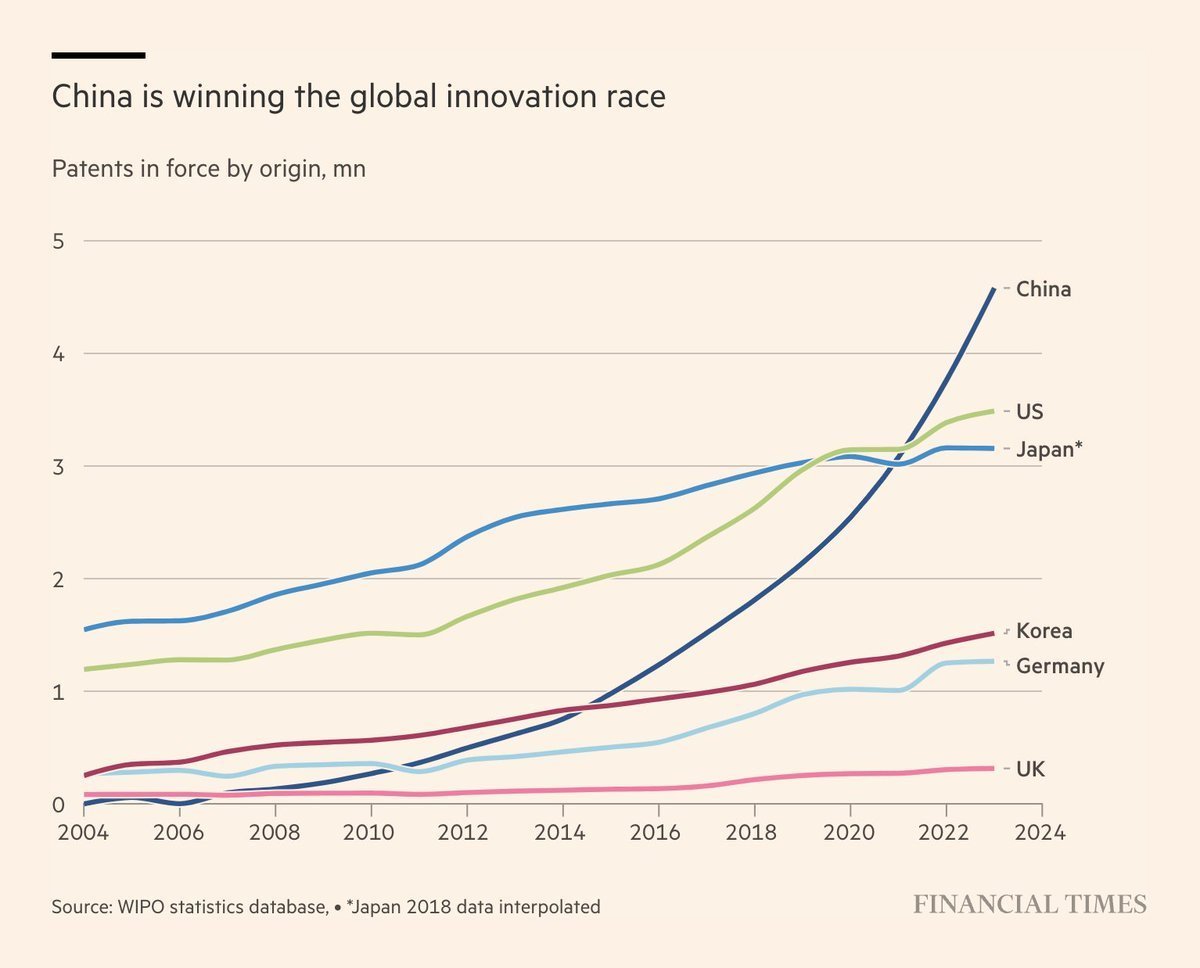
Advocates of laissez-faire economics — including libertarians, neoliberals, and free-market capitalists — have long claimed that one of the biggest dangers of too much state intervention is that it will stifle innovation.
China is taking a sledgehammer to that idea, completely annihilating it.
Sure, there is a thriving private sector in China that plays a key role in the country’s national system of innovation.
But the state — not the capitalists — ultimately controls the direction of investment in China.
The state — not the capitalists — has formulated strategic industrial policies to make China a global powerhouse in clean energy tech, electronics, and rare earths processing.
The state — not the capitalists — is in control of the means of production and the commanding heights of the economy.
China is a socialist market economy where corporate power and wealth don’t translate into immense political power. This makes China fundamentally different from many Western capitalist economies. And this also explains why China will most likely win the global innovation race even more decisively in the years ahead.
Schockierend: In den Medien hatten Forschungsministerin @DoroBaer@CSU und Gesundheitsministeriun @ninawarken@CDU Hilfe für #LongCovid und #MECFS angekündigt. Nun kommt heraus: Es wurde nichts erarbeitet und Gelder gibt es auch keine. Unverantwortlich!
https://t.co/n3P0AyTLWy