Small financial habits matter.
But structural choices are what changes your trajectory.
This is what allowed me to double my savings, and reach a 70% saving rate in 2017, and financial independence in 2018.
Reducing wasteful spending is useful.
But eventually there is nothing left to remove without damaging your quality of life.
Income growth is harder, but there is virtually no limit.
Sometimes the expensive option is worth it.
Sometimes it is just an expensive substitute for something simpler.
Try the questions next time you’re considering a big purchase.
🔥
Before your next major purchase, ask three questions:
1. What do I actually value here?
2. Can I get the same value for less?
3. How does this compare with the freedom I could buy by investing the money?
Often, we do not value the product itself.
We value the comfort.
The memory.
The time saved.
The status.
The experience with people we love.
Once you identify the real value, you can look for a better way to obtain it.
Expenses optimisation is not deprivation.
Cut costs that add little to your life.
Protect the spending that supports your health, relationships and happiness.
FIRE is not about saving as much as humanly possible.
It is about buying what matters most to you.
What are you willing to spend generously on?
And what are you happy to stop buying?
You need productive assets.
You need reasonable expenses.
You need a withdrawal strategy that can survive difficult markets.
And you need room for taxes, inflation and uncertainty.
For me, the solution was diversified ownership of businesses and high-quality bonds through index ETFs.
Simple and effective.
What’s your plan for financial independence?
🔥
Financial independence is simple: passive income > living expenses.
When the income generated by your assets can sustainably cover your spending, paid work becomes optional.
The equation is simple.
Building both sides is not.
On 7 and 8 of September, I’m sharing my roadmap: how to build wealth on autopilot, evidence-based passive index investing, optimized for Belgian taxes.
Grab your free spot here: https://t.co/39mqoLghOX
💸 Many Belgians are leaving thousands of euros on the table.
Not because they are careless.
Because the default options feel safe:
Cash sitting on bank accounts.
Expensive bank products.
That approach helped me build a €1 million portfolio and reach financial independence at 33.
It was not one brilliant trade.
It was a system followed for years.
🔥
Index investing can be done in less than 2 minute per month
With the development of automatic investment features by Belgian brokers such as Saxo and Bolero, investing can be fully automated.
Once you’ve developed your Personal Investment Plan, you can set it up on autopilot.
I still recommend you take a minute each month to make sure things are going according to your plan and the money actually gets invested, but otherwise there is nothing to do (assuming the automatic investing system also handles all Belgian taxes).
If you’re unsure how to start with index ETF investing, then join us for the free workshops on how to build wealth on autopilot, evidence-based passive index investing, optimized for Belgian taxes:
https://t.co/39mqoLfJZp
🔥
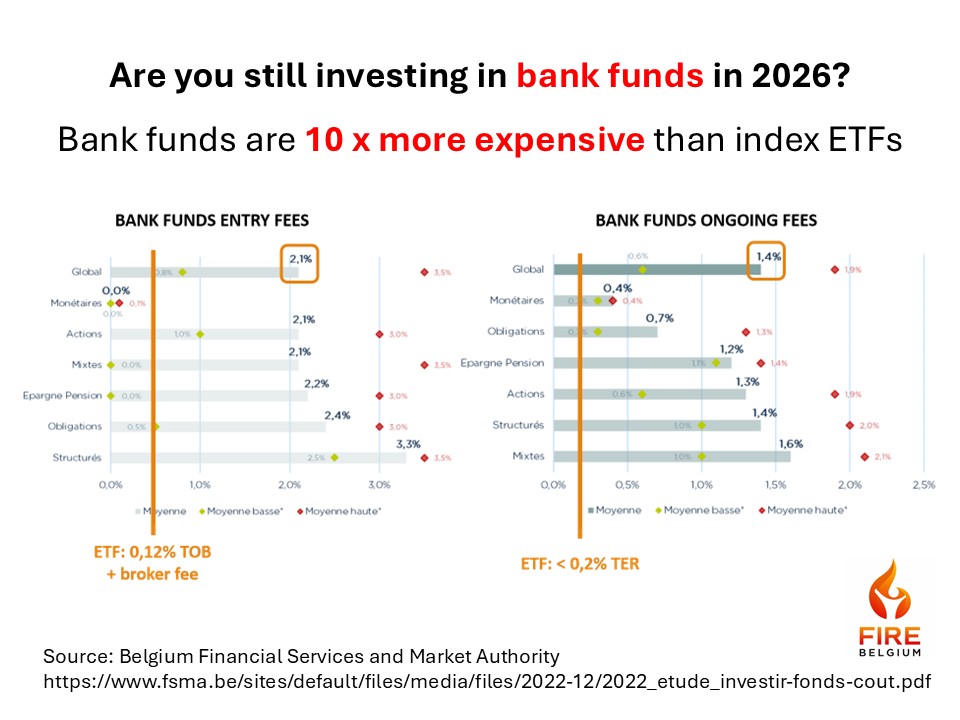
Are you still investing in bank funds in 2026?
Index ETFs are much cheaper than investment funds offered by banks.
A typical bank fund in Belgium costs 2.1% entry fees + 1.4% ongoing management fees (see FSMA report). There is also usually a 1.32% sale tax at the end.
In comparison, a well-selected index ETF will have a transaction tax of 0.12% and an average management fee of 0.14%. Broker transaction costs will vary, but some brokers offer free transactions.
This is 10 times cheaper than banks!
And the effect compounds year after year!