TOI exclusive - A Rs 284 crore footpath scam.
Greater Chennai Corporation has cancelled ₹284 crore worth of footpath tenders floated in Feb after officials flagged multiple irregularities including alleged pre-fixing of contractors, inflated project costs, bids quoted above estimates, restrictive eligibility conditions and potential loss to the exchequer.
The project was announced in the GCC budget by Mayor R Priya on Feb 19 and tenders were floated by the special projects department on Feb 20, ahead of MCC coming into force on March 15.
The works were split into 35 packages covering footpaths across major roads including Shastri Nagar (Adyar), Fourth Avenue (Besant Nagar), Raja Muthiah Salai near Jawaharlal Stadium, Barnaby Road (Kilpauk), Dr PS Siasamy Salai (Mylapore) and other arterial stretches. L1 bidders had been identified for all 35 packages, but work orders were not issued.
Each package covered 2–3 roads and was valued at ₹8–9 crore. Officials said similar stretches would normally cost ₹1.5–2 crore as the work largely involved masonry and concrete flattening.
They cited the 500m Kader Nawaz Khan Road pedestrian plaza project: which involved utility shifting, lighting, seating, cobble-stones and premium flooring and itself cost ₹19 crore. In comparison, the cancelled packages proposed spending nearly ₹9 crore merely to relay concrete footpaths across 2–3 roads.
Example: Package 6 proposed ₹8.2 crore to lay around 1km of footpaths on Park Road and North Avenue Road in Anna Nagar West Extension. Officials said the per-metre cost worked out to nearly four times the usual rate despite involving only basic concrete masonry.
Tender participation patterns also triggered scrutiny.
Package 9: ₹8.3 crore footpath works on Jawahar Street and Sixth Main Road, Mogappair - only two firms participated: P and CE Projects and Sri Sivaram & Co. P and CE quoted 9% above estimate and emerged L1; Sri Sivaram quoted 7.15% above estimate.
Package 2: ₹7.9 crore works on Erikarai Salai, Pillaiyar Kovil Salai and Bazaar Street - the same firms participated. P and CE quoted 9% above estimate (L1), Sri Sivaram & Co 12% above estimate (L2), and Adithya Infrastructure 15% above estimate (L3).
Officials contrasted this with normal competitive tenders. In a June 24 road-cut tender on Ambattur Estate Road worth ₹25 lakh, 10 contractors participated; eight bid below estimate, one bid 5% above, and SMK Contractors emerged L1 at 25.9% below estimate. Five contractors quoted around 25% below.
“There was escalation in project cost and a pattern in contractor participation. DPR also included unnecessary ramp construction components,” an official said.
Another official said some proposed works overlapped with MRTS-CMRL project sites.
Officials also flagged mandatory site visit and machinery visit certificates, saying these conditions restricted participation despite Chennai having nearly 400 contractors capable of bidding.
“The project has state approval and is not shelved. We cancelled only the tenders. DPR will be reviewed and the project will return with revised estimates,” an official said.
Rama Rao questioned why action had not been initiated against officials if GCC itself had found irregularities.
MAWS, headed by CM C Joseph Vijay, has directed scrutiny of all ongoing tenders initiated during the previous regime. Around 40 works are under review, with revised estimates and fresh proposals being prepared.
Introducing Claude Tag, a new way for teams to work with Claude.
In Slack, Claude joins as a team member with access to the channels and tools you choose. Tag Claude in and delegate tasks to it while you focus on other work.
‼️BREAKING: a tiny lab in Tokyo just built a model that matches the performance of Fable and Mythos.
the numbers are real too - 54.2 on SWE-Pro, 95.1 on GPQA-D, 93.2 on LiveCodeBench v6. it edges out Opus, Gemini 3.1, and GPT 5.4 on each one and because it’s just coordinating existing models, it delivers Mythos-class capability with zero export control risk.
seems like another lab is breathing on Anthropic’s neck again.
‘Fugu Ultra’ is also available to use in codex.
Are you not entertained yet?
A much-needed reform.
Tamil Nadu is perhaps the only state where consumers are effectively restricted to purchasing a limited set of liquor brands selected by a privileged few. Apart from products manufactured by SNJ, Kals, Enrica, and a handful of others, most brands are simply unavailable.
This situation is particularly concerning given that liquor sales constitute a significant source of government revenue. Consumers are denied the choice and variety that are readily available elsewhere in the country.
Many popular national brands that are available in other states have long been absent from the Tamil Nadu market. Allegations have persisted that previous administrations demanded unofficial “per-case” payments from manufacturers, creating barriers to entry and limiting consumer access to a wider range of products.
Kudos to the new government @CMOTamilnadu
Peekaboo 3.0 is live. Biggest release since 2.0.
⚡ Action-first macOS computer use
👁️ Unified screenshot + UI detection
🧩 Cleaner JSON across CLI + MCP
🛠️ Better snapshots
I started this last year, but the models just weren’t good enough. Now they are. https://t.co/0wvhR0NWOj
This Chinese guy created agents in Claude Code for landing pages and single-handedly serves 47 small businesses a month, taking $400 from each.
He built a system of 7 agents on Claude Sonnet 4.6 that analyzes Google Maps in small towns, finds small businesses without websites there, and over 1 weekend takes each one to a finished mockup with video and cold message.
No assistant, no sales team, no SDR. Just him, a MacBook, an iPhone, and 1 API key.
And traditional web design agencies keep teams of 8 people on salary for the same order flow, while his expenses are only tokens and subscriptions to Lovable, Higgsfield, and Calendly.
7 agents work through 1 orchestrator on Claude Code Router. Usage is about 3 million tokens a day, the average API bill is about $480 a month.
All 7 go through MCP servers and write shared state to the file system, without shared state in memory and without race conditions, and 1 of them lives right in the iPhone and picks up positive replies from the subway, a taxi, or on walks.
And here is the system prompt he put into the orchestrator before launch:
"You are the orchestrator of a solo agency that sells ready-made websites to local businesses. You delegate read-only tasks to 6 sub-agents and own all writes.
sub-agents:
// Scout (walks through Google Maps in selected cities, looks for narrow niches: 5+ years on the map, fewer than 50 reviews, no website or a website from 2014, but high ratings)
// Diagnoser (for each lead writes a 50-word diagnosis, hero angle, tone matched to the industry, and a cold message under 70 words)
// Builder (generates a landing page mockup in Lovable through MCP only for the top 5 leads per day, with the sharpest diagnoses and the biggest gap)
// Filmer (pulls 5 screenshots of the mockup and through Higgsfield renders a 10-second vertical video 1080x1920 with a soft zoom)
// Pitcher (sends a personalized cold message through the right channel for the niche: email to roofers, SMS to tradesmen, IG DM to salons, LinkedIn to realtors)
// Checker (runs every message through evals for personalization, absence of AI markers and buzzwords before sending)
// Mobile (lives in the iPhone, handles positive replies in real time, books Zoom calls in Calendly through MCP while the owner is on the go).
You never let 2 sub-agents touch 1 lead. You stop and request approval from the human only when a deal exceeds $3,000 or the reply rate in a niche for the day drops below 12%."
Meaning the system knows what it is and within what boundaries it is allowed to act.
It knows it is supposed to find leads on its own.
It knows it is supposed to take each one to a mockup, video, and cold message without intervention.
It knows the human only steps in when a deal goes above $3,000 or the reply rate stops converging.
→ The system runs 24 hours a day
→ Scout goes through about 220 local businesses on Google Maps per day and leaves 30 new leads in the queue
→ Diagnoser outputs 30 structured diagnoses + briefs + cold messages per day
→ Builder assembles 3 to 5 finished landing pages in Lovable for the sharpest leads
→ Filmer renders a 10-second vertical video in Higgsfield for each one
→ Pitcher sends 30 personalized messages per day across 4 channels with a reply rate of about 14%
→ Checker runs every message through evals before sending
And only when a deal breaks $3,000 or the reply rate for the day drops below 12% does the orchestrator wake the owner.
And when the owner at that moment is sitting in the subway or a taxi, the Mobile agent in his iPhone picks up 1 move on its own: replies to a fresh positive reply from a dentist, books a Zoom through Calendly synced to the local time of the client, and puts the lead back in the queue. The owner only has to tap "approve" and in just 10 minutes join the call.
Here is what the system writes in his log during 1 of the Saturdays:
"scout report: 218 businesses checked in Austin, Denver, and Miami, 34 without a website, 19 with a website from 2014, 6 with an active redesign request in reviews. passing top 30 to diagnoser."
"pitcher: 30 cold messages sent across 4 channels, 14 replies, 5 positive, 3 Zoom calls booked for Sunday. passing to closer."
"builder: landing page for Westside Cosmetic Dentistry built in Lovable, 5 sections, mobile, soft beige. URL placed at /Users/dev/maps-agency/clients/westside/v1. filmer launching Higgsfield."
"eval flag: deal with The Lotus Salon at $3,400 exceeds the approved limit of $3,000. sending for manual review."
He has no server of his own and no separate backend.
Just a local file sandbox at /Users/dev/maps-agency, an MCP router, 1 API key to Claude, and the same key forwarded to Claude Code on his iPhone.
Out of everything I have seen this year, this is the cleanest one-person agency for selling websites to small businesses: $480 a month on the API, about $18,800 into the account, and between them 7 prompts, 1 file system, and 1 phone in the pocket.
STOP TRYING TO CREATE CONTENT ON EVERY PLATFORM
I see too many people trying to do everything at once.
You don’t need that. You just need ONE channel that works.
For @romanbuildsaas, it was Reddit.
The outcome? A $30K MRR saas.
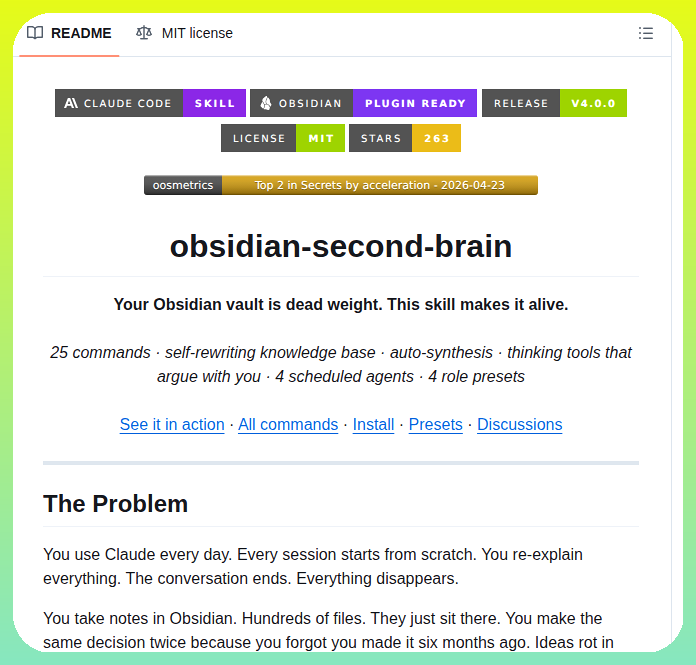
Nearly 23K stars for a collection of markdown files I wrote
I guess they must be pretty good
I want to invest more time in this repo. So, folks who starred it, what can I do to make these skills more obvious to you?
- A docs site for the skills?
- Send them to plugin marketplaces?
Help me help you
https://t.co/64UuxC8V0T
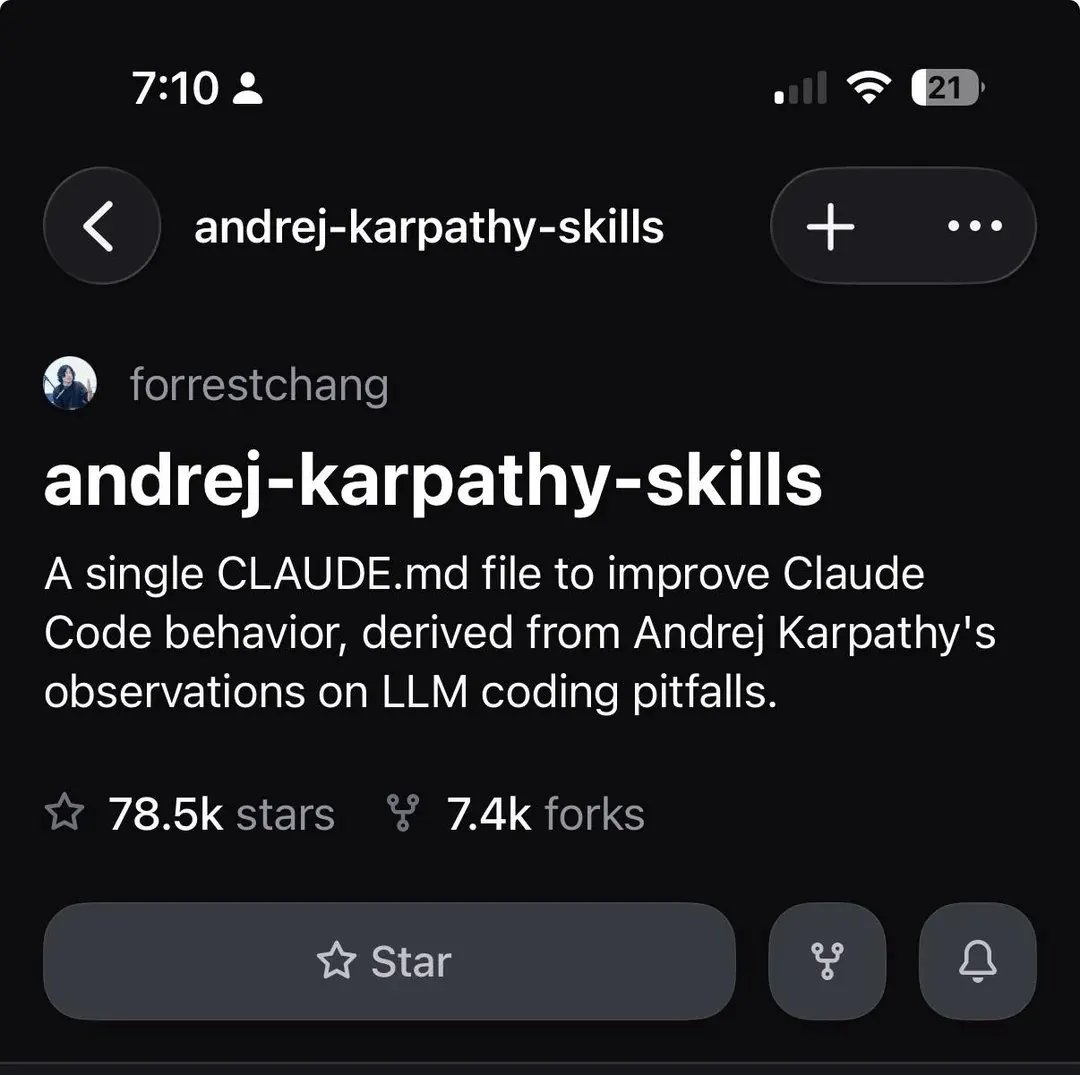
SOMEONE BUILT A SINGLE CLAUDE.MD FILE THAT FIXES EVERY BAD HABIT CLAUDE CODE HAS AND IT HIT 78.5K STARS
it's based on andrej karpathy's public observations about how LLMs write code
the problem he pointed out is that claude makes silent assumptions, overcomplicates everything, writes 1000 lines when 100 would do, and sometimes deletes code it doesn't fully understand as a side effect
so forrestchang turned karpathy's critique into 4 behavioral principles and dropped them in one claude.md file:
1\ surface your assumptions
don't pick an interpretation silently. if there are multiple ways to read the task, say so. if uncertain, ask. push back when something doesn't make sense instead of just running with a bad plan
2\ minimum viable code
no speculative features, no abstractions for single use code, no "flexibility" you weren't asked for.
if you wrote 200 lines and 50 would work, REWRITE IT. ask yourself if a senior engineer would call this overcomplicated
3\ surgical changes only
don't touch code you don't fully understand, don't refactor unrelated stuff as a side effect, don't delete comments because they look unnecessary. only change what the task actually requires
4\ goal driven execution
give claude success criteria instead of step by step instructions.
karpathy's exact quote: "LLMs are exceptionally good at looping until they meet specific goals. don't tell it what to do, give it success criteria and watch it go"
one file has 78.5k STARS AND 7.4k FORKS on a single github repo.
install is one curl command that drops it straight into your ~/.claude folder
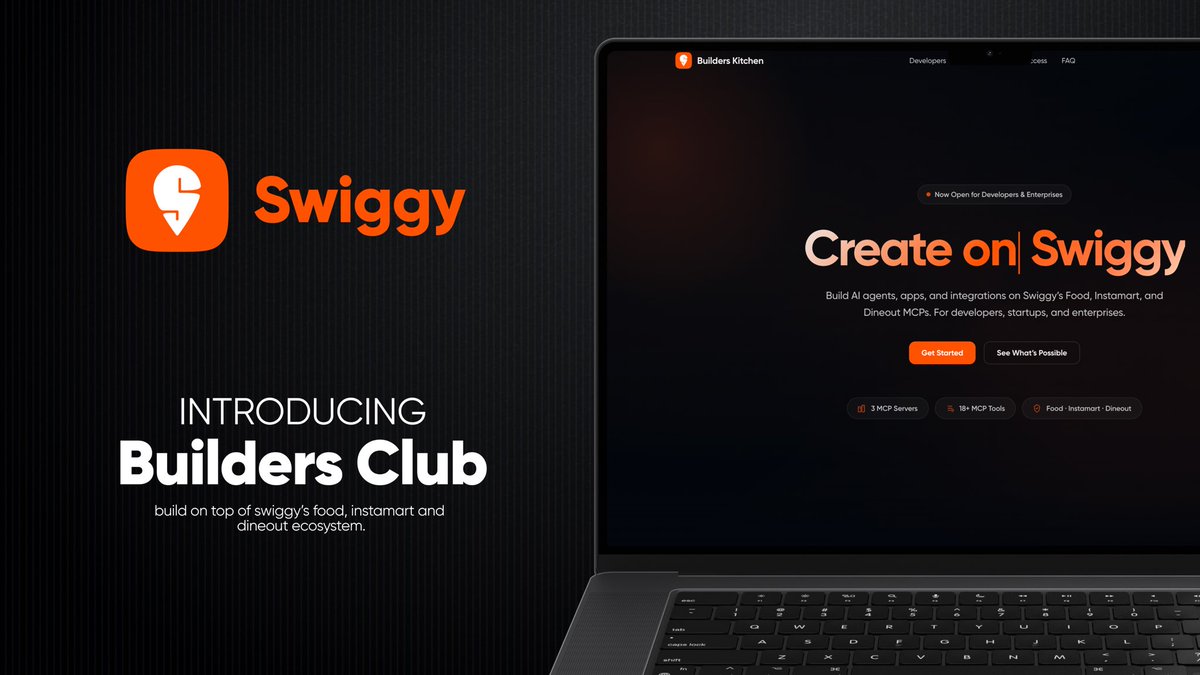
Introducing Swiggy Builders Club
We’re opening @Swiggy commerce infrastructure to developers and enterprises to build on top - build AI agents, apps, and integrations on top of Swiggy’s Food, Instamart, and Dineout ecosystems - with real APIs, real data, and real users.
What you get:
3 MCP Servers (Food, Instamart, Dineout)
18+ API tools covering the full convenience stack
Production data access from day one
Direct engineering support
Who it’s for:
Individual developers with bold ideas
Startups building AI-native commerce products
Enterprises looking to integrate Swiggy into their platforms
Smart grocery restock bots. AI ordering assistants. Dining recommendation agents. Group ordering tools, health first products.
If it makes commerce better for users, we want to see it.
Ship something great and we’ll feature it. Ship something exceptional and our recruiting team might reach out.
Today we're launching a rebuilt version of Claude Code on desktop.
The app has been redesigned for the ground up to make it easier than ever to parallelize work with Claude.
I haven't opened an IDE or terminal in weeks. Excited for you all to give it a shot!