@richiemcilroy It's currently No. 9 on Nomad List. Based on 1,500 reviews, people seem to have voted it down for language, cost, density, racism and a little bit for community.
As a white European, I didn't experience racism myself, but I remember it was bad for people from other places.
@FieryHasbara The number of immigrants accepted into Thailand each year is in the 100s. At any time, there are about 5 million expats in Thailand.
They are almost certainly talking exclusively about expats.
@AlanRMacLeod If you drive to the supermarket to buy these, that is by far the most inefficient, expensive, and environmentally damaging part of the process.
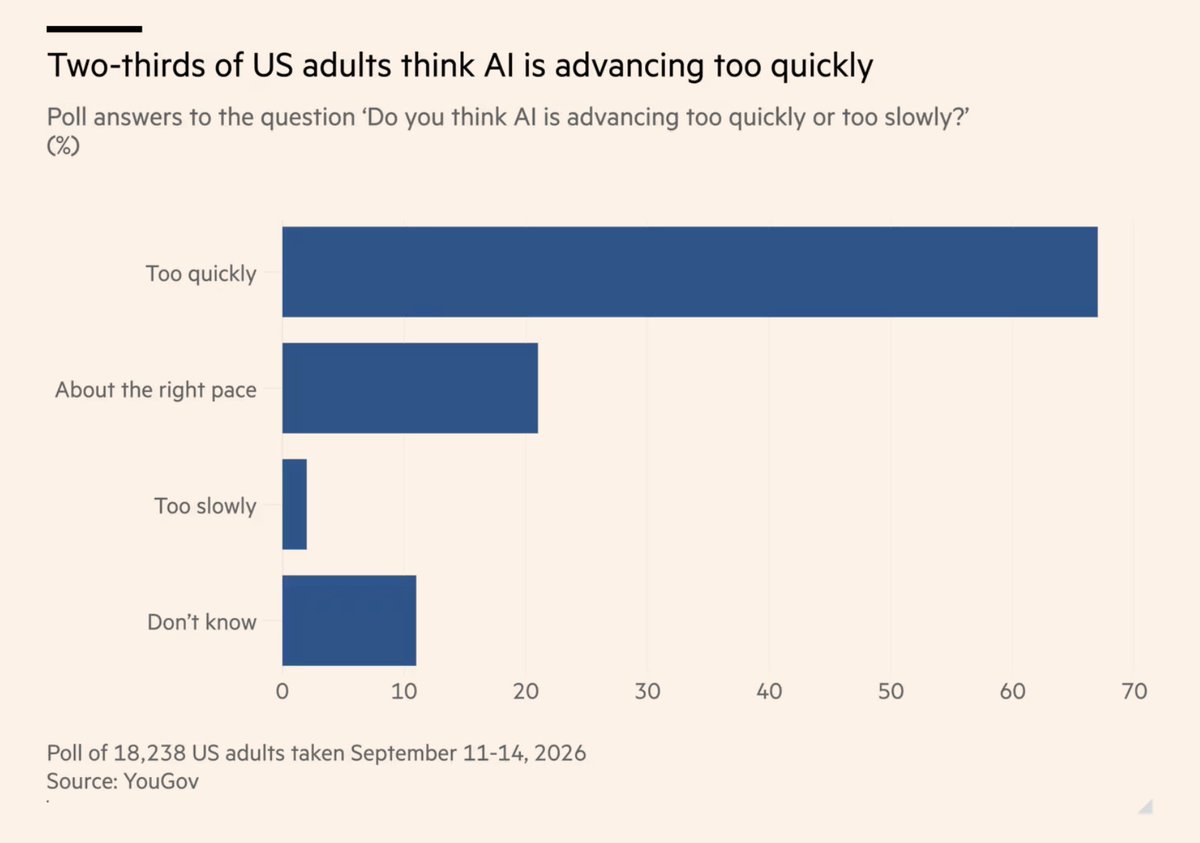
The AI backlash is fast becoming the 21st-century version of the temperance movement: massive, bipartisan, hugely powerful.
Here's what I said last year in my final BBC Reith Lecture, before the AI revolt went mainstream:
––
In my previous lectures, I spoke about two moral revolutions of the nineteenth century: the fight against slavery, and the struggle for women’s rights. But I didn’t mention the third one yet: temperance. Many abolitionists and suffragettes were also temperance activists.
This movement is largely forgotten nowadays, but it holds important lessons for us. Back then alcohol was an even bigger social catastrophe than it is now. There were no warning labels, no age restrictions, no limits on advertising. Saloons dotted every street corner, wages disappeared into the bottle, and families were torn apart by violence and neglect. The alcohol industry profited from human weakness while devastating entire communities.
That is why people rose against it. The temperance movement was one of the largest democratic movements in history, led by women and workers. They believed that real freedom meant being fully present. They saw addiction for what it is: the moment when the power of choice no longer exists. And so they demanded radical measures: higher taxes, stricter licensing, and even total prohibition.
Today we face a new addiction industry. Not of wine and whiskey, but of apps and algorithms. Many of Stanford’s brightest minds are building a single great Moloch, an attention-hijacking machine that steals our time and leaves us emptier by the hour. AI threatens to supercharge it all.
But here’s my warning to Silicon Valley: You’re awakening a dragon. Public anger is stirring. And it could grow into a movement as fierce and unstoppable as the temperance crusade a century ago. Poll after poll finds that people across the West think AI will worsen almost everything they care about, from our health and relationships to our jobs and democracies. By a three-to-one margin, people want more regulation.
History shows how this movement could be ignited by a small group of citizens and how powerful it could become. Just as Bertrand Russell led mass protests against the nuclear arms race, we may soon see mass resistance to the AI arms race. A century ago temperance activists even managed to push a constitutional amendment through Congress to ban alcohol altogether.
Those who want to avoid provoking something equally drastic should learn from the past.
@zarahsultana I don't think you'll get through to people by insulting them. Maybe just tell everyone what the policy is that your proposing and why you believe it'll work.
@SaintBobby5 Ironic that he was over 1000 years off when he talked about the invention of algorithms.
Also. Most concepts in rhetorical algebra predate Islam. The modern form of abstract algebra used in computing was mostly developed much more recently in Europe and has very little overlap.
Governments are frantically creating legal frameworks to protect citizens from AI, but few are implementing them.
Source: Global Index on Responsible AI, 2026. https://t.co/9o8vp5qbNR
Looking at 130 countries across 14 indicators.
When a model suddenly becomes unreliable, training metrics rarely explain why.
A loss landscape helps us visualise stability. So we can spot and fix training issues early.
#AIInterpretability#ExplainableAI#DataVisualization
https://t.co/2BcR7daXGp
Some of history's biggest advances came when we trusted we were living in a fair system.
If we can make AI transparent and explainable, we would create a new level of trust.
First, we need to agree on what fair means
https://t.co/WFEDOWo2Iz
#AIEthics#ExplainableAI