Wrong decisions in the bull market can cost you life-changing money.💵
In my first bull run, I went from $5k to $350k and again back to $40k.
Here are 12 lessons that I now use daily which will give you an edge to not just survive, but THRIVE in the upcoming bull market. 🧵
Two things to be grateful for:
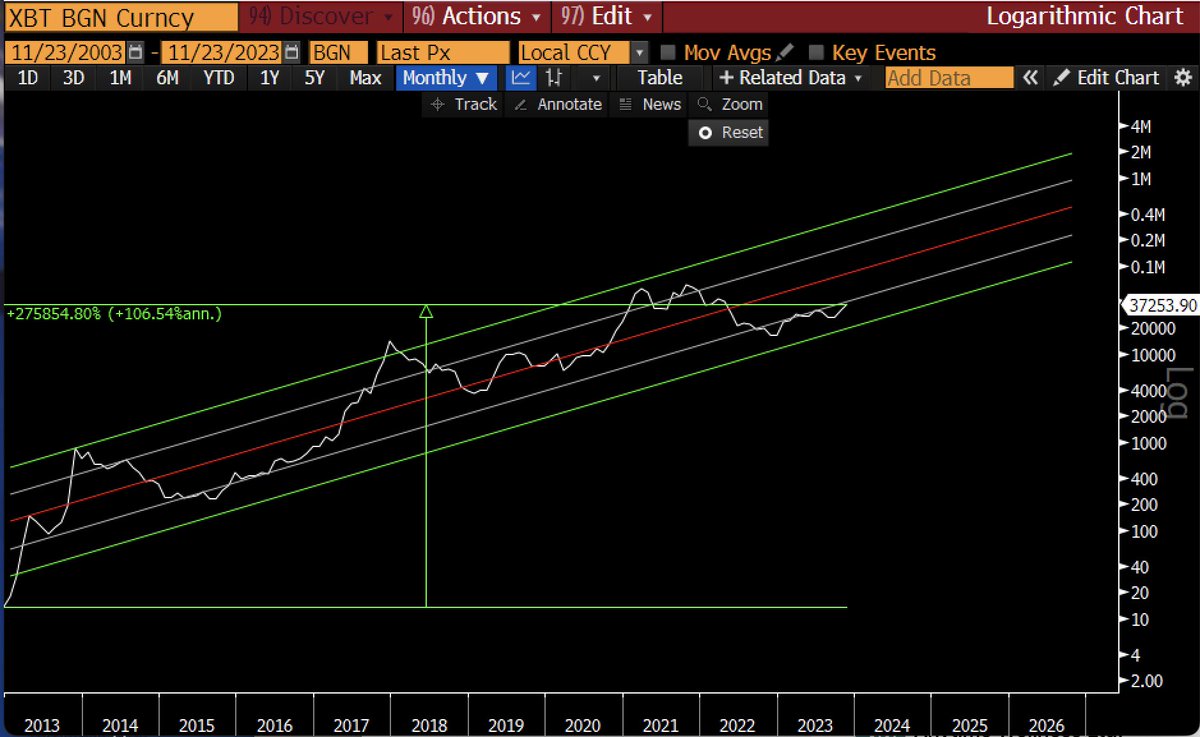
Bitcoin - The best-performing asset of all time +275,000% since 2013). A stunning log trend we should be thankful for too...
Confluence of very powerful forces coming together for #Bitcoin
Best position 4 yr cycle year 1 end approaching.
8 month consolidating range. Squeeze.
Sellers exhausted.
New base holders $20/$30k range.
Halvening narrative.
#BTCETF approval spark.
Dec Cycle Low start run
The @Paypal announcement is not priced in.
#Paypal has 435M active accounts vs #Ethereum L1/L2 Active Addresses 1M.
If 1% covert a $ balance to $PYUSD (4.35M) and begin to use it then the ramifications for the #Ethereum ecosystem and $ETH, the asset, are massive.
My worst trade, ever...and other lessons:
My buying ETH at the highs in 2021 is a meme that goes round on Twitter a lot (or just fuels the trolls!) but that was by far and away not my worst trade...even though it was a terrible call!
The ETH bet was actually a call option that cost 5% of my ETH, which was up 13x at that point. I made the bet very publicly, along with how I structured the trade (which people want to forget...sigh). It was a low risk, high reward bet that didn't pay off and had HUGE leverage to the upside if it worked.. It was pretty prudent risk management. I lost 5%.
The truth is many bets don't pay off. That is the nature of investing. However, over the years I have learned that getting your investment time horizon to match your idea horizon is the super power. That was a lesson that Paul Tudor Jones explained to me back in 2003.
My time horizon is longer than most, and has gotten longer over time. I have gone from 6 months, to 2- to 5- years on most of my investments, as I am trying to capture SECULAR trends.
That has given me a 19-year published track record in Global Macro Investor (GMI) of 60% winners vs losers and many, many years of over 100% returns (and a few 200%+ years too), which is beyond ludicrous.
I do firmly believe secular trends compensate you for the risks and often those risks require you to stomach a 80% drawdown. See crypto for details or Amazon in 2001 or tech last year! I have had to stomach some big drawdowns too. I rode BTC down 87% in 2013 (back to my entry) and crypto in down 75%+ in 2022 (which bottomed several hundred percent above my initial entry).
Secular trends are often volatile in nature so its important to size them right and it is CRUCIAL to add when they are down big (as long as you have done the deep analysis that the trend remains in place on the longer term time horizon). That compounds your returns. Again, never get over your ski tips and never use leverage!! This is vital...leverage is mostly your enemy.
My worst trade was the entire year of 2009...boy, oh boy did I fuck that up. I m Ade every mistake possible as long time GMI subscriber know all too well. It took me a long time to recover my P&L and more importantly my confidence.
In 2009, my macro indicators suggested the business cycle had bottomed but my emotions overrode them. I believed (and maybe wanted?) that the entire system was going to go down in a 1929-style event. I stayed bearish the entire year, against all of my macro framework. I doubled down on the bet too. I completely fucked it up.
That cost me -50% to -60% (after a 100%+ rise in 2008 and a big gain in 2007). Dogmatism and my own false narrative absolutely killed me.
It took me a few years to get my confidence back. I think 2013 was the year I truly got it back (that was the year I bought BTC and it went up 5x).
I have learned NEVER to trade against the deep analysis I do, however tempting.
Sometimes I get it wrong, sometimes right, but 60% winners is good enough for me, and focussing on long-term secular trends has meant that I have nearly entirely given up the more crowded Business Cycle investing approach of the 3 month to 12 month time horizon. I have proven it gives suboptimal returns over time (using my 19 year recorded track record in GMI) virus secular trend investing. It makes you sound so smart, using the business cycle but it's mostly "midcurve" these days. Same with "plumbing", "value", and other ultra smart-sounding doom theories. They generally don't make a lot of returns in the current macro.
Unlike 2009, where I was betting against my work, 2022 was a bad year, but it was a drawdown year in a secular trend. I was super comfortable that my thesis was right, whilst testing that there constantly.
I used the horrific sentiment and price action to significantly add to my crypto (including NFT's) and used the tech collapse to buy Exponential Age technology names for the first time. This proved thus far to be the right course of action. NFT's are currently in their capitulation phase so I am paying close attention to accumulate ( I have started) but its not an easy game to know what to choose.
This secular investment approach has to be in big, liquid, understandable things. Some of you are smart enough to find the small gems but I am not. I find the risk of capital loss too high if I am wrong.
I tend to take bets with small baskets of larger companies or tokens/NFT's and my more speculative bets are much, much smaller. In a secular trend, you can make a lot of money even in the bigger stuff. You don't need to chase the 100x, however alluring it is!
I also have moved away from diversified portfolios to hugely concentrated ones. I find it easier to stay on top of everything and it stops me from style-drift or FOMO. I like to really, really FOCUS.
These are big bets and they demand all my attention.
The biggest secular trends I see are crypto and technology, along with debasement of currency which compounds the secular trend in these asset prices.
I find it sad that many people fight this narrative because they don't want the world to change, want to believe that value stocks and dividends work in this new world, or just don't understand it all.
What starts as confusion as to what is going on slowly morphs into fear and then anger, and many are caught in a trap of wanting the world to collapse to prove out their views. Most of those people who reflect this dont have capital on the line. They cant or they'd be broke after buying all the tin hats and sardine cans on top of all the puts...and they truly believe their own narrative too. They live it.
Meanwhile, the world keeps turning. Humans build new technology and things advance. Some people get rich, some lose out. Gold doesnt go up as much as people desire. Value stocks underperform. Passive investing beats most things. Buying mining stocks mainly makes you poorer, smart option tail-risk hedges lose endlessly (except very occasionally), and commodities go up and then down. It has always been so...but they help you sound smart and doom-y. Trust me, Ive been there. I lost money to prove it.
But I do always remember the KEY lesson - whenever you think your shit smells of rose, you are about to have you face rubbed in it. That keeps me paranoid about being wrong and listening to all opposing views and adjusting probabilities in real time. I know my next big egg-on-face moment is just around the corner...
Right now, I might have done really well by buying tech and crypto at the lows in 2022 but I fucked up trading bonds so far.
I ask myself every day what I am missing? It has been a poor use of capital versus my much more important theses of The Exponential Age, The Everything Code and the the Crypto Super Massive Black Hole (yes, I like a meme name because if I cant make it simple, I am midcurving it!).
Mid-curving it is the single best way I know to miss a trend. Don't midcurve it with overly "smart" and complex analysis paralysis, but also accept that you might be wrong too. This sounds simple but is bloody hard! If you can't explain it to your mate in the pub, you wont make money. The CDS trade in 2008 was a once in a lifetime thing. Don't worship it.
So, here are the tips...
Buy secular trends.
Focus on it very closely.
Expect big volatility.
Add to it when things are awful.
Assess your odds in real time by listening and filtering. Don't let your emotions drive you investments.
Don't use leverage unless you know exactly what you are doing...even then shy away from it.
And most of all, don't midcurve it...
Good luck. The Everything Code suggests the next 3 years might well be rather important for us all.
Let's see. Maybe I'll be wearing egg on my face or I'll be wearing diamonds.
Time will tell.
I was fortunate enough to participate in the ETH ICO in 2014 (in a small way). This then led me to be all-in on crypto since 2016.
Here are 5 reasons to be mid to long-term bullish on ETH. Now is a good level to DCA (dollar-cost average) and stack that gwei.
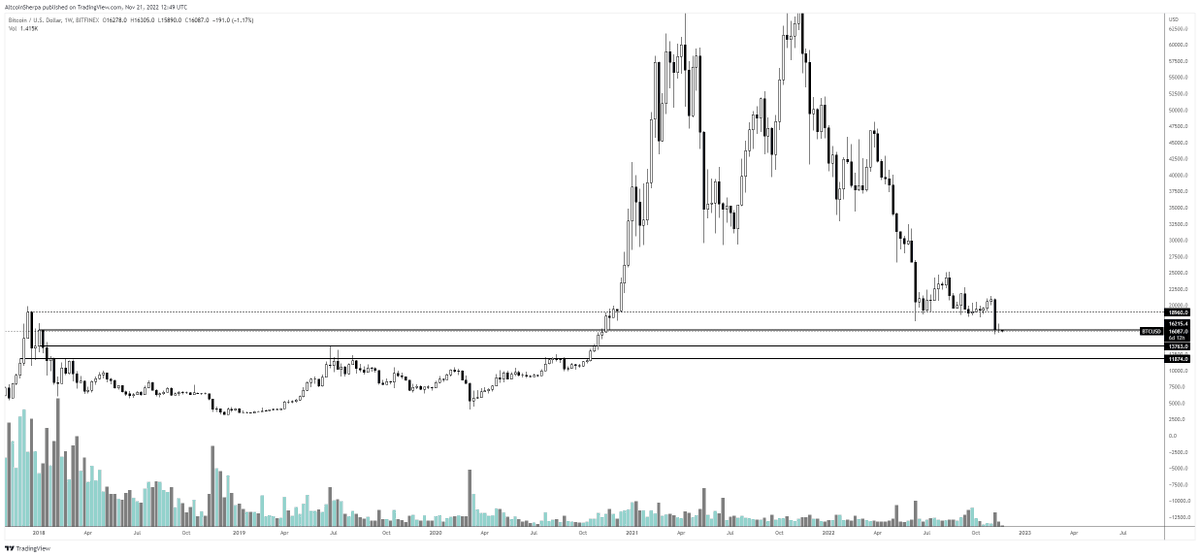
$BTC: High time frame levels. I think that 16k/14k/12k are all great levels to buy for the longer term and most investors would do fine just DCA-ing into those 3 levels. put a 30% buy at each of these and then walk away for a few years to a lot more $ IMO. #Bitcoin#BTC
A lot of people think the collapse of FTX is evidence that crypto doesn't have a future.
For me, it's the exact opposite. This proves why crypto—trustless, permissionless, uncensorable crypto—is the only path forward for the future.
This week, we grieved. Next week, we build.
The terminal total difficulty has been set to 58750000000000000000000.
This means the ethereum PoW network now has a (roughly) fixed number of hashes left to mine.
https://t.co/3um744WkxZ predicts the merge will happen around Sep 15, though the exact date depends on hashrate.
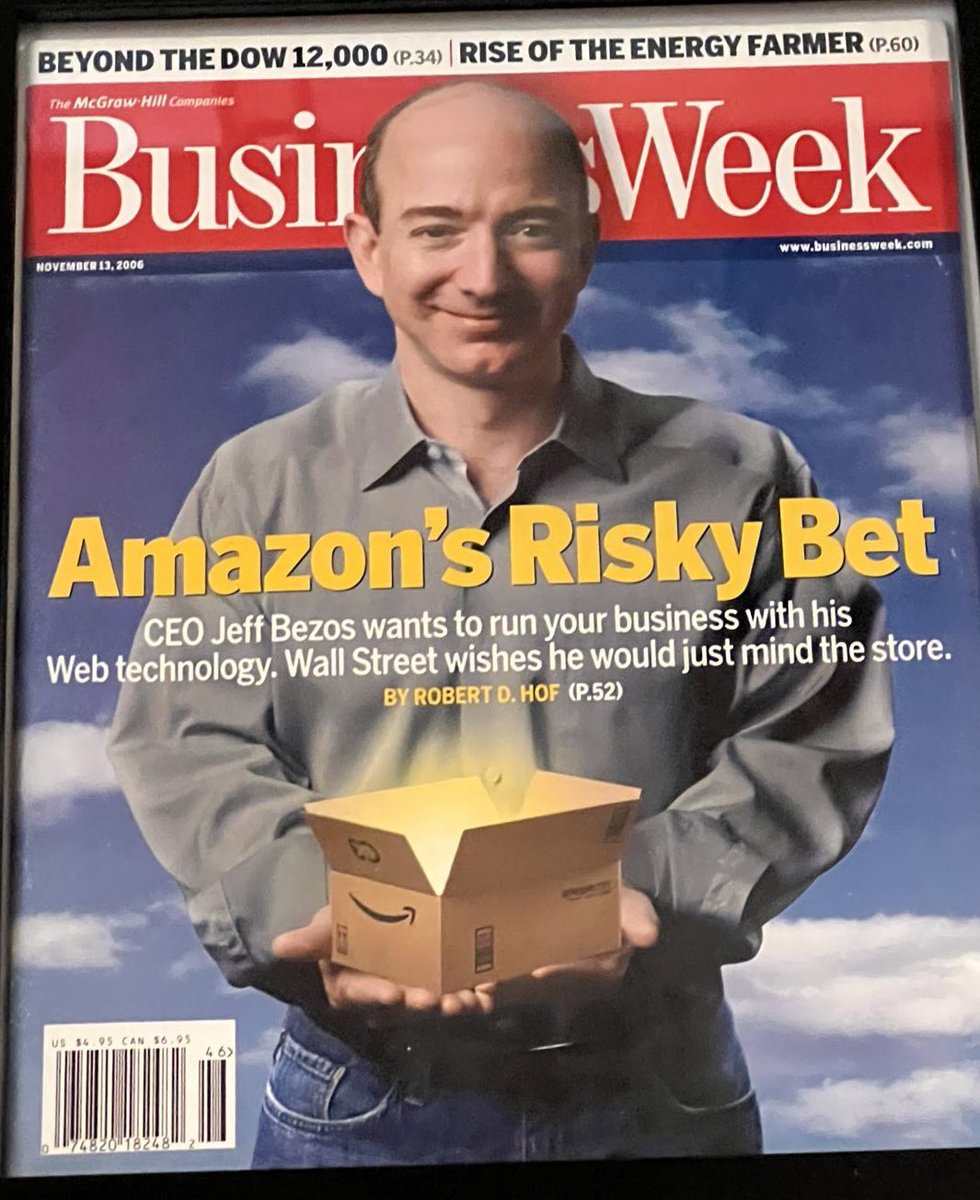
I have this old 2006 BusinessWeek framed as a reminder. The “risky bet” that Wall Street disliked was AWS, which generated revenue of more than $62 billion last year.