Adoro fazer amizades, amo o que faço..... minha profissão,... Fisioterapia/T.O. ... Terapia da Mão.(área de atuação.. reabilitação mão/MMSS).. dupla paixão..
You have a team of always-on AI coworkers with their own cloud computer, signed into your actual tools, and you're still asking them questions one at a time in separate chats, like it's just another window.
That is wrong.
The myth that changes the build order: every Bot shares the same cloud computer, browser sessions, and logins; xAI's own docs say don't treat separate Bots as a security boundary
Several architectural facts most people miss that change how you should build the whole team are in this article.
Read the full build guide below.
Giga bullish here
everyone loves looking at revenue
i’m more interested in what @Collector_Crypt actually keeps after the cards are minted
$2.1M last week
and it’s been climbing for a month
if that trend continues, they’re going to have some serious firepower to deploy
$gCARDS could get interesting imp
You're running the most capable model Anthropic has shipped against a system prompt written for one that's already dead, and it's following every stale line exactly!
> What changed: Fable 5 shipped June 9, 2026, with thinking always on and several old parameters now hard 400-erroring instead of just being ignored.
> The core principle: "provenance, not preference": every instruction has to name the failure and model it patched, or it's a deletion candidate
> The 8 builds: Contract, Inventory, Gate, Ledger, Scan, Fossil Sweep, Delete Log, Trigger, run in that order
> The trap this catches: a surviving "explain your reasoning" line doesn't error, it just silently trips a refusal and falls back to a weaker model
> The honest caveat: no eval means no pipeline; skip BUILD 2 and everything after it is guesswork
Save this before you forget. Full breakdown below.
restaking was the biggest narrative of 2024. @symbioticfi alone peaked at $2.7b tvl in december 2024. today it sits near $460m.
and it's normal, this product market repricing was inevitable. security-only yield was never going to pay enough on its own. the interesting part is what the team did about it: they stopped being a restaking protocol.
core v2 turns symbiotic into capital infrastructure. not "security for networks", a layer where one pool of collateral backs obligations across multiple onchain markets at the same time.
here's the problem it attacks.
defi capital is structurally lazy. in tradfi, the same piece of collateral gets reused roughly 2.5x on average, imf research on rehypothecation has tracked this for years.
in defi, collateral velocity is basically 1x. your dollar is only on one protocol, does one job, earning one yield. that's half the reason yields compress so fast: everyone's capital is single-purpose.
core v2 correct this. capital providers deposit once and earn 3 layers at the same time:
> base yield, with capital parked in blue-chip venues like Aave and Morpho
> premiums for backing obligations across symbiotic's markets, credit, insurance, liquidity
> extra returns when available capital gets routed into short-term opportunities
when an obligation triggers, the capital gets recalled automatically. the rules, duration, allocation, recall conditions, loss parameters, are defined before the money moves.
if that sounds like rehypothecation, it is.
tradfi has run this model for decades, and it blew up in 2008 precisely because collateral reuse was opaque and unbounded.
this is the same efficiency with the opposite properties: reuse is whitelisted, capped, and every rule is public before deployment. the auditable version of what prime brokers do in a black box.
2 proof points, both live:
1/ today's 3f integration. tokenized rwas settle asynchronously, an asset can take days to arrive before it becomes usable collateral. that gap either kills the strategy or forces dedicated capital to sit idle waiting for it. symbiotic now routes vault capital into those financing gaps just-in-time: money keeps earning elsewhere and moves only when financing is needed. context: rwas are at $33.5b onchain, roughly 3x in a year. settlement financing is becoming a real market, and someone will own the routing layer.
2/ keyrock's vault, already running. $1.54m usdc across 3 configured strategies. it earns ~5% base apy on morpho, and when a 3f financing window opened, it automatically supplied $315k at 1.9 bps per day, about 6.9% annualized, with the capital set to flow back to morpho after repayment. that's a 190 bps pickup on the routed slice, captured automatically, zero idle buffer, zero manual intervention.
the dollar amounts are small. the mechanism is the point: 1 pool of capital, multiple approved markets, automated rotation into the best available return.
defi has been promising exactly this since 2020 and mostly deploying single-purpose vaults instead.
this model lives or dies on whether more institutional curators show up and whether the list of connected venues keeps growing. those are the two metrics to watch.
but directionally this is the right pivot. security-as-a-service was a feature. capital infrastructure, making every onchain dollar do two or three jobs, the way tradfi collateral already does, is bullish tbh.
the protocols that survive this cycle will be the ones that make tvl obsolete as a metric, because their capital moves.
Gm. Didn’t post anything yesterday because I was still in shock.
This is probably the first time I actually made a huge entry in the right accumulation zone. But getting the entry right wasn’t even the hardest part. The hardest part was waiting and suffering through the drawdown before the breakout finally came.
Congrats to everyone who won big today.
Now comes the next challenge: riding the trend properly. Being able to add leverage on higher-low dips, scale up size early in the trend when the setup is strongest, while still being disciplined enough to stop out and accept when the ride is over.
We’ve been waiting for this moment for almost a year since 10/10.
So now it’s time to win.
Higher.
Alex Finn just called Grok Bot the best AI agent out right now, and it's not another chat window, it's an army of agents working around the clock!
I've said it before: the products that actually change your workflow are the ones that finish work while you're not watching, not the ones that answer faster.
Here's what his walkthrough covers:
> Full setup from scratch
> Real use cases
> The plugin ecosystem, what actually makes it different from a normal chatbot, each Bot runs on its own persistent cloud computer and keeps working after you close the app
Set it up right, per Finn, and you're not prompting one agent at a time anymore, you're managing a team!
Bookmark so you do not lose it!
Follow @neil_xbt for more!
Most people think optimising a system prompt for a new model means adding more instructions to handle its quirks!
Actually, Anthropic's own prompting guide states the opposite directly: skills built for prior models "are often too prescriptive for Claude Fable 5 and can degrade output quality."
Anthropic's own team proved this internally too, removing roughly 80% of Claude Code's system prompt for the Claude 5 models, from about 2,686 words down to 514, with no measurable loss on coding evaluations.
Used against a stale prompt, Fable 5 is a $10-per-million-token machine for executing your 2024 opinions with perfect fidelity.
Used against an audited surface, it's the first model that hands your hardest unsolved problem back finished.
Yet the old instructions are holding it back and this article teaches you the system to use Fable 5 to the max!
Follow @neil_xbt for more on why deleting prompt instructions often beats adding them.
I built a 3D PC configurator where every single part, down to the screws, is math instead of a downloaded model!
> No 3D model files anywhere in the repo, the entire catalog is procedural geometry driven by plain data
> A 3-slot graphics card is a slot-width variable. A 240mm radiator is a length variable
> Two independent compatibility checks run against each other: a declarative rule engine and a literal mesh-collision test, so the geometry and the rules can't silently drift apart
> Renders with real-time RGB lighting, an exploded view, and five camera presets that adapt to whichever case is loaded
Most configurators fake physical accuracy. Mine derives it from the actual geometry, every time.
Follow @neil_xbt for more content like this!
Most people think Telegram applying for a .gram domain zone is just a branding play, a nicer-looking link format.
Actually, this reads more like a direct response to a real outage.
In July 2026, every https://t.co/LLoE60pUAz link worldwide went dead with no explanation, because that shortlink domain belongs to Montenegro's .me registry, not Telegram.
Telegram was one registry-level decision away from losing its own link infrastructure.
A domain zone Telegram actually owns and controls removes that dependency entirely and gives its billion users personal second-level domains they could build interactive, prompt-generated websites on, hosted directly by Telegram.
This would make building and hosting with Telegram significantly easier and smoother.
I am excited for this!
$BTC: $64,531 (+2.59%). $ETH: $1,913 (+2.00%).
S&P 500 is down.
Crypto is showing relative strength.
The tide is turning. Are you on the right side?
A dev just open-sourced the exact category of product xAI charges monthly for, an autonomous AI bot platform, except this one you fully own!
> Every bot gets persistent memory and its own dedicated computer, not a one-off chat session
> Bots can spawn child bots or short-lived subagents to divide up work automatically
> Ships with a real live Linux desktop the agent can see and operate, not just a terminal
> Runs on Docker, a remote sandbox, or your own desktop, your choice
> Model-agnostic: point it at OpenRouter, OpenAI, GitHub Copilot, or Grok itself
This isn't a wrapper around one company's API. It's the entire agent-with-a-computer concept, decoupled from the subscription.
Follow @neil_xbt for the frameworks quietly replacing the products that inspired them.
Repo: https://t.co/urAFsSuII9
Monad is doing everything it can to hold $MON within this range.
The Foundation offered up to $60M to buy locked MON directly from selected early investors at a discount (same lockup).
The tokens were not removed from future supply. Monad was trying to improve who holds that supply before it unlocks, while ecosystem incentives continue pushing onchain activity and TVL.
We have seen other chains use a similar playbook. It can reduce the risk of foreseeable sellers, support the price and buy the ecosystem more time.
But in the end, we all know what happened.
Will history rhyme for Monad? Let’s see.
I think we are getting closer to the end of this heavy MSTR-selling phase.
Like I said, Saylor selling MSTR to build the USD Reserve and defend STRC around $95 was the right move.
It is painful for MSTR holders, but it became inevitable once the weakness in STRC’s original design was exposed.
The variable dividend was supposed to keep STRC trading near $100. But when Bitcoin fell and credit confidence weakened, adjusting the yield alone was not enough. Once STRC dropped below $90, Strategy had to prove that the product was more than a high yield promise backed by a volatile asset.
That required three things:
1/ A large cash reserve to remove doubts about dividend coverage
2/ STRC buybacks to create demand and reduce future dividend obligations
3/ A willingness to prioritize the stability of its capital structure over buying more Bitcoin
This hurts MSTR in the short term because common shareholders absorb the dilution while none of that capital adds to the Bitcoin reserve. But allowing STRC to keep falling would have been worse. It could have destroyed confidence in Strategy’s entire preferred-stock platform and closed an important source of future capital.
The good news is that I think we are getting closer to the end of this heavy MSTR-selling phase.
Strategy now has a $4.8B USD Reserve, covering roughly 2.8 years of dividends and interest. That is already beyond its original goal of at least 24 months. STRC has also recovered to around $95, and Strategy has said its buybacks should taper as the price approaches $100.
MSTR may take a few months to come alive again, but the path is still there.
First stabilize STRC. Then rebuild MSTR. Then return to growing Bitcoin per share.
No way this exists for free!
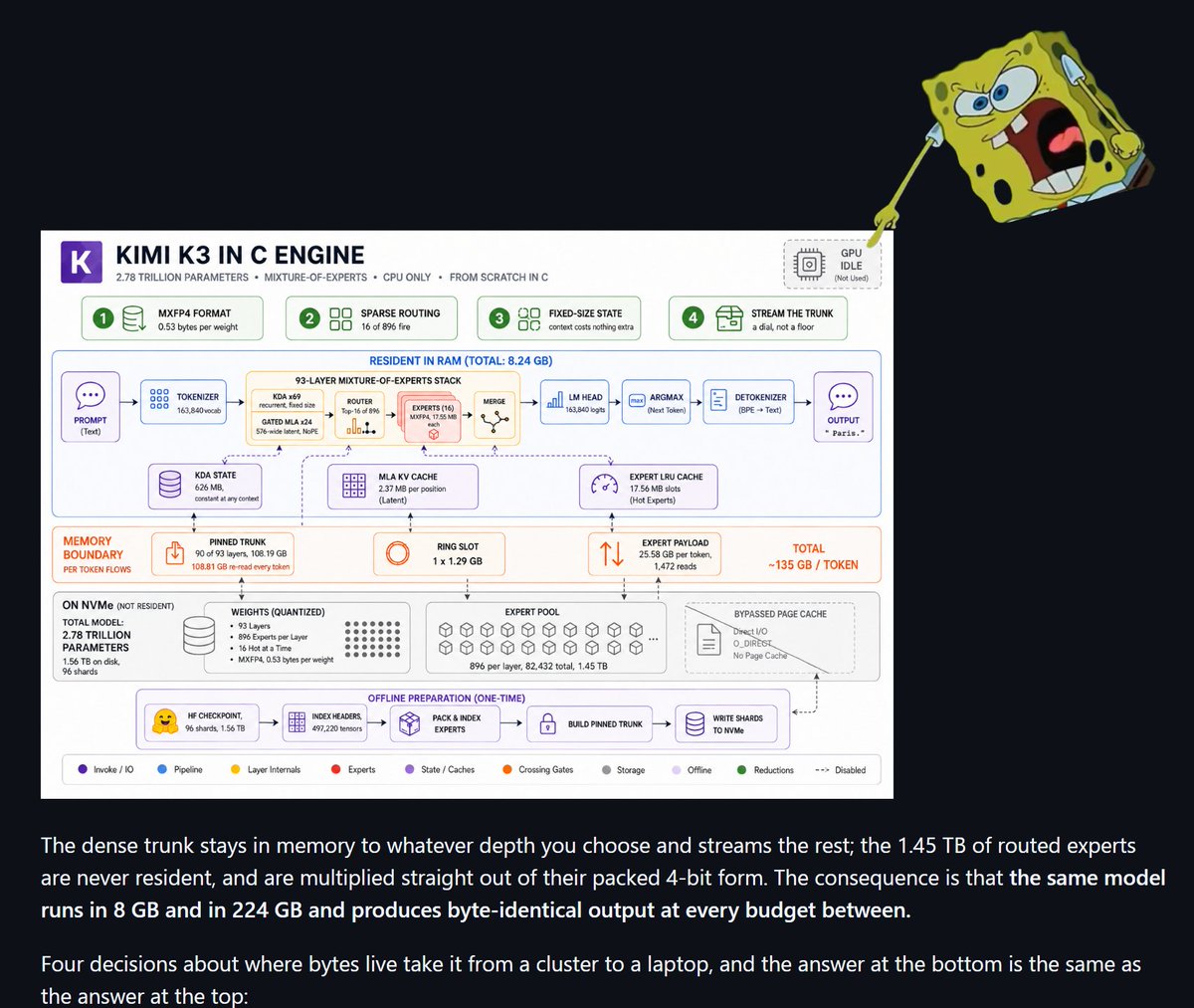
Most people assume trillion-parameter models are permanently out of reach without an enterprise GPU budget.
That assumption just got a lot shakier.
> A 2.78 trillion-parameter model doing inference with zero GPUs involved
> Runs in 8.24 GB of RAM, less than a lot of laptops ship with
> Verified bit-identical output across memory configs from 8 GB up to 224 GB, so it's not a lossy shortcut
> 176 KB binary, no ML framework to install, nothing to fight for dependencies
> Nearly 6,000 stars in 2 weeks and still climbing
If the ceiling on "what needs a GPU" just moved, the people who don't notice are the ones still budgeting for hardware they may not need.
Repo: https://t.co/7Ji6xYZpjP