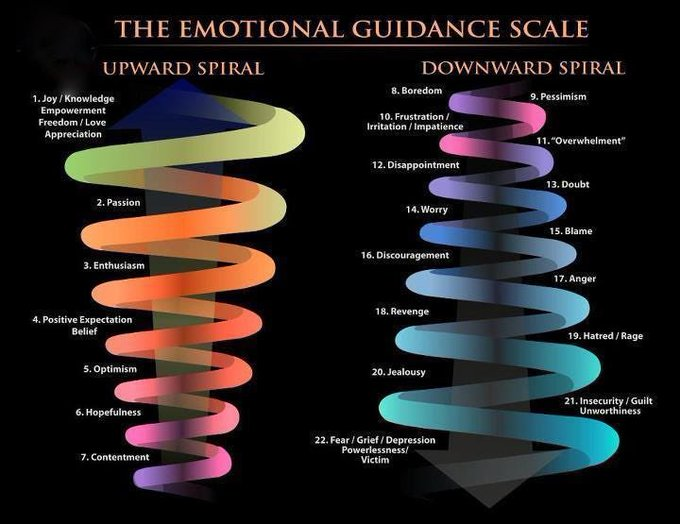
Avoid negativity at all times.
It will infect your mind.
Do not tolerate people to talk negative around you, break their frame of thought by showing how you see the same situation from a positive lens.
View everything positively and create your own upward spiral.
Elon Musk on the most underrated reason to read a lot of books:
Asked about the search for meaning, the Tesla and SpaceX CEO goes straight to reading volume.
"I encourage people to read a lot of books. Just read, I mean basically try to ingest as much information as you can and try to also just develop a good general knowledge, so you at least have like a rough lay of the land of the knowledge landscape."
The standard he sets is low on purpose. A rough lay of the land is all he asks for:
"Try to learn a little about a lot of things."
Then comes the reason, in the form of a question most people never think to ask themselves:
"You might not know what you're really interested in. How would you know what you're really interested in if you at least aren't doing a peripheral exploration broadly of the knowledge landscape?"
That question is the whole point. Reading widely works as a search function.
You can only be drawn to a field you have actually encountered. The set of things you are capable of wanting is capped by the set of things you have been exposed to, and for most people that exposure arrives by accident: whatever your parents did, whatever your school offered, whatever your first job put in front of you. Read nothing outside that and you are choosing from a menu someone else handed you.
Books are one input. Musk applies the same logic to people:
"And you talk to people from different walks of life and different industries and professions and skills and occupations. Like just try, you know, learn as much as possible."
Same mechanism, more surface area.
When the interviewer reframes all of this as a search for meaning, Musk accepts the framing and routes it straight back to reading:
"Yeah, what's the meaning of life and all. But just generally, like I said, I would encourage people to read broadly in many different subject areas and then try to find something where there's an overlap of your talents and what you're interested in."
The reading populates one half of that overlap. Talent, the other half, tends to reveal itself whether you go looking or not.
@elonmusk is specific about why talent on its own falls short:
"People may be good at something, or they may have skill at a particular thing, but they don't like doing it."
Talent on its own is a trap. Being good at something generates praise, money and more of the same work, which locks you in years before anyone asks whether you enjoy it. Plenty of people end up a decade into a career they excel at and quietly resent, having optimised for the half of the equation that pays out fastest.
His conclusion:
"So you want to try to find a thing where that's a good combination of the things that you're inherently good at, but you also like doing."
Elon Musk warns that time is running out:
At most, there are 3 years left in which you can still make money selling your work. After that, AI will automate most tasks, and paying a person for their time will no longer make sense.
The model of the last 200 years - "I give you your salary in exchange for your time" - is coming to an end.
This will trigger the greatest transfer of wealth in modern history. Those who are already making the shift understand it. Those waiting for it to hit the news will arrive too late.
In the end, what matters is not how much you work, but what you own.
The smartest asset you can build right now isn't Bitcoin or land.
It's an income stream that runs on AI and compounds while you sleep.
One skill. One niche. $10K/month.
Here's the exact playbook ↓
@BoringBiz_ Animals don't get depressed outside where they are hunted and always on the brink of starvation.
They get depressed in captivity.
Pathetic.
Elon Musk's personal pilot once described what happens on the plane between meetings.
He said Elon doesn't sleep on flights. He doesn't watch movies. He doesn't make small talk with whoever is traveling with him. He reads. For the entire flight. Technical papers, engineering specifications, physics textbooks. Highlighted. Annotated. Pages folded. Like a graduate student preparing for an exam that never ends.
The pilot said he has seen Elon read an entire 400-page engineering manual on a single transatlantic flight and then walk off the plane and ask questions about it that the authors of the manual probably couldn't answer. Not because he's trying to impress anyone. Because he genuinely needs to understand every system at the level of the engineers who designed it.
He said the most unsettling part is the speed. Elon doesn't read at a normal pace. He processes pages the way most people process paragraphs. And he retains almost everything. Engineers who worked with him for years say he will reference a detail from a paper he read six months ago mid-conversation as if he read it that morning.
The world sees a CEO making decisions. What actually happens is a man who reads more technical material than most PhD students and then walks into a room with the engineers and speaks their language. The authority isn't inherited from the title. It's earned page by page on every flight between factories.
“In my whole life I've never been good at something I wasn't very interested in. It just doesn't work. There's no substitute for strong interest.”
— Charlie Munger
> notorious womanizer despite being fat and bald
> retires at 42 as the richest man in the colonies by building a fortune on posting
> world-leading scientist in his SPARE TIME despite little formal education
> hired by the government during the revolution to schmooze people in France
> founded the future most powerful country on earth
> died at an old age universally admired
Reminder: Ben Franklin was the biggest baller of all time