@F_Desouche Il faut rétabli la peine de mort pour ces ordures et nettoyer la France de ces pédophiles pervers…ça suffit les postures politiquement correct. Ces prédateurs n’ont pas le droit de vivre en société.
A French engineer who lives quietly in Paris has spent 30 years writing software that the entire internet now runs on without knowing his name.
He wrote the code that streams every YouTube video, every Netflix show, every TikTok clip. He wrote the code that runs the virtual servers underneath AWS, Google Cloud, and Microsoft Azure. He calculated more digits of pi than anyone in history. He has no Twitter. He has no marketing. He just keeps shipping.
His name is Fabrice Bellard.
Here is the story, because almost nobody outside the systems programming world knows what one man has built.
Fabrice was born in 1972 in Grenoble, France. He studied at École Polytechnique, the top French engineering school. He never went to Silicon Valley. He never built a startup empire. He just wrote code.
In 2000 he started a project called FFmpeg, an open-source multimedia framework for encoding, decoding, and streaming video. He was 28. The project did one thing nobody else had done well. It handled every video and audio format that existed, in one library, on every operating system. He led it himself for years.
Today FFmpeg is the invisible engine of the internet. YouTube uses it. Netflix uses it. VLC uses it. Chrome and Firefox use parts of it. Every Android phone, every iPhone, every smart TV, every video editing tool you have ever touched runs FFmpeg somewhere underneath. If you have watched a video on a screen in the last 20 years, Fabrice's code processed it.
He was not done.
In 2003 he started QEMU, a machine emulator and virtualizer. He wrote it solo until version 0.7.1 in 2005. QEMU lets you run any operating system on any other operating system. It became the foundation of modern virtualization. KVM, the Linux kernel hypervisor, runs on top of QEMU. Every major cloud provider, AWS, Google Cloud, Microsoft Azure, IBM Cloud, runs virtual machines on infrastructure built around it. The Quick Emulator is the most cited piece of cloud infrastructure code on Earth.
He kept going.
In 2001 he won the International Obfuscated C Code Contest with a small C compiler that grew into TCC, the Tiny C Compiler. TCC can compile and boot a Linux kernel from source in under 15 seconds. In 2004 he calculated the most digits of pi ever computed at the time, using a personal desktop computer and an algorithm he derived himself called Bellard's formula. In 2011 he wrote a complete PC emulator in pure JavaScript that runs Linux in your browser, a project called JSLinux that engineers still cannot believe is real.
In 2019 he released QuickJS, a small but complete JavaScript engine that fits where V8 cannot. In 2021 he released NNCP, a neural network based lossless data compressor that immediately took the lead on the Large Text Compression Benchmark.
Then he turned his attention to large language models. He built TextSynth Server, a web server with a REST API for running LLMs locally. He released ts_zip and ts_sms, compression utilities that use language models to compress text and short messages at ratios traditional algorithms cannot reach. He released TSAC, a very low bitrate audio compression system. In December 2025 he released Micro QuickJS, a new JavaScript engine for microcontrollers, separate from QuickJS, designed for environments with almost no memory.
Fabrice co-founded a telecom company called Amarisoft in 2012, where he serves as CTO. Amarisoft builds 4G and 5G base station software used by carriers and labs around the world. He has been running it for over a decade while continuing to ship personal projects from his own home page at bellard dot org
He has no Twitter. He has no Instagram. He gives almost no interviews. His personal website is a flat list of projects with no styling, no fonts, no marketing copy. Just titles and links.
A quiet French engineer who never moved to Silicon Valley wrote the code that quietly runs the internet.
He is still shipping.
BREAKING:
VanEck just made a bold call on Bitcoin.
Matthew Siegel. $199,000,000,000 in assets under management.
"Bitcoin will become a mainstream asset that will compete with other reserve settlement currencies."
Not a store of value. Not digital gold.
A reserve settlement currency.
Competing with the dollar. The euro. The yen.
The institutions aren't buying Bitcoin because they believe in decentralization.
They're buying because they see where the monetary system is heading.
🔴 Michael Saylor déclare que « l'expansion de l'IA absorbe des capitaux à une échelle historique » mais que « le bitcoin reste l'actif de premier plan à long terme ».
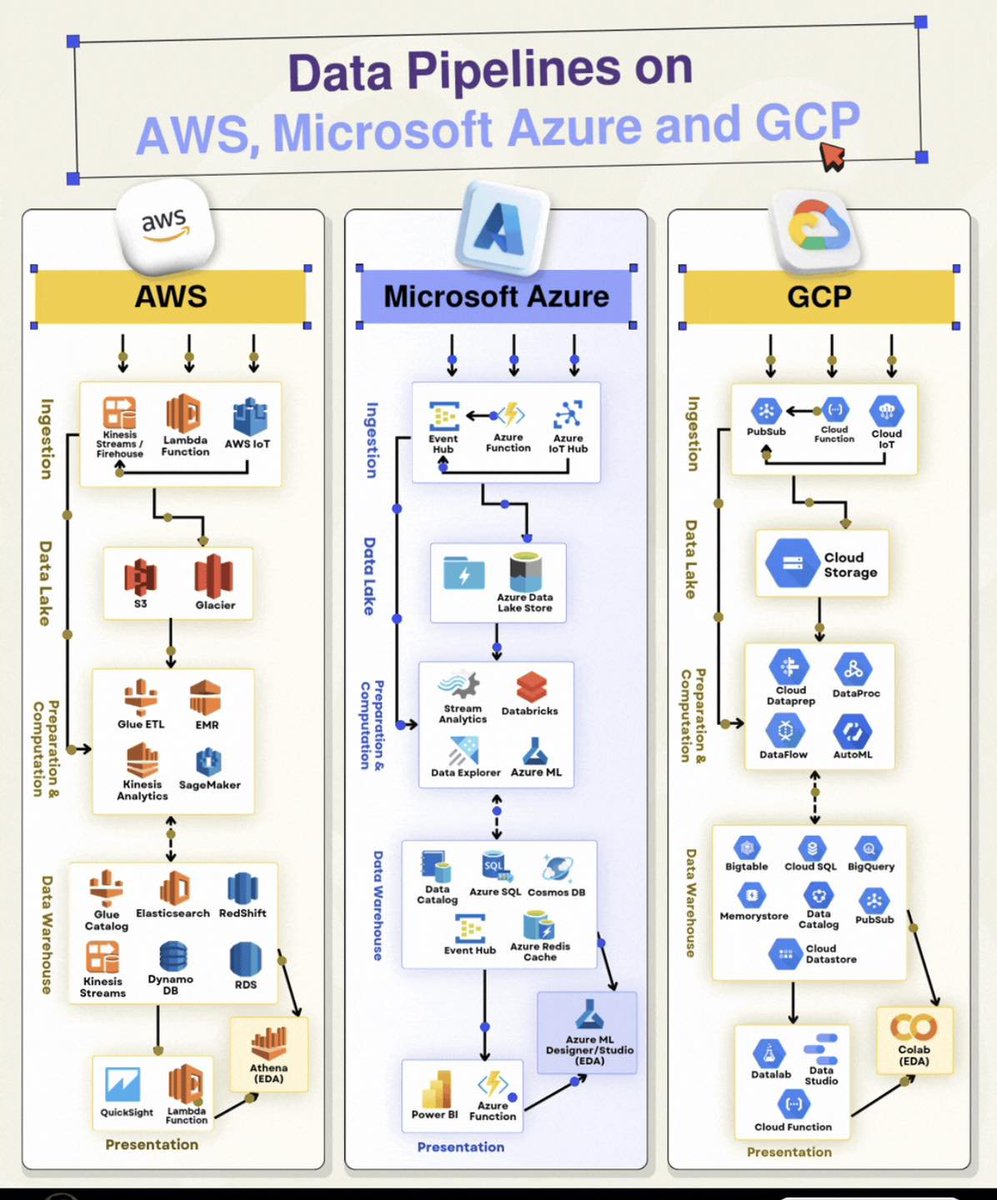
AWS vs. Azure vs. GCP looks overwhelming, until you realize they all do the exact same five things.
Different names. Same architecture. Here's the translation map across all three clouds 👇
𝗜𝗻𝗴𝗲𝘀𝘁𝗶𝗼𝗻
Get data flowing in. AWS uses Kinesis and Lambda, Azure uses Event Hub and Functions, GCP uses Pub/Sub and Cloud Functions. Same job: capture the stream.
𝗗𝗮𝘁𝗮 𝗹𝗮𝗸𝗲
Store everything raw and cheap. S3 and Glacier on AWS, Data Lake Store on Azure, Cloud Storage on GCP.
𝗣𝗿𝗲𝗽𝗮𝗿𝗮𝘁𝗶𝗼𝗻 & 𝗰𝗼𝗺𝗽𝘂𝘁𝗮𝘁𝗶𝗼𝗻
Clean, transform, and model. Glue/EMR/SageMaker on AWS, Databricks/Stream Analytics/Azure ML on Azure, Dataflow/Dataproc/AutoML on GCP.
𝗗𝗮𝘁𝗮 𝘄𝗮𝗿𝗲𝗵𝗼𝘂𝘀𝗲
Serve query-ready data. Redshift/DynamoDB/RDS on AWS, Azure SQL/Cosmos DB on Azure, BigQuery/Bigtable/Cloud SQL on GCP.
𝗣𝗿𝗲𝘀𝗲𝗻𝘁𝗮𝘁𝗶𝗼𝗻
Turn it into insight. QuickSight/Athena on AWS, Power BI on Azure, Looker/Data Studio/Colab on GCP.
Once you think in stages instead of services, switching clouds becomes easy — you're just swapping tools, not relearning architecture.
🔖 Save this and stop memorizing service names.
Which cloud do you know best? 👇
#DataEngineering #CloudComputing #AWS #Azure #GCP
Instead of watching an hour of Netflix, watch this 2 hour hour Stanford lecture will teach you more about how LLMs like ChatGPT and Claude are built than most people working at top AI companies learn in their entire careers.
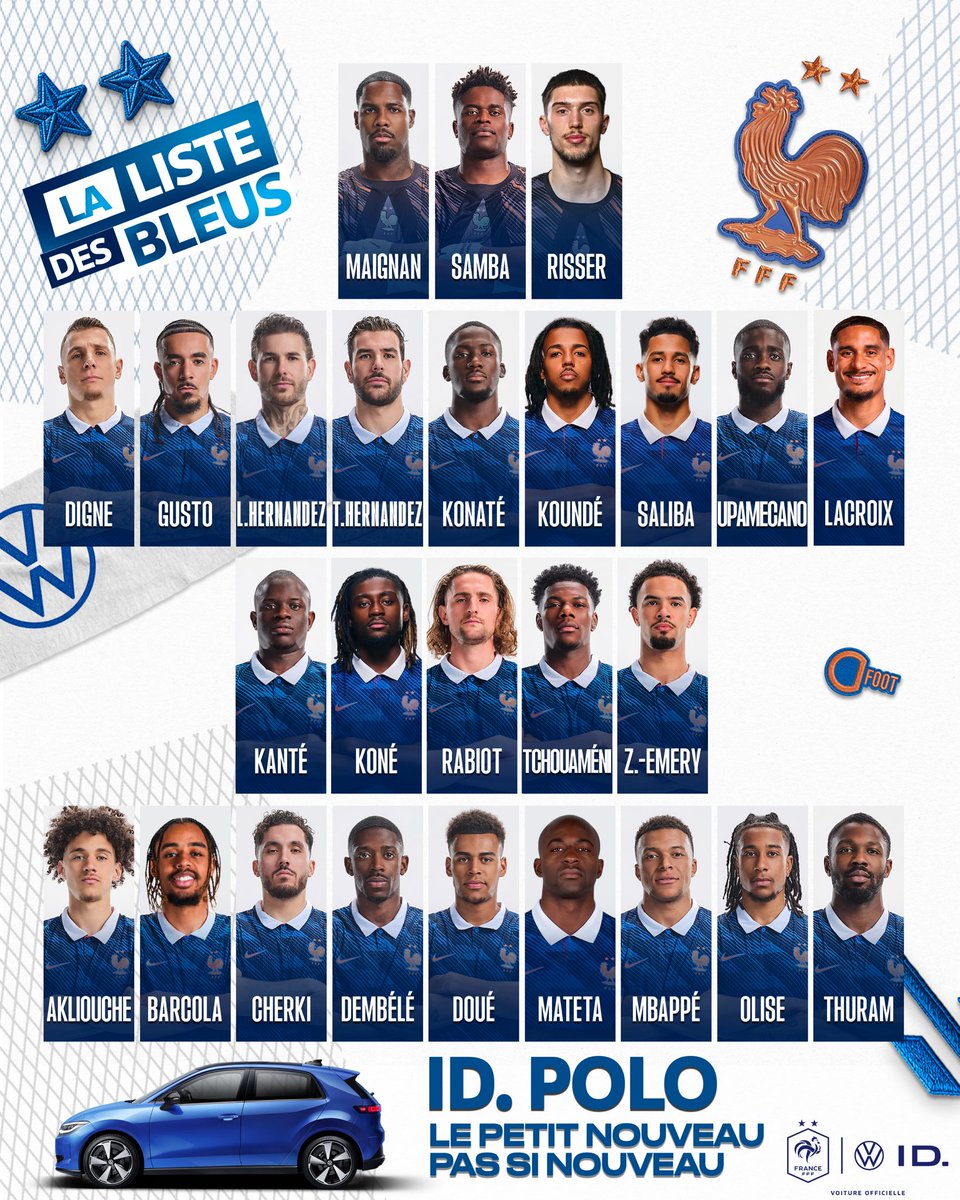
🚨💣 OFFICIEL ! LES 26 BLEUS 🇫🇷 APPELÉS POUR PARTIR EN AMÉRIQUE CONQUÉRIR LE MONDE !!! 🌍🏆
La compétition démarre LE 16 JUIN PROCHAIN pour l’Équipe de France ! 🍿
LE CALENDRIER COMPLET DES 3 PREMIERS RENDEZ-VOUS👇
▫️ FRANCE 🇫🇷 - 🇸🇳 SÉNÉGAL
🗓️ 16 juin - New York
▫️ FRANCE 🇫🇷 - 🇮🇶 IRAK
🗓️ 22 juin - Philadelphie
▫️ NORVÈGE 🇳🇴 - 🇫🇷 FRANCE
🗓️ 26 juin - Foxborough
26 joueurs EN MISSION pour se hisser sur le toit du monde. 🌍🤩⭐️
Sans oublier le petit nouveau, la ID. Polo de Volkswagen. ✨😉
🤝 𝘌𝘯 𝘤𝘰𝘭𝘭𝘢𝘣𝘰𝘳𝘢𝘵𝘪𝘰𝘯 𝘢𝘷𝘦𝘤 𝘝𝘰𝘭𝘬𝘴𝘸𝘢𝘨𝘦𝘯
Complètement d’accord avec ce classement, je valide ! De toute façon, autant choisir des bonnes, c’est la seule
chose qu’on pourra se payer bientôt, avec les œufs.