Credit podcast for institutional investors. Forensic conversations on HY, Private Debt & Distressed with leading voices in finance. Hosted by PM@lit_like_lehman
“If there’s too much capacity in the industry, why would they renew with CoreWeave?”
Jordan Chalfin (@CreditSights), who has a buy on the bonds, on CoreWeave’s customers that own data centres.
Household debt to GDP has fallen to levels not seen since the late 1990s.
Business debt to GDP keeps declining gradually, but is still in the upper quartile of its historical range. Fed Financial Stability Report, November 2026 (@federalreserve)
https://t.co/y0bsAOopWI
@debt_serious Over the past year it was the other way round: private credit grew 13.8% and leveraged loans 5.0%. The 25.9% is the average since 1998, when loans were a small market; the private credit average only starts in Q4 2012.
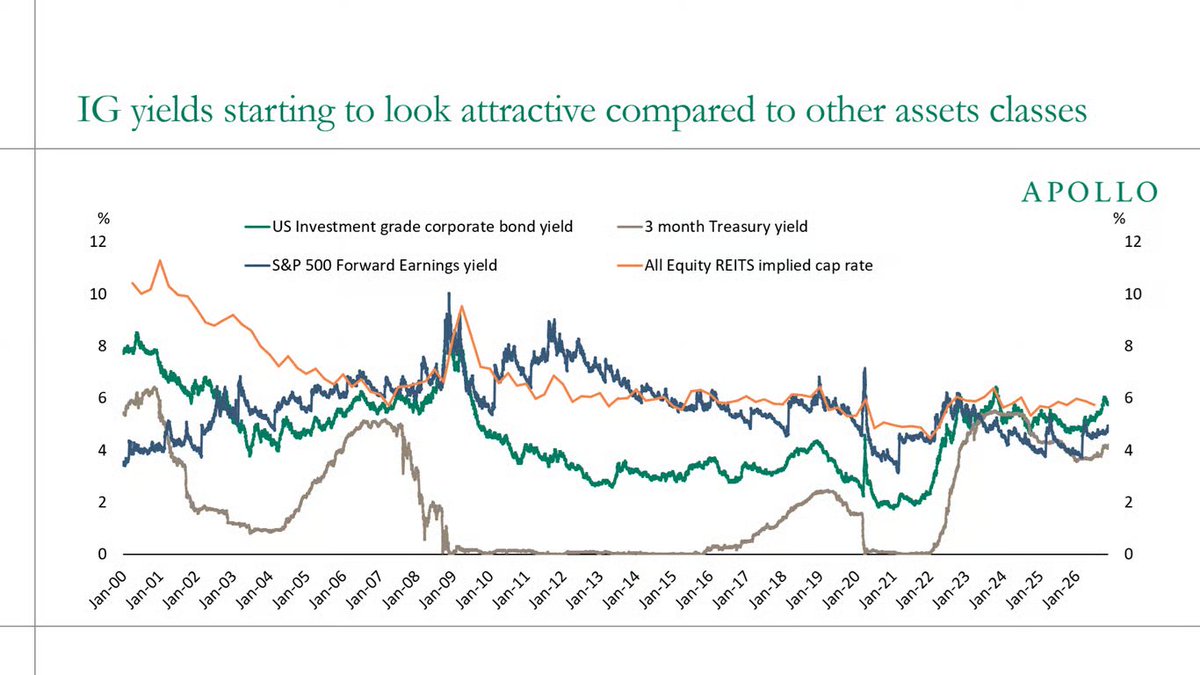
Interesting chart from Torsten Slok: High-quality credit now yields more than equities. Fair point, but that has been the case since yields moved to a higher plateau again.
“In Chalfin’s view the collateral is the most valuable part, and the parent guarantee the less valuable one.”
From our article with Jordan Chalfin (@CreditSights) on CoreWeave’s GPU loans ↓
https://t.co/DAWkoQQ4F0
“Customers are kinda so desperate for capacity right now that they’re willing to make a prepayment on an old generation of a chip.”
Jordan Chalfin (@CreditSights) on CoreWeave.
CCCs are a much smaller part of the US high yield market than in the past, about 9% of the index against around 14% in 2016. The high spreads come mainly from higher rates, which make many of their capital structures unsustainable. Strong CCC borrowers can still access the market.
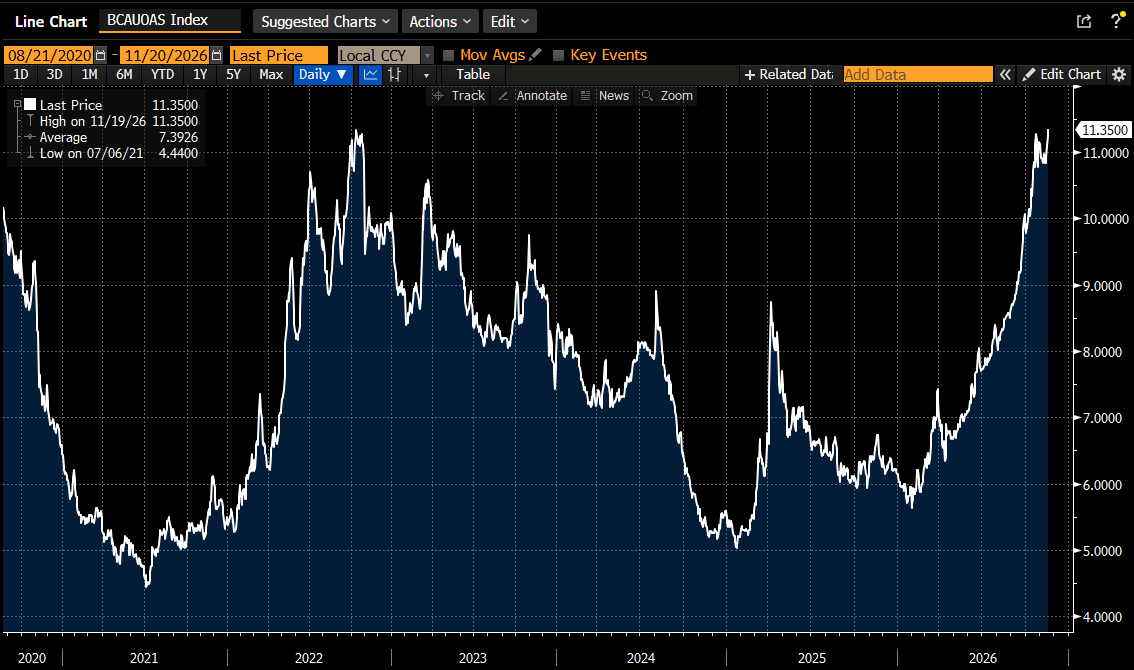
Spreads on the lowest-rated high-yield bonds have widened out to the most since 2020. Investors are increasingly shunning the weakest companies, especially as they can get ample yield lending to much safer borrowers.
"Customers are so desperate for capacity right now that they're willing to make a prepayment on an old generation of a chip. CoreWeave doesn't even have any CapEx associated with it. The debt is fully paid off on that."Jordan Chalfin (@CreditSights) on CoreWeave.
@dailychartbook@sblitz1@TS_Lombard Software is only about 3.5% of the US high yield index and mostly better quality, against about 13% of leveraged loans and more than 20% of private credit. So HY spreads are not where to look for software stress.