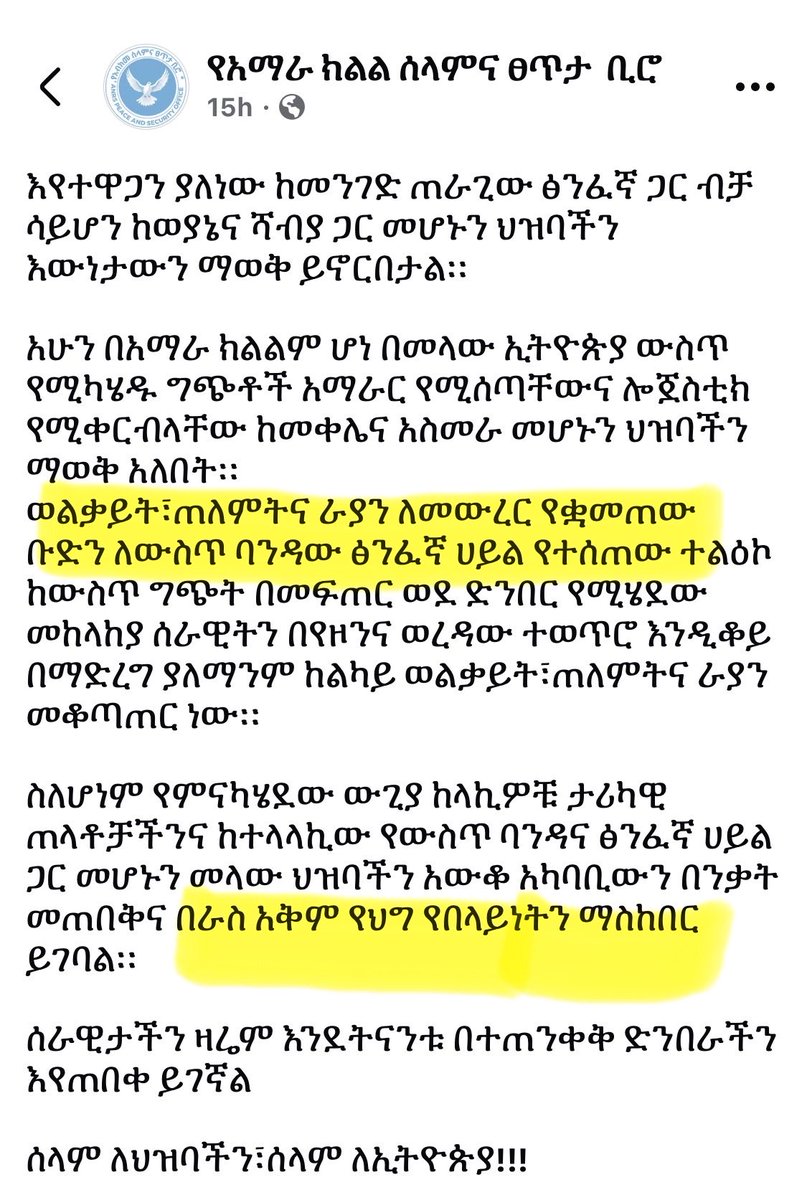
Given recent developments, the Saudi presence in Addis adds an interesting dimension. A considered opinion is that they will offer win-win economic incentives and integration. All the bellicose rhetoric was a call which seemed to be answered. But it will require sobriety to implement; a missing but major risk factor. US sponsorship + finance + political settlement - rogue state action = a likely scenario.
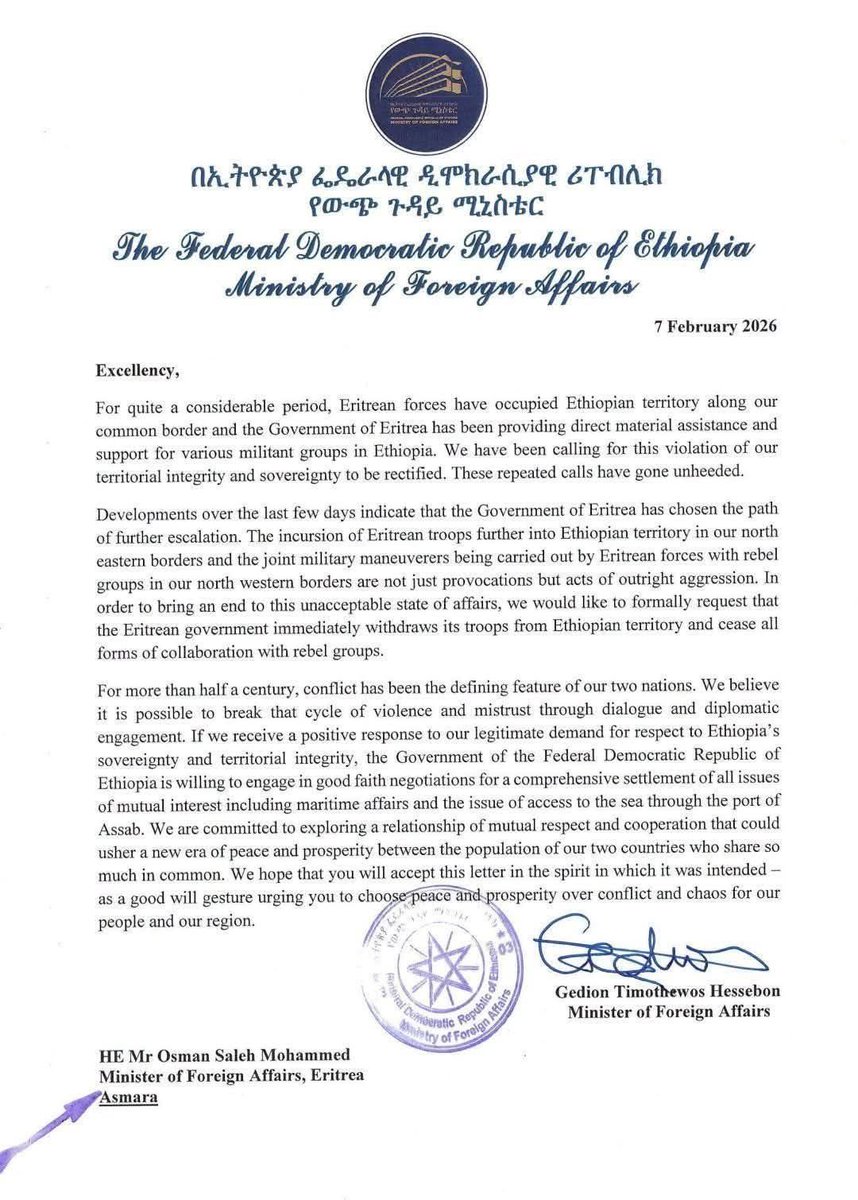
The letter @GHessebon sent to Eritrea seems to be interesting social media posturing. Neither his X account nor the Ministry of Foreign Affairs communicated or posted it. That aside, it makes sense when understood in terms of PM Abiy Ahmed’s statement in parliament last week. The letter appears to accomplish coercive diplomacy, with a formal accusation while paving the way for negotiation on business terms (GERD share, a %age of Ethiopian Airlines) for port access. The land swap mentioned in the speech seems to be a veiled reference to the Algiers agreement and this proposal to negotiate -a revival of Saudi agreement of 2018.
The considered opinion is that the overall solution increasingly seems to settle on a comprehensive cooperative package deal with US sponsorship + Saudi finance. Naturally this will involve handling UAE interest by fortifying the Ethiopian state from UAE vassalage.
This yield curve is a warning light; indicating an economy in crisis. Banks are happy to lend to the government for up to 6 months, charging a steady 15%. But for a 1-year loan, they demand 20%. This 5% price hike (risk premium) confirms that the market is terrified of what will happen to inflation or the currency after the 6-month mark. This hardly jives with the PM's rapidly growing economy narrative . The Gov of Ethiopia's own numbers tell the truth.
Just exactly how was the GERD and other State Owned Enterprises (SOEs) financed? Hopefully this explains both President Trump and PM Abiy Ahmed’s claims. Essentially the Commercial Bank of Ethiopia (CBE) provided a bulk of the financing + some public/diaspora participation. The IMF then bailed out the debt burdened bank. This diagram explains that mechanism👇
The Egyptian president Esl-Sisi gave a speech using a Police anniversary occasion. In it, he identified items which might be read as resisting UAE influence; true where applicable. From Ethiopia perspective, it can be read as reflecting a preference for “institutions of the state” confirming a positive and beneficial relationship Egypt has with Addis Ababa. Below is the relevant except
“. . . and in light of the recurring patterns of instability seen in some countries, Egypt reiterates its categorical and decisive rejection of any efforts aimed at dividing the region’s countries, or carving out portions of their territories, or establishing militias and entities that parallel legitimate national armies and institutions. Egypt considers such practices within its neighboring countries to be a red line that it will not allow to be crossed, as they directly impact its national security.
Here, I affirm to you that the institutions of the state are a pillar of stability and security for the country. Militias do not protect nations, and the countries that believed that establishing militias could play a role in protecting regimes have seen these militias turn into tools for the destruction of states. Those who did that have departed, and it is only by the will of Allah Almighty that this country has been preserved. . .”
The Egyptian president gave a speech using a Police anniversary occasion. In it, he identified items which might be read as resisting UAE influence; true where applicable. From Ethiopia perspective, it can be read as reflecting a preference for “institutions of the state” confirming a positive and beneficial relationship Egypt has with Addis Ababa. Below is the relevant except
“. . . and in light of the recurring patterns of instability seen in some countries, Egypt reiterates its categorical and decisive rejection of any efforts aimed at dividing the region’s countries, or carving out portions of their territories, or establishing militias and entities that parallel legitimate national armies and institutions. Egypt considers such practices within its neighboring countries to be a red line that it will not allow to be crossed, as they directly impact its national security.
Here, I affirm to you that the institutions of the state are a pillar of stability and security for the country. Militias do not protect nations, and the countries that believed that establishing militias could play a role in protecting regimes have seen these militias turn into tools for the destruction of states. Those who did that have departed, and it is only by the will of Allah Almighty that this country has been preserved. . .”
President Trump’s recent letter on the Nile/GERD compresses Ethiopia’s decision space. Aside views on its merits, it signals accelerating external agenda-setting. Under such conditions, fragmentation is not neutral—it directly erodes national agency.
Here is an idea: a narrowly defined internal Grand Bargain among stakeholders with real material influence, focused only on core national interests (water, power, economic survival, security), to enable a single external negotiating mandate. In practice, this could also serve as a modest litmus test—whether actors are willing to give primacy to national interest when it matters.
Time will tell if he will succeed but it looks like Somalia’s President Hassan Sheikh Mohamed is already making moves and playing an active role in the HOA.