Obviously proving the Riemann hypothesis is an amazing achievement of humanity, but people I think are still missing its significance. We can scale formal verification to previously unseen levels. We are going to formally verify all your software, from the python code to the operating system to the assembly. Bugs will be impossible.
LLMs will take ambiguous tasks, produce specialized software to do said task, and prove that the software is going to do what they said it will.
Verification is the infrastructure
of the next great achievements.
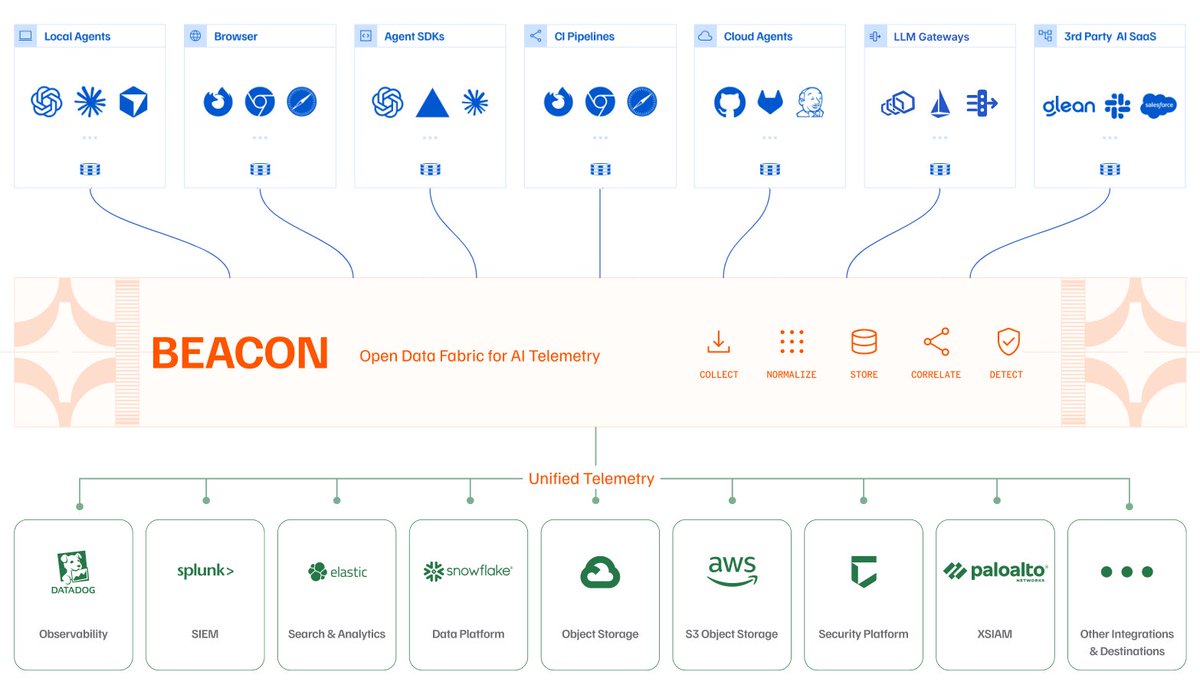
Until today, there was no single view of what AI agents are doing across your environment. Agent activity is scattered across browser chats, developer laptops, cloud sandboxes, internal apps and LLM gateways. Each one is a separate log in a separate format, if it’s logged at all.
Today we're introducing LLM gateway support in Beacon. 🔀
If you route model traffic through LiteLLM, Envoy or Portkey, Beacon now reads it there. It sees every prompt, reply and tool call, and catches the tool call 𝗯𝗲𝗳𝗼𝗿𝗲 the agent acts on it.
That completes Beacon’s coverage of every surface where agents run:
🌐 Browser
💻 Endpoint
☁️ Cloud
🧩 SDK
🔀 Gateway (new)
Why it matters:
→ One language for every agent. Every surface is normalized into the Beacon open data schema, which extends OpenTelemetry: one schema for querying activity against any agent and any harness.
→ Detect once, catch everywhere. Detection rules run on that single stream, so one rule covers every agent on every surface.
→ Stop it before it happens. With the Beacon control plane, enforce policy at the point of action and block the risky tool call before it executes.
→ Fits your stack. Events stream to your SIEM, with a metadata-only mode when content can’t leave.
Beacon is open-source and free to deploy today.
Get started now: https://t.co/ZYKclj1hGE
i've been wanting to build something like this for a while.
imagine having a shared memory layer for all your coding agents, where every debugging session, workaround and correction becomes reusable knowledge
so you don't have to start from scratch every time you switch tools.
really interesting to see teams building this.
Our open-source devtool is trending #1 on Product Hunt!
Beacon is self-improving memory for coding agents.
🫶 I’d love your support: https://t.co/sQTNGMt68f
→ Turn past debugging sessions into reusable skills
→ Share learnings across Claude Code, Cursor, Codex, and 20+ harnesses
→ Search and replay past sessions
→ Stop wasting tokens rediscovering solutions
→ Build a feedback loop that makes your agents better over time
→ Free, open source, and local-first
We built Beacon because we were tired of teaching our agents the same things over and over, only for them to start from zero every new session.
Every agent session should make the next one smarter.
⭐️ Star us on GitHub: https://t.co/ZYKclj1hGE
2 weeks since launching Beacon and our $5.5M seed announcement 🚀
→ 3K+ GitHub stars
→ 300% Discord growth
→ 85%+ Cloud user growth
→ 6,200+ actionable findings
The response has been incredible. Thank you all!
Support us on Product Hunt ❤️
https://t.co/9Nfl9Ae2Gu
Incredibly proud of @shakshukan for crushing the NYC marathon today!
He was going so fast I just missed him twice, but finally caught up at mile 22 :)
Absolute legend.
Ok yep, this gating process is what you should be telling everyone about! Tbh anyone who's paying attention to agentic development and being honest with themselves wants to shorten the path to main. What they're hearing is "we have no quality checks," but that's obviously not true.
@thorstenball@odas0r Does main auto-deploy somewhere? Or do you have a separate release process? If so, I think I can relate to this -- some past projects (Python-based) that only ran build/release on a new git tag, so it wasn't a big deal of main was "dirty" for short periods of time.
I'm a big fan of trunk-based development, but tests and CI are my issue here as well. There are ways to optimize your test/build runners to minimize costs and latency without pushing direct to main.
In fact, short-lived feature branches can be quite useful for fast experimentation, if you have setup preview deployments. Nothing like firing off 10+ feature variants, each with its own live deployment for testing/QA.
What changed (broke) in the Codex remote control feature recently? Both my laptop and phone now often tell me that the thread is being used on another device, and there's no obvious way to unblock it without constantly forking sessions on desktop.
I've been a big Codex user, especially over the past ~6 months, never had this problem before. @OpenAI